being a teacher, new teacher

And Then You Say We Failed…

Go on any social media platform and inevitably you see the discussions cropping up about how the teaching during the shutdown was not enough. How educators failed their students. How kids are now so far behind. How removing grades meant that kids didn’t learn anything. How we must open schools up for face-to-face instruction for all or else our nation will fall even further behind, or else our children will suffer. How dare schools want to teach online? How dare educators try to put their own health into the equation, after all, we knew what we signed up for when we became teachers?

I had hoped that the conversations online wouldn’t be so predictable. After all it was not too long ago that educators were held up as heroes, as people who were part of the solution. And yet I knew that within the adoration would soon come the backlash. The predictability of how we had failed, how we were not enough, that we better get back to to work or leave the profession. It happens every time educators are held up as heroes.

I get the panic driving many of these conversation. I have four children of my own whose school district has just declared that they will be virtual for at least the first quarter. We don’t know how we will make that work. We don’t know how we will pay for childcare, who will be with our children as we both work full-time as teachers. How will our children’s education be changed because of the online format? How will the social components work? How will services and needs be met for my two kids with IEP’s? We have a lot of questions, but we also have a lot of faith, because we saw how their entire school rose up to the challenge the spring presented to us all. We saw the work that happened under incredible stress.

And so, I just want us to take a moment to remember what did happen during the shutdown in many places. How educators and school districts rose to the challenge and will continue to do so as we face an uncertain future. How almost none of us were ever trained to teach online, I don’t know many educators that were, we still rose to the challenge.

Because we educators tried. We did our very best when the world shut down around us. We lost sleep both literally and figuratively as we worried about the students we would no longer see, how we would translate what we had built face-to-face, how our students would still be able to learn at home facing unknown situations, some navigating life or death situations and we were no longer there to help.

I wanted to make it work for every child, for every child to feel that I was right there with them supporting them through all of this new unknown while myself grappling with a really scary time: a major family emergency and also being presumed positive for COVID-19. This is while we lost more than half of our income, much like many other families. And yet, I showed up with a smile every day because that is what we do as educators.

We took what we were supposed to be teaching live and tried to transform it to digital teaching, knowing that we had to cut back on our curriculum because it would be overwhelming otherwise. Many of us were told to not do synchronous teaching because it would be inequitable for kids. We were told to make it all accessible, to go deep but make it short, to not assign too much because the kids were barely managing it all.

We recorded videos for read aloud, lessons, check-ins and anything else we could think of to help kids understand and stay connected with us.

We created different paths for kids to choose their learning so they still had choice and voice in their education. This meant finding extra resources, creating extra resources, and then scaffolding kids through with extra resources. That takes time, time that we put in in order to somehow make this unfamiliar territory more familiar and inviting.

We set up opportunities for live question and answer situations whenever we could. We invited students to show and tell, to record videos, to do kahoots, and any other games and events just to give them a space to connect with one another in a way that had nothing to do with academics.

We mailed letters and sent postcards with encouraging notes, funny stickers, and quick hello’s just so kids knew we were there thinking of them.

We met one-on-one with students whenever they needed us at all hours of the day. My husband would have to remind me to turn my computer off every night at 10 PM, urging me to let it wait until morning. It was hard because I knew that some kids would be up late at night sending emails, I didn’t want them to feel alone.

We found time to sit in professional development to learn new digital tools in order to increase understanding and engagement. Then made time to implement it into our teaching on the fly whenever we could.

We continued meeting with colleagues to discuss needs of students and figure out crisis plans for the many kids whose mental health spiraled. We tried to think of new ways to reach kids who weren’t answering our phone calls, our texts, our emails, we tried to get them reconnected with their learning until the very last day. We continue to reach out over summer vacation.

We continued to communicate with all adults supporting their kids so that they felt included but also not overwhelmed, navigating a tight balancing act where the adults at home both needed information but also didn’t need all the information at the same time.

We continued to recreate resources that were locked in our classrooms without the necessary tools needed (even things like tape, posters, whiteboards, printer ink and such were things we had to find or pay for).

We coordinated and sent supplies to students so they could participate on as equal footing as we could create. We dropped off books on porches, brought food to those with no transportation, got internet to those whose applications were denied.

We purchased better internet plans or other tools for ourselves so that we could do our jobs, knowing that it was one more expense we would not be reimbursed for. We sat in parking lots when the wifi went down or when we needed to record videos and home didn’t have anywhere quiet. We searched for solutions to make it work whenever a new problem inevitably arose.

Many worked 12 hour+ days while trying to navigate online school with our own children as well. I had to place all of the needs of my students in front of my kids because that’s my job, and my job is our only income. I know many others in the same situation, whose own children were set aside because of the demands of work and not just within education.

We fought for the kids to not be unduly assessed on situations that were outside of their control. It’s easy to say that removing grades means kids were not motivated when your child has few obstacles to access their learning.

We tried to reach every child and provide the tools they needed to continue their growth.

We adapted, innovated, created, collaborated, grew, and rose up to meet the challenge that we were given little time or funding to prepare for. And we did it. And we will continue to do it, no matter what the fall brings. We will spend our summer preparing for a fall that many of us still don’t know what looks like. We will show up for trainings. We will create resources and lessons. We will collaborate. We will plan. We will dream. Not because we are getting paid to do so, because most of us aren’t, but because we care deeply about the education of our future students even if they cannot be with us face-to-face.

I know it will be better, after all, we now have more experience, we have had some time to think, to gather feedback and to learn. We have had more training and hopefully have more access to tools, to ideas, to resources.

So to say that we failed, or that we didn’t do enough, once again diminishes the extraordinary work that many educators and school staff put into a situation that none of us could ever have predicted. Was it perfect? No. Did everyone do all of these things? No. But did many go above and beyond because it is what we do? Yes.

I know that the fall will bring more challenges. I know that even as I plan for either a hybrid model or full online teaching experience that I have a lot of things to work out, a lot of obstacles to navigate. And yet, I saw what my own kids’ teachers did in the spring, how their school rose up as a community, and we will, forever, be grateful. So thank you to all who rose up, who tried, who continue to do the work, despite being in a nation that prefers to defund schools and blame staff rather than work on solutions.

So if we want to talk about failure, let’s discuss how a school system founded on inequity and systemic racism continues to push out children every year. Let’s discuss how schools are funded. Let’s discuss how in the US our population poverty is so large that many families depend on schools to feed their children. That in one of the richest nations of the world we have schools with unsafe water, with crumbling buildings, with unfilled positions because there is no money to hire staff. That the cost of living is so high that many people cannot afford childcare. Let’s discuss how education as a profession is disparaged rather than supported. How the voices of stakeholders are easily dismissed whenever procedural decisions are made, whenever federal changes are implemented. How our federal government failed to act in many ways to contain the spread of this virus. Let’s discuss that before we proclaim the crisis teaching that did happen as a failure. Perhaps then we can actually see some changes that we all could get behind.
building community

But How Do We Build Community? Ideas for Virtual and Hybrid Learning

While my district has yet to release its plan for the fall here in Wisconsin, things are not looking so good. The last two days we have set new records in my county for positive test results for Covid-19, as a family we went through our own wait-time to get results this week so we have continued to stay at home with very limited movement. And while there is a lot of uncertainty that are furiously being discussed and planned for as best we can, one thing is practically certain; our year will not start in the normal sense.

And it shouldn’t, we have changed. Our world has changed.

Community lies at the heart of everything we do, the threads that bind us together create a learning space that will hopefully work for all of the children in our care. I know most of the learning success I had in the three months of crisis teaching was dependent on the community we had spent all year establishing and maintaining. On the trust we had built, on the care for each other, on the fun we had had. We know that building that community is hard work, it is not just simply putting together fun activities and hoping kids will buy into it and immediately build trust. There is so much that goes into creating the space that we hope kids will flourish in throughout the year. But how do we do that when we are not face to face? When we perhaps are both teaching live and online at the same time?

My hope every year is that the children in my care feel safe within our community. Safe to be who they are. Safe to challenge themselves. Safe to take risks. Safe to disagree. Safe to speak up. Safe to show up even if they are not at their best. Safe to go on a year long identity journey together. One that hopefully will matter to them beyond “just” developing their English Language Arts skills.

And yet the whole determination and definition of safe is something that has been weighing on me. When we say that we want our classrooms to be safe, what do we really mean? I have been reading the brilliant book Not Light, But Fire: How to Lead Meaningful Race Conversations in Classroom by Matthew R. Kay and he writes about this as well, “…for most students, a teacher’s safe space designation doesn’t mean much.” Because we don’t definite it, because we don’t think about our cultural norms that at times exclude kids, because we don’t think about the extent of the required needs to be met for someone to feel safe. And so when I think of community building work, I want it to be meaningful, it want it to be real. Yes, there is room for fun, for get-to-know you activities, but how do we go past that? How do we get further?

For me, I plan on spending our face-to-face time on a lot of the community building we usually do. As it stands, it sounds like my district will be hybrid with some face-to-face and some online, where I teach both at the same time (no, I am not sure how that will work). This means that as always we will spend the first few weeks laser focused on laying the groundwork for our year-long identity work. We will do the work we do every year. We will reflect on our reading and writing identity. We will discuss when reading sucks. We will create our reading rights together. We will set meaningful goals for our own growth. We will read and discuss personal essays that speak to not fitting into the world, into being seen as different, into finding your people, finding your own strength. We will start our focus on whose voices are missing and how that impacts our understanding of our world. We will do all of this together so that online can become learning time. So that online can be manageable for the kids who can access it. So that the online work becomes a time for kids to go deeper with what we are already doing rather than further to-do’s. And yet, the community aspect also needs to continue to be developed while we are apart, so that we can feel connected, so that we can grow together.

A few ideas I am contemplating using:

  • Ready-Set-Go conferences before the year starts, we offered these up last year face-to-face and had a good turnout. This year, depending on access, they will either be face-to-face or virtual for a chance for us to meet.
  • Yard visits, for those who are okay with it, I would like to say hello from a distance before the year starts. Either by standing in the street, a public park, or some other decided place. This will be an option to see each other from a far and say hello.
  • A welcome video for the students hopefully shot in our classroom so they can get a sense of what it looks like. If not it will be from my home with my kids.
  • Welcome postcards. I wrote a lot of postcards in the past few months, I think they made a difference, and even if they didn’t, it is one more way to say hello. I am playing with the idea of including a postcard they can mail back to me with the postage already paid. I don’t know how many kids would take me up on it but perhaps some would.
  • Weekly surveys checking in worked well for me last semester. Here is a sample of one.
  • I want community to be built through the work we do, not just as an add on feature, so the work we do needs to be worth their time and dedication. This is huge as I start to plan the work and our year focus.
  • Easy accessible Google Slides to work through every day they are online, only a few items but I want to focus on sharing either through video, audio, or written form. We will use Padlet, Flipgrid, or whatever else we can use to respond to each other.
  • I won’t be able to do morning meetings live because I will be teaching at the same time, I will be doing recorded morning messages every day though and keep them short! My own kids scoffed the minute their morning videos were longer than 3 minutes.

I will be offering free PD on how I plan on embedding authentic choice and voice throughout our year in August, I will be definitely sharing more about my ideas for building community authentically. To sign up and see more information, please go to this website and search for my name. This is also the heart of my work alongside students and I write extensively about it in my book, Passionate Learners: How to Engage and Empower Your Learners.

I want to be mindful of a lot of things:

  • Virtual teaching is inherently more inequitable than even live teaching.
  • Not all kids will be able to access virtual teaching for many different reasons.
  • Kids have no reason to trust me.
  • Having a device (provided for all kids by my district) does not mean you have space to or time to use it.
  • Students are in many different places in their journey of learning and also in how safe they feel at school. I want to be acutely aware of this and let it guide my work.
  • The world continues to be overwhelming, kids are in a lot of different places when it comes to their mental health. Everything we do has to be shaped through equity and care.
  • I will be one of many classes.
  • We, teachers, need to deeply collaborate especially when it comes to how much work we are asking kids to do.
  • We need even more safety nets such as trusted adults for every child.
  • We need to find ways for students to connect with one another, not just in an academic sense.
  • I keep thinking about this webinar: A conversation with Bettina Love, Gholdy Muhammad, Dena Simmons and Brian Jones about abolitionist teaching and antiracist education. I have been a part of a lot of learning this summer and this was one of the most powerful hours I spent, their voices are definitely resonating loudly as I plan for my upcoming year.

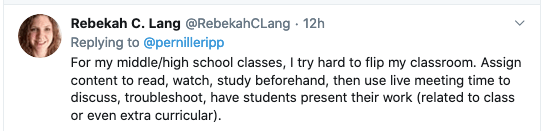
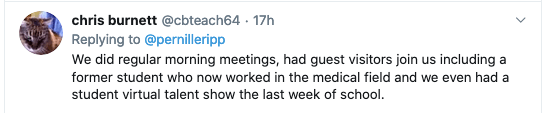
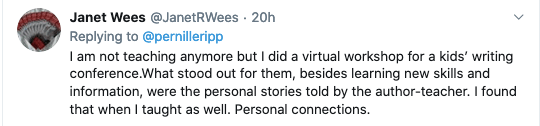
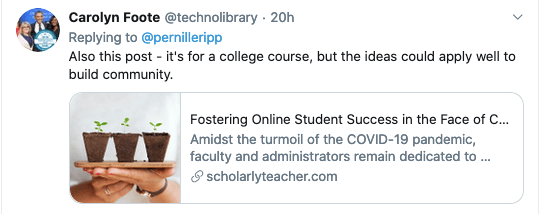
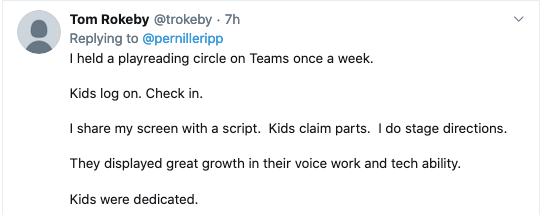
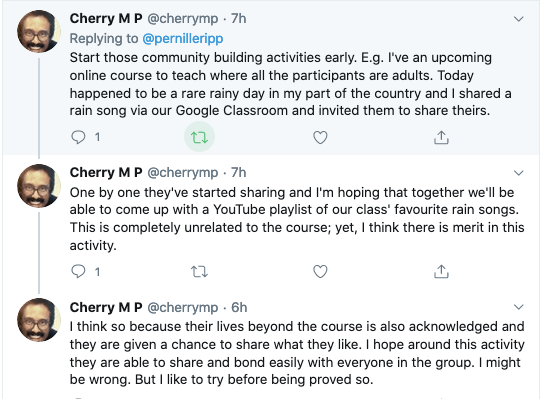
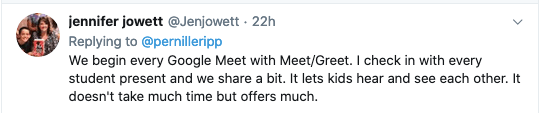
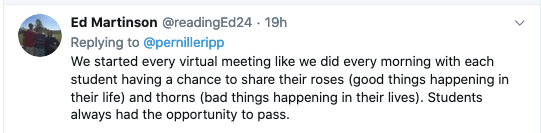
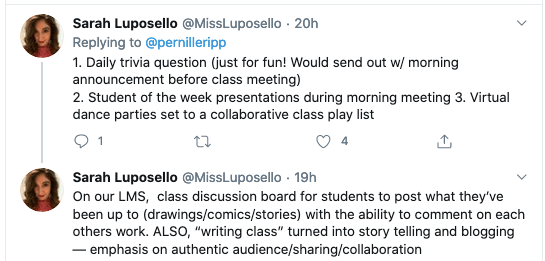
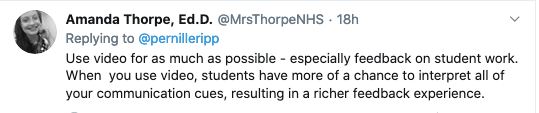
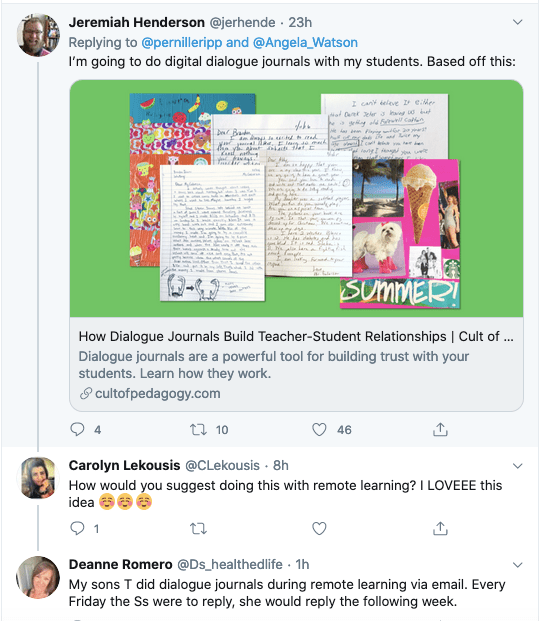
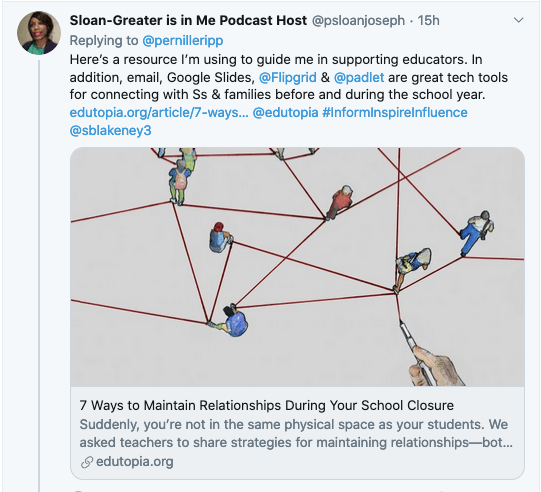
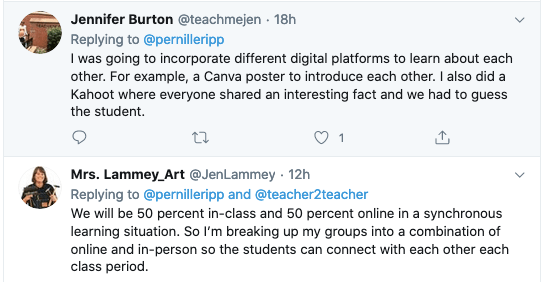
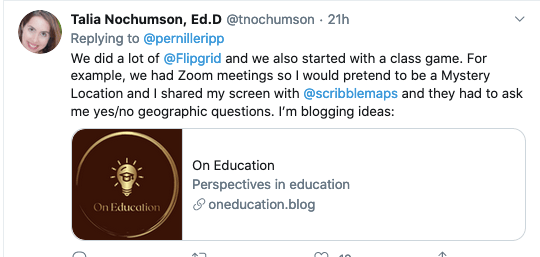
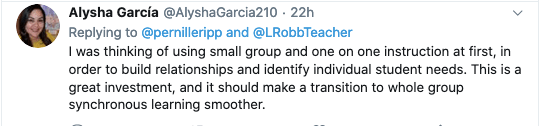
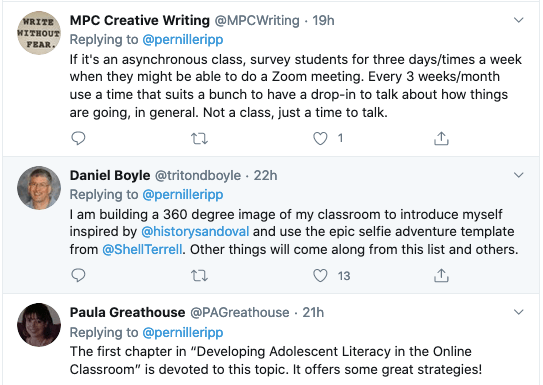
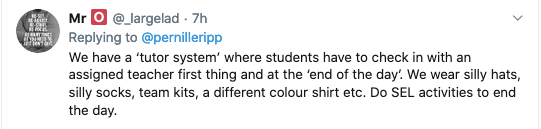
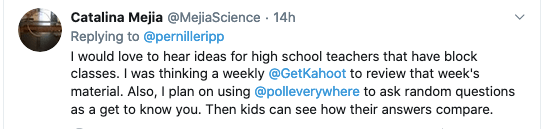
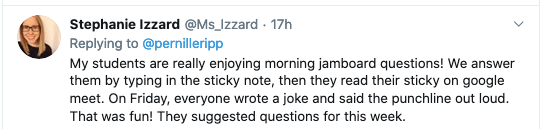
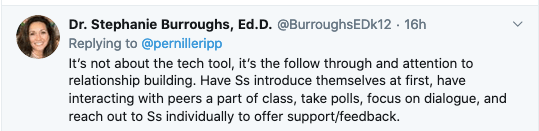
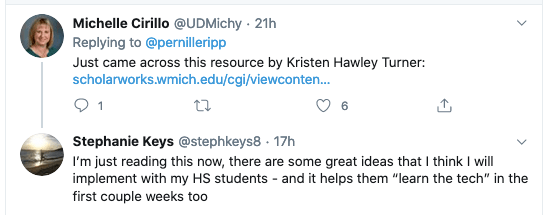
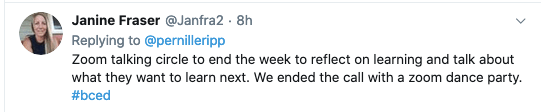
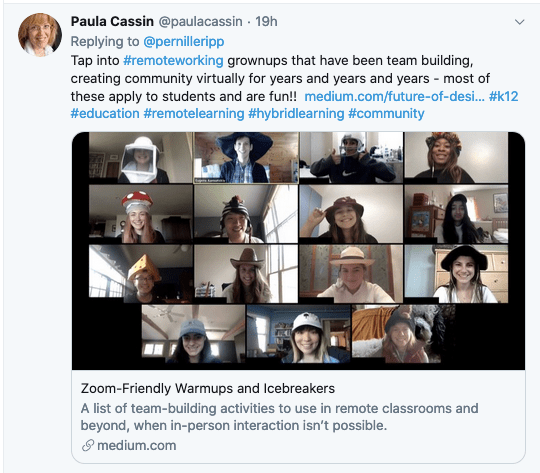
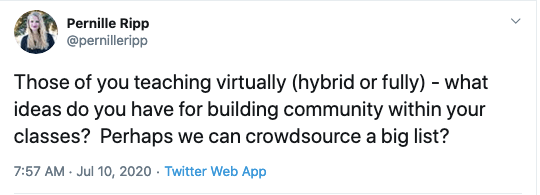
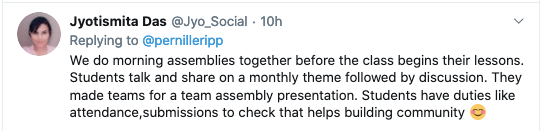
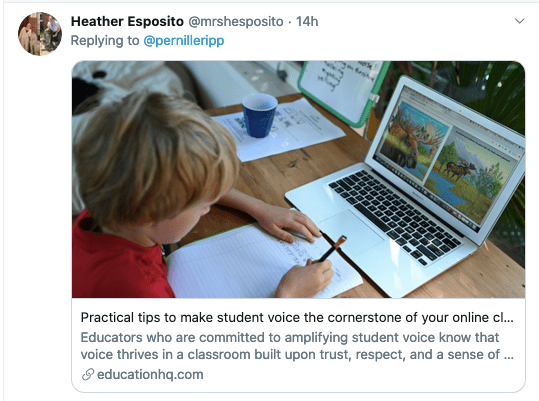
Yesterday on Twitter I asked for ideas for building community online because surely others have been grappling with this idea as well. I promised I would share the ideas here as a list not to take credit, but instead to highlight all of the ideas floating around. So thank you to all who shared. Thank you to all who took the time to share new or tried and true ideas. May we all be able to find something that will help us out.
Major take aways from ideas shared:

  • Identity work and creating learning conditions that honor each child is a must.
  • Having access in many different ways to allow kids choice.
  • Making yourself available in many different formats.
  • Scheduling virtual drop-in times where kids can hang out and also interact with you works well.
  • Don’t require video or their face to be shown.
  • What works for your students will depend very much on your students.
  • Don’t be afraid to try things and then change them or not use the idea if it doesn’t work.

What were other ideas shared?

The brilliant Julie Jee also asked this question, here is the thread with all of the ideas shared.

Link to these webinars
Link to blog
Link to blog post
Link to blog post
Link to blog post
Link to blog
Link to book
Link to blog post
Link to Google Doc
Link to Youtube
Link to resource
Link to article

I am grateful for all of the ideas shared, there were even more than were posted here, to see the original thread, click this link. We may face an uncertain future when it comes to our school but one thing remains; the kids will show up and need us to be fully human, to be present, and to be safe. I hope that you can use some of these ideas to help you move toward that.

Also, if your district or conference are interested in bringing me in virtually throughout the school year, please see information here. I have been supporting teachers remotely as they plan for meaningful literacy instruction in a virtual and hybrid model throughout the summer and would love to help others as well.

being a teacher, books, Literacy, new year, Reading, Reading Identity

But They Still Hate Reading: Establishing and Cultivating a Personal Reading Identity – A New Free Masterclass Offering

Note: the link now works to register, hooray!

As summer continues here in the Northern Hemisphere, I am excited to move into my next free Masterclass focusing on developing and supporting an individual student reading identity. This is the work I have been invested in with my students for the past six years in particular and I am so excited to offer others a deep dive into all of the components that we integrate into the curriculum as we try to create and maintain experiences that center on the individual student’s journey in reading. These sessions will be live as well as recorded for later access if the times do not work for you.

This masterclass is in 4 parts:

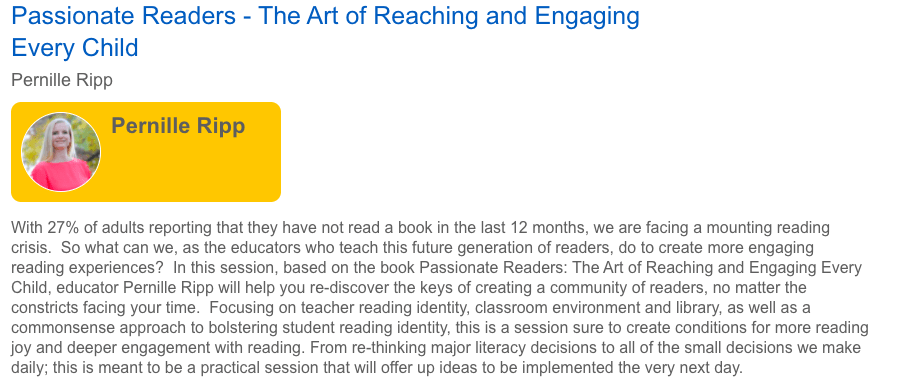
July 8th at 11 AM PST – Passionate Readers: The Art of Reaching and Engaging Every Child.

This first 1-hour session is focused on the birdseye view of the entire year, the research behind why student identity needs to be at the core of our work as well as practical ways to start or continue the focus on reading identity. This will also focus on how to do an all-district or school reading audit and how we can align practices better so that students are not victims of an educational lottery where some get access to meaningful reading experiences that center on personal reading, and others do not.

July 15th 1:30 PM PST – But They Still Hate Reading: Establishing and Cultivating a Personal Reading Identity- Part 1.

July 22nd 11 AM PST – But They Still Hate Reading: Establishing and Cultivating a Personal Reading Identity- Part 2

July 29th 11 AM PST – But They Still Hate Reading: Establishing and Cultivating a Personal Reading Identity- Part 3.

These three parts will focus on all of the components that make up our year together: Creating and maintaining an inclusive book collection, supporting independent and joyful reading, reflection and goal setting throughout, scaffolds and supports we can use to help kids whose reading experiences have been negative, using book clubs as a meaningful way to discuss the world, individual reading challenges, and of course, how to help students find space for reading in their life outside of school. The three sessions will take place on the following dates. This is an invitation into the work I do behind the scenes, the work my students take on, as well as planning for a virtual or hybrid school start.

While the sessions will take on the form of presentations, there will be office hours to go along with them. These office hours are meant for questions, discussion, resource sharing, as well as anything else related to the sessions. These are also free, but not recorded.

Office Hour July 12th – 8 AM PST

Office Hour July 19th – 8 AM PST

Office Hour July 26th – 8 AM PST

Office Hour July 29th – 7 PM PST

I hope that these free PD offerings will be helpful to you. To sign up, please click on the link embedded in this sentence and you can sign up

The final masterclass after this one will be embedding authentic choice and voice as we start the year together with students. It will be focused on all of the things I am trying to wrap my head around as we prepare for our new year together. The information for those can also be seen on the website and sign up will be open soon.

Also, if your district or conference are interested in bringing me in virtually throughout the school year, please see information here. I have been supporting teachers remotely as they plan for meaningful literacy instruction in a virtual and hybrid model throughout the summer and would love to help others as well.

being a teacher, being me, Personalized Learning

Collaborate With Me During Free Office Hours

One of the ventures I have been a part of this summer has been the incredible professional development line up facilitated by CUE and sponsored by Microsoft. As I have written on the blog before, every week throughout summer, I, and many other amazing educators, are offering free PD on a variety of topics. I am loving the chance to deep dive into some of my favorite topics such as creating authentic and student-centered literacy experiences and embedding choice and voice into our classrooms. To see all of the sessions I am still offering this summer, please click this link. One of the other components though is equally amazing; office hours.

Once a week, or sometimes more, there is a free drop in office hour with me where we get to just talk. These office hours are not recorded, but are stand alone brainstorm sessions where we can discuss whatever I might be able to help you work through. Perhaps you have clarifying questions about something I have shared, perhaps you are trying to do the Global Read Aloud for the first time, perhaps you are wondering about reading and writing identity. Whatever it is, if you have questions about reading, writing, student engagement, the Global Read Aloud or anything else you think I might be able to help you solve or think about, these hours are for you.

Here is when I will have office hours:

  • 6/28 – 8 AM PST
  • 7/2 –  7 PM PST
  • 7/5 – 8 AM PST
  • 7/12 – 8 AM PST
  • 7/19 – 8 AM PST
  • 7/26 – 8 AM PST
  • 7/29 – 7 PM PST
  • 8/7 – 8 AM PST
  • 8/15 – 8 AM PST
  • 8/16 – 8 AM PST
  • 8/23 – 8 AM PST

All you have to do to access them is to register through this link – come for an hour or just a few minutes but I hope to see you there. I also hope to see you at any of the free sessions being hosted, there are so many wonderful opportunities to learn.

being a student, being a teacher, being me, hopes, Passionate Readers, Reading, Reading Identity, student choice, Student Engagement, teaching, Writing Identity

Creating Passionate Writers – Next Masterclass Kicks Off Tomorrow

Moving to America at the age of 18, gave me a whole new education. An education in privilege, in control, in power, and how to know your place. To pursue your dreams but only if others see you as worthy of that dream.

Becoming a teacher in the American public school system has been one of my greatest joys but also one of my biggest frustrations, my biggest moments of failure, of regret. The power handed those of us with teaching degrees is immeasurable; I can continue the systemic inequities of the structures we work within, or I can learn, listen, question, dismantle, disturb, and create an education that is truly for all kids. I didn’t know that when I started as an educator, my own privilege awarded me blinders and ear muffs. But 10 years ago I started to wake up, a little at a time, although not fast enough, and I recognized that how I used control as a way to ascertain my power in the classroom meant that not all kids could thrive, that not all kids were cared for. That my classroom might have said “Welcome” but those were shallow words. And it was echoed in the curriculum we did and how I helped students grow, how I used choice, how I used rewards and punishment.

And so I started to change the way I taught, the way I thought of education, of my own power within the classroom. I immersed myself in the expertise and wisdom of others who have been on this journey so much longer than I have, I started to ask my students questions I should have been asking from the start and I started writing this blog; sharing my thoughts out loud, inviting others on the journey as I stumbled through and tried to create an education that might work for all kids. A shared experience that would center on the identity of each child rather than the curriculum. It is the work I continue to do and will for a long time. I continue to stumble through on this journey, I continue to share on here, I continue to learn and grow from others while offering my own journey up and now I have been invited by CUE and Microsoft to share through their channels as well as a way to invite you into the journey.

And so I invite you into a conversation surrounding the writing we do in our classrooms with students and how we can use storytelling not just as a way to teach standards but to help students examine and find power within their own identity and story. To come along with me as I share the questions we discuss in our community, the writing we do, and also the resources I have learned from so perhaps you can learn from them as well. So if you have space in your life or a desire to go on this journey with me, please go here to register

The Masterclass will be three parts much like the other masterclass I have done this summer, you can join live or access the recording when it is posted here. I will also be finishing up Embedding Authentic Choice and Voice. part 3 this week, on Thursday at 11 AM PST.

Posting this today, I also know that not everyone is in a place for PD or perhaps that this is not the type of PD you want to immerse yourself in, this is okay. The world is rightfully continuing to need our attention and perhaps you are putting in your energy elsewhere or fully taking a break. I know I have been taking many breaks the last few weeks as I plan for actions in the fall and right now, but for those of you who want to learn with and from me, please know that there will be several offerings all the way through summer.

Live office hours will start up next week – my first drop in one is on the 22nd at 8 AM PST. This is a great opportunity for you to bring problems of practice and we can brainstorm together for an hour or so. If you participate in the Global Read Aloud, you can also use the office hours to brainstorm with me or just ask questions.

All of these sessions are free and the sessions are recorded (office hours are not) so even if you can’t or don’t want to be there live, you can access them later.

The schedule for the rest of the summer’s free PD from me looks like so:

Sessions:

  • 6/17 7 AM PST – Masterclass: Passionate Writers Pt1
  • 6/18 10:30 AM PST – Choice and Voice Pt 3
  • 6/24 7 AM PST – Masterclass: Passionate Writers Pt 2
  • 7/1 7AM PST – Masterclass: Passionate Writers Pt 3
  • 7/8 11 AM PST – Passionate Readers – stand-alone session
  • 7/15 11 AM PST – Masterclass: But They Still Hate Reading – Supporting and Developing Student Reading Identity Pt 1
  • 7/22 11 AM PST – Masterclass: But They Still Hate Reading – Supporting and Developing Student Reading Identity Pt 2
  • 7/29 11 AM PST – Masterclass: But They Still Hate Reading – Supporting and Developing Student Reading Identity Pt 3
  • 8/6 7 PM PST – Passionate Learners – stand alone session
  • 8/13 7 PM PST – Repeat Masterclass: Embedding Authentic Choice and Voice as we get ready for a new year Pt 1
  • 8/20 7 PM PST – Repeat Masterclass: Embedding Authentic Choice and Voice as we get ready for a new year Pt 2
  • 8/27 7 PM PST – Repeat Masterclass: Embedding Authentic Choice and Voice as we get ready for a new year Pt 3


Office hours:

  • 6/22 – 8 AM PST
  • 6/28 – 8 AM PST
  • 7/2 – 7 PM PST
  • 7/5 – 8 AM PST
  • 7/12 – 8 AM PST
  • 7/19 – 8 AM PST
  • 7/26 – 8 AM PST
  • 7/29 – 7 PM PST
  • 8/7 – 8 AM PST
  • 8/15 – 8 AM PST
  • 8/16 – 8 AM PST
  • 8/23 – 8 AM PST

I hope I can be of service through these sessions. I hope to see some of you there.

If you are wondering where I will be in the coming year or would like to have me speak, please see this page. I offer up workshops and presentations both live and virtually that are based on the work I do with my own students as we pursue engaging, personalized, and independent learning opportunities. I also write more about the design of my classroom and how to give control of their learning back to students in my first book, Passionate Learners.

Be the change, being me

Who I’ve Learned From

For ten years this blog has been my own little corner of the world. A place where I have gone to reflect out loud in order to move forward in my own journey. A place where I have shared a few good ideas but also a lot of failures. A lot of missteps, a lot of hurt, regret, shame and it has been the way I have processed the world I live in. I have invited others along on my journey, at times physicially handing them the space, more often than not linking resources, sharing voices when I can.

For a while now, I have not known what the role of this blog should be. It mirrors the internal conversation I have had for the past two years about whether my voice should take up any space in education when there are so many others whose voices, particularly those of anti-racist and anti-bias experts, should be heard above mine. While I have not come to any final conclusion about this space, I have slowed down, I have focused more on my immediate sphere of work and life than on here. I have allowed myself to do the work and not share rather than share at all times.

Right now, again, I want to recognize the space I have been offered, the rooms I have been invited to, the events I get to be a part of and use it as a way to direct you to other resources that support the anti-racist work that us, White educators, need to further immerse ourselves in and carry with us into the classroom. To perhaps help you discover the work of others who have shaped small or large parts of my journey. To invite you into the work of others who may change you like it has changed me. I hope my resources below are old news to you, that you have followed these people, read these books, or taken the steps already. I hope this post is redundant, but in case it is not, here you go.

I will never be able to give every single person credit whose words have shaped me so please see the links here as a small sample. One of the biggest benefits of being connected to other people through social media is that I can use the work shared to guide me to others whose work then leads me to even more resources.

Read all the posts from #31DaysIBPOC founded by Dr. Kim Parker and Tricia Ebarvia from the past two years and then follow all of the people who wrote them, support their work by paying for their work, buying their books, and signal-boosting their work.

Interrogate and audit the media you immerse students in. Be inspired and enlighted by the work of the women behind #DisruptTexts – educators Tricia Ebarvia, Lorena Germán, Dr. Kim Parker, and Julia Torres – who so generously share tools to “to challenge the traditional canon in order to create a more inclusive, representative, and equitable language arts curriculum that our students deserve.” 

As Julie Jee asked on Twitter, how many book clubs do we need to be a part of before we move into action? Join a community like #CleartheAir founded by Val Brown to read but then push yourself to actions beyond the learning. As Christie Nold reminded me this week, it is easy to get stuck in the learning part of disrupting your own thinking, but our students don’t need us to just learn, they need us to change. Create book clubs in your own community but then create action steps beyond that, not just lofty goals.

Plan for change now and in the fall. There are so many learning opportunities being offered through books, PD, or even future small in-person events. Look at this list offered by The Brown Bookshelf of resources as a start or watch the incredible Kidlit Community Rally for Black Lives. Join the Author’s Village In Conversation series. On Twitter and Instagram, every single day, there are resources shared and events publicized, it is incredible to see. Ask your administration who they are partnering with for PD. Who are they asking you to learn from and demand inclusive representation. Partner locally with community resources, I love that my district has partnered with Nehemiah to continue our antiracist work past platitudes and promises. Use the free resources offered by incredible sites like Teaching Tolerance or Equal Justice Initiative. See who else they link to and do your own learning. Create your own accountability group, even if it is just one other person to go on the journey with you. Invite your students into the work with you by using a resource such as This Book is Anti-racist by Tiffany M. Jewell and illustrated by Aurelia Durand, I am using this book with my own young children as well over the summer. Buy more children’s anti-racist books sure, read them as well and book talk them throughout the year, there are many lists floating around, but as The Conscious Kid and Edith Campbell reminds us, do not just show one aspect of the Black experience, show the full lives, show the joy as well.

Do more than just be angry. As Layla F. Saad, Jes Lifshitz and many others reminds us turn that anger into action now and come fall. Don’t sit in silence, instead take actions. Sure, you may absolutely screw up but then learn from it. Don’t let your fear of doing it wrong stop you from taking action, I know I feel such shame at times but the shame passes and my own feelings are simply not as important as the lives of others. I have to be the growth for myself, I have to model it for my own kids and bring them on the journey. Am I bound to screw up, absolutely, but I still need to do the work.

Support Black owned bookstores, one of my goals this year is to stop using Amazon and shop locally. If you are in a space to read and have the financial opportunity to do so make it your mission to shop local for book additions. But then also make it your mission to read the books so that you can share the boks with others. If you cannot purchase the books, ask your public library to get them if it is open or offering curbside service, once you read the books, review them, especially on the “big sites.” Every review is free for us but can make money for the creators.

And finally, if you are reading this post and like me, you are a White educator who is asked to be a part of a lot of different spaces, I urge you to look around and take notice in whose voices are missing and how that is impacting the conversation. But don’t just notice, take action. If you say yes to be on a team, who else is on it? If you are part of a hiring committee, who is being interviewed and offered jobs? If you are planning community events, who is part of the planning? If you are creating curriculum, whose voices are centered? If you are an invited speaker, who else has been invited? If you are offered another opportunity to share your voice, ask whose voices are also shared and if the answer is more of the same people that look like you then push back. Have a list of names to offer up instead of you. Rescind your name if you can, make space, demand space, do better, give up your space.

I am so grateful to so many who have allowed me to learn from them and alongside them. Who inspires you? Who pushes you? Who holds you accountable? Sending love into the world to those who need it. I wrote more about who I have learned from here but this learning doesn’t end now with my anger. It doesn’t ever end. It continues and I know I still have so much more to learn, don’t we all?