Next week, in my 3rd grade Danish class, we’re starting something new — or maybe something old, just done differently.
We’re bringing the Thinking Classroom to our literacy work. I have seen the excitement from it in math, which made me wonder; how can we model the same concept but within ELA (or DLA in my case 😊).
So in true Pernille fashion, I asked if anyone was interested in seeing the slides with prompts I had made in either Danish or English, and it turned out that, yes! Many were interested, thus this blog post. I’ve made about 40 slides filled with open-ended prompts — things that make kids talk, think, argue a little, and notice patterns together. They’ll work in groups of three at whiteboards with pens in hand, no right answers in sight.
Some prompts are silly. Some are uncomfortable. Some might just stay half-finished on the board — and that’s fine. The goal isn’t to finish, it’s to think.
We’ll spend 15–20 minutes at a time exploring ideas like the rules of horror, what truth really means, or how emotions might have colors. The work will shift with them — from laughter to silence to something that feels almost like discovery.
I can’t wait to see what happens next week when we start.
If you want the Danish slides, join my Facebook group: Læselyst i Danmark.
Facing long meetings or tasks where I need to intently listen, I instinctively reach for something to draw on—not as a means of escape, but as a way to focus. I know I am not the only one.
Doodling, when done mindfully, has been shown to boost attention and cognitive processes. It helps in information retention, reduces mind-wandering, and provides a creative outlet that promotes stress reduction.
I think we could all use some of that. And so with the Global read Aloud kicking off on Monday – are you joining? I thought why not share this post again on some ideas for using directed drawing prompts during read alouds.
Now, these are not necessarily for during the reading; after all, we want students to be able to relax into the text, and if you are asked to do something simultaneously often it is the attention to the text itself that gets lost. But, it can be used as a way to dive deep into the story, to showcase critical thinking, and to start conversations about what we noticed and what we know.
To further enhance this practice, consider incorporating a few best practices for mindful and directed drawing:
When we bring drawing into our read-alouds, the goal isn’t just to keep kids busy with pencils and paper. It’s to help them see, feel, and process the story in new ways. Here are some ways to make drawing during read-alouds both intentional and joyful.
Start with an intention. Kids do better when they know why they’re drawing. A simple, kid-friendly goal—“today we’re trying to show what the main character is feeling” or “let’s draw the setting so we can picture it more clearly”—gives focus without shutting down creativity.
Connect drawings to the story. Anchor the drawing to what you’ve just read. Maybe it’s a character’s choice, a key object, or a powerful scene. This helps kids process and remember what matters in the text.
Slow down and notice. Encourage kids to pause and pay attention to the details in the words before they draw. What did the text actually say? What clues help us imagine it? This practice builds careful readers as much as it does careful artists.
Leave room for choice. Prompts are great, but don’t box kids in. Let them interpret the scene or character in their own way. This freedom is where their personality and imagination show up.
Share and talk it out. Build time for kids to show their work and explain their choices. “I drew the sky dark because I think the character felt scared.” These small conversations grow community and deepen understanding.
Use drawings as conversation starters. Ask, “Why did you draw it this way?” or “What made you notice that detail?” Their answers often reveal big insights about how they’re making sense of the story.
End with reflection. A quick question—“What did your drawing help you notice in the story?”—can turn doodles into deeper learning.
When we approach directed drawing in this way, it’s not about pretty pictures. It’s about creating another doorway into the story, one where creativity and intention work together.
When I first moved back to Denmark, I had the privilege of working in marketing—a completely different field from teaching, but somehow familiar. Everything was new: teams, assignments, routines. It was exhilarating, exhausting, and, unexpectedly, deeply thought-provoking when I considered my work as a teacher.
One of the first things I had to learn, fast, was how to ask questions. I knew very little, every day I was surrounded by people who knew far more than I did, even those fresh out of school. My gut and past experience were all I had to rely on. And so I asked questions—constantly. Not because I wanted to seem smart, but because I wanted to learn, to understand, to avoid assumptions that could lead me completely astray.
Even now, I ask a lot of questions. I would rather ask and realize I already know, than assume and be wrong. It’s a habit I try to bring into my classrooms every day.
We tell our students the same thing: ask questions, share your ideas, don’t be afraid. And yet, we also know it’s not easy. It’s hard to speak up when everyone else is silent. It’s hard to admit you don’t know something, especially when you’re unsure if your peers will be kind—or if they even care. And in a world dominated by AI answers, misinformation, and polarizing rhetoric, the courage to wonder, to experiment, and to be wrong can feel more vulnerable than ever.
This is why we continue to focus on questioning as a core part of learning. Not just the act of asking, but creating spaces where students feel safe enough to risk it. Where curiosity is valued above correctness. Where play and collaboration make questioning something natural, not intimidating. Because the ability to ask, to wonder, and to explore ideas is not just a classroom skill—it’s an essential part of growing up in a world that constantly challenges what we know and what we believe.
So how about a few ideas that do just that?
Curiosity is at the heart of all learning—and asking questions is the brave part of that. When we give students the space to wonder, to take risks, and to speak up, we’re teaching them far more than facts. We’re teaching them how to think, how to explore, and how to navigate a world that often values certainty over wonder.
As teachers, our job is to make that bravery feel possible. By using play, collaboration, and experimentation, we can help every child see that their questions matter, their ideas are valued, and their curiosity is worth showing—even when it feels scary. Because when students feel safe enough to wonder, that’s when real learning happens—and the joy of discovery follows them long after they leave the classroom.
A month off with big plans of all the things I was going to do, and so many things I didn’t. I didn’t plan really. I didn’t read PD books, or watch webinars, or delve into education shorts. I have not stressed, mostly. Instead I have read, I have cooked, I have gardened, I have explored, I have napped – so many glorious naps. And I have been present with people I care about as much as possible. It has been glorious, and oh too short.
But now a new year beckons, and with that I will teach 2 different third grades in Danish. I cannot wait to experience what being a split classroom teacher will be like.
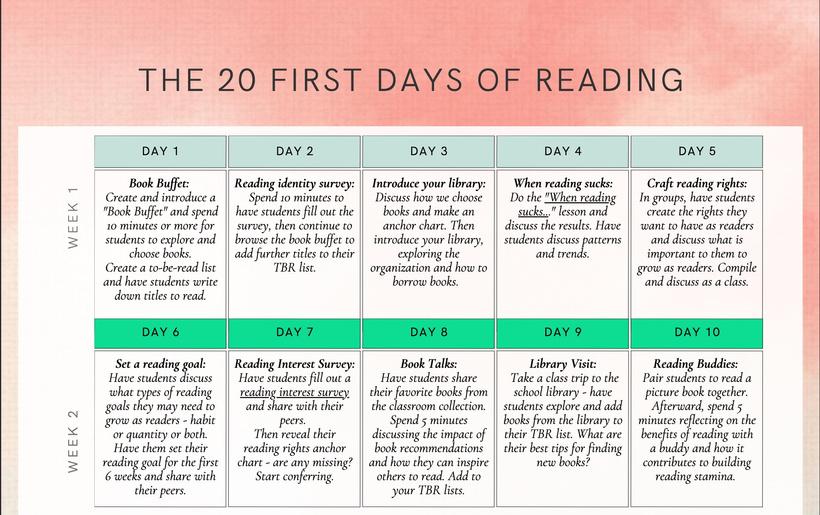
I know many of you are also gearing up to head back. Some of you still have weeks left, others only days. Perhaps like me you are looking for some inspiration of where to start? Two years ago, I created this resource for my Patreon community, and so I thought it might be helpful to share it here- it’s called the “First 20 Days of Reading” calendar, and here is a sneak peek of what is behind the link.
As many of us embark on a new school year, I believe that fostering a love for reading is one of the most precious gifts we can give to our students. This calendar is designed to build independent reading stamina and cultivate a reading community within our classrooms.
📖 Why the First 20 Days? 📖
Research has shown that dedicating just 20 minutes of daily reading time can have a significant impact on children’s word acquisition, vocabulary, and writing skills. Moreover, creating a positive and engaging reading environment can help instill a lifelong love for reading in our students.
💡 What’s in the Calendar? 💡
The “First 20 Days of Reading” calendar is a curated collection of 20 fun and manageable reading activities, each meant to take little time and be added on to our independent reading time. These activities are designed to introduce reading choices, nurture reading enthusiasm, build reading stamina, and foster reading independence. And of course start the focus on reading identity development.
You can pick and choose between using some of these activities or all of them. You do not need to follow the order precisely either, as always, you know what you need. But I wanted to pull out a timeline approach for all of the components we can introduce when fostering reading culture and give you a placer to hang your ideas. The sky is the limit and I would love to hear what else I could add in.
👉 Access the Calendar 👈
To access the calendar and get started on this reading adventure, simply go here! Feel free to customize the calendar based on your students’ needs and interests. I included links to all the surveys and questions plus more.
So as I pack up my family to head home from a summerhouse, say goodbye to my family visiting from the US – wow is that ever hard – I hope this little post will give you some ideas, maybe save you some time, or maybe be that missing thing that you didn’t know you needed.
I will be sharing throughout the year as I embark on this new school year. Perhaps you will too?
How many times have we heard a child say, “I’m not good at reading”? Or watched one put a book back on the shelf, saying, “This is too hard for me,” even though we suspected that they could read it — if only they would give it a shot?
Lately, I’ve been thinking a lot about what stops kids from fully stepping into their reader identity. About the stumbling blocks that are, indeed, man-made. It’s not always decoding or fluency or stamina. Sometimes, it’s internal.
After reading Anne-Laure Le Cunff’s powerful piece on intellectual self-doubt, I couldn’t stop seeing the connections. The very patterns she outlines in adults show up, in different ways, in our students’ reading lives. Because while every reader is on unique path of discovery and reading exploration, there are similarities in how they interact with books when they don’t feel like a reader, and those we can look more closely at.
We know that the act of reading is wrapped in emotions. That self-worth and social hierarchy placement can be closely linked to your perceived skills as a reader. That being a reader or not being a reader can be anchored in childhood as an adult identity-marker. And so it makes sense that our students want to shield themselves from perceived hardship or failure – don’t we all? And so we often see a form of “reading resistance,” which to some may come across as laziness or avoidance. But what if instead we viewed as a form of imposter syndrome? Then we can enter the conversation in a different way, while bringing the readers in our care along.
Here’s how these patterns might show up in our classrooms — and what we can do to help.
Support: Model messy reading. Think aloud when you mess up. Celebrate effort over perfection. Give them low-stakes spaces to take risks — silly poems, decoding games, or buddy reading with younger peers where they feel competent.
The Reading Perfectionist
Potential underlying imposter syndrome: “If I don’t get every word right, I’m a bad reader.”
🧠 Manifests as:
Whispering or mouthing words when reading aloud, avoiding risk of error.
Fixating on misread words or “getting stuck” and refusing to continue.
Asking repeatedly, “Is this right?” before turning the page or writing about a book.
Getting upset during assessments even with high accuracy.
Support: Model messy reading. Think aloud when you mess up. Celebrate effort over perfection. Give them low-stakes spaces to take risks — silly poems, decoding games, or buddy reading with younger peers where they feel competent.
💡 Further ideas:
“Mistake of the Day” Club: Make small decoding or comprehension missteps a shared, safe laugh — create a space where every reader can submit one and reflect.
Sticky Notes of Bravery: Let kids mark pages with a note like “I wasn’t sure, but I tried.” Celebrate risk-taking during sharing.
Co-created anchor charts: “What Good Readers Do When They’re Stuck” — keep it visual and student-owned.
The Natural Genius Reader
Potential underlying imposter syndrome: “If this book is hard, it means I’m not a good reader after all.”
🌟 Manifests as:
Makes vague claims like “This book is boring” or “I already know what’s going to happen.”
Rapid early reading growth, followed by a plateau and sudden disengagement.
Avoids challenging books after one or a few “failures” (can’t pronounce, understand, or keep up).
Prefers familiar series or picture books they can master easily.
Support: Teach struggle as normal. Share your own stories of books that stumped you. Use “just right struggle” texts and help them see confusion as part of deep reading. Introduce the idea that strong readers ask questions — and don’t always know the answers.
💡 Further ideas:
“Struggle Stars” wall: Post quotes from students about books that challenged them. Normalize confusion as part of growth.
Teach the “Reader’s Curve”: A simple visual model showing early success → plateau → productive struggle → breakthrough.
Reading Journals with “Stuck Points”: Instead of summaries, have them record where they don’t understand — and celebrate re-reading or asking for help.
The Solo Reader
Potential underlying imposter syndrome: “If I ask for help, it proves I can’t read.”
🚪 Manifests as:
May quietly resist support or conferencing.
Hides books behind desks or reads in isolation.
Avoids joining book clubs, doesn’t volunteer to partner read.
Says “I’m fine” or “I like reading alone” but rarely talks about books.
Support: Normalize collaboration. Use pair shares, peer book recommendations, or “reading buddies” where asking questions is expected. Let them be the helper sometimes too — it builds trust. Shift the narrative: strong readers talk about books together.
💡 Further Ideas:
Invisible Book Clubs: Let kids respond to the same book on post-its or Flip videos without needing to talk face-to-face at first.
“Ask Me Later” buttons: Offer students a nonverbal way to defer help — gives autonomy without removing support.
“One Book, Two Readers” challenge: Quiet students read the same book as a peer — then choose their own way to share (drawing, writing, or private discussion).
The Super Reader
Potential underlying imposter syndrome: “I have to read more than everyone else to prove I’m a real reader.”
🏁 Manifests as:
May use reading to seek validation, not joy.
Logs 30+ books per month, but gives vague or superficial summaries.
Gets anxious when “behind” on reading goals.
Chooses quantity over quality: “easy wins.”
Support: Slow them down. Invite reflection. Use journals, book talks, or drawing to process books in new ways. Help them find balance by honoring books that move them — not just books they finish.
💡 Further Ideas:
“Read Slow” Challenges: Celebrate books that take a week or more to finish. Offer awards for “most thoughtful pause,” “best reread moment,” etc.
“This Book Changed Me” board: Help them reflect on impact, not volume.
Weekly Deep Dive: Once a week, they must pick just one book to discuss in detail — what moved them, surprised them, challenged them.
The Expert Reader
Potential underlying imposter syndrome: “I need to understand everything before I can say I read it.”
📘 Manifests as:
May demand “correct” interpretations from teachers. Freezes up during book discussions, afraid of being wrong.
Asks few questions, fearing they’ll reveal gaps in knowledge.
Abandons texts quickly if meaning isn’t immediate.
Support: Emphasize curiosity over correctness. Use “I wonder…” prompts. Let them see you grappling with questions too. Build habits of metacognition — maybe through post-its, wondering journals, or group discussions where questions are more valued than answers.
💡 Further Ideas:
“Wonder Logs”: Replace standard comprehension questions with “I wonder,” “I noticed,” “I’m confused by…” logs.
“One Word Summaries”: Ask students to capture a whole chapter or character using one word — forces synthesis, not certainty.
Un-Googleable Questions Wall: Collect and explore deep, complex questions that have no single right answer.
Bonus Tip: Support All 5 with Metacognition Mini-lessons
Build in weekly reflection that honors emotional and identity aspects of reading, not just skills:
“What kind of reader were you this week?”
“What made you feel confident — or not?”
“What book surprised you?”
“What was hard… and what did you do about it?”
So where do we go from here?
We remind ourselves and our kids: doubt is normal. Growth is messy. And identity — especially a reader identity — isn’t something we give them. It’s something they build, slowly, with support, belonging, and choice.
We can’t eliminate their reading struggles, but we can reframe them. We can help them see effort not as evidence they’re failing — but as proof they’re learning.
Like Anne-Laure writes, the most successful people (and readers!) aren’t those who never doubt themselves — but those who learn to keep going with the doubt.
I had my first back-to-school nightmare yesterday.
Woke up feeling unprepared, heart in my throat, and all sorts of nervous. It was nothing special, the standard one where everything starts off smooth, and then all of a sudden everything falls apart. I am unprepared, lost, and being evaluated. I woke up in high alert, what do I need to do right now in order to not get there.
School starts August 11th in Denmark, and on that day I get to take on the role of homeroom teacher for two 3rd grades. I get to continue with the class that has made me a teacher in Denmark, and then I get to add their neighbor class to be mine as well. And the nervousness is real.
After all, how do you split yourself between two classes like that? How do you make sure that both classes know that they matter? How do you invent, create, reflect, and ponder without overworking yourself? How do you make each kid feel seen when you are split evenly between two communities that both need you in unique ways? How do you show up in the way that you know matters, when these new kids are wondering how much you will be their teacher and whether *you will be with us a lot, Pernille?*
It almost feels like I am welcoming my second child, hoping that my heart will stretch enough to love widely, knowing that it will.
But tell that to my nightmares.
In the past, I would have thrown my into prep wok, spending countless hours planning, conceiving, creating. I would have gone in for hours, trying to get it just so, trying to work my way through my nerves. Making copies until I could feel my anxiety ebb.
But not now. Not anymore. Instead, I garden. I bake. I go to cross fit. I read. And sure, I dream a little. I reflect on how I want that first day to be framed. I consider how I want to get to know them, and how we want to continue to build their community.
So I plan. But differently now, a plan where I don’t drown, and summer just feels like the checklist item to be done before another school year. I plan for presence. For slowness. For the moment when a child looks at me and wonders, Are you really here with us? and I can say yes—not just with my words, but with the way I show up. And to do that I need to not work. I need to not stay in that space where teaching takes up most of me. Because that doesn’t fill me in the ways I need to be filled, in order to go all in.
So I give myself permission to pull back. To trust that stepping away is also a kind of preparation—that rest is not a pause in the work, but part of it. Because when I give myself space to breathe, I make space for them too.
I think about how I want that first day to feel. Not just for them, but for me too. I want it to feel calm. Possible. Like a beginning, not a performance. I want them to know I see them, both classes, both groups of humans who deserve a teacher that isn’t running on empty.
And so, instead of drowning in to-do lists, I remind myself of what I already know: that the magic isn’t in the deeply detailed plans or the laminated name tags – although those will come. It’s in the way we build trust, one small moment at a time. It’s in the way I let my heart stretch and make room—just like it always has.
If you’re waking up from your own back-to-school nightmare, you’re not alone. This time of year is heavy with what-ifs and should-dos. But maybe the work isn’t to prepare more. Maybe it’s to believe more—in who you already are, and the teacher you’re still becoming.
We’ll be ready. Not because we’ve done it all, but because we’ll be there. And that matters more than anything else. We’ll be ready, because that’s what we do.




 Pernille Ripp