being a teacher

A Few Tips From a Parent for Better Parent-Teacher Conferences

‘Tis the season of parent teacher/conferences, not just for me as a teacher, but also for our three school-aged children.  Having been on both sides of the table now for a few years, I have been thinking about how we as teachers can use the parent perspective to prepare well.  So here are a few tips for better parent/teacher conference from a parent’s perspective.

Send home a questionnaire beforehand.

All three of my children’s teachers did this and it allowed us to really think about what we were hoping to hear about at their conference.  We knew that my husband would be the only one present and so we could discuss beforehand what was important to both of us.  We then sent it back a few days before so the teacher had time to prepare.  Simple questions such as; what would you like to know more about or what concerns do you have if any will do the trick.

Have the child evaluate if they are not present.

While I am a firm believer in student-led conferences, if that is not a possibility have the children self-evaluate beforehand and also invite them along.  Thea had circled her answers on her own behavior and work habits and it was great to see the self-reflection.

Start with the praise, sure, but be realistic too.

While I would love to know all of the great things about my child, I certainly need to know where their areas of growth are, even if it as hard conversation to start.  More than likely the teacher will not say something surprising.  We know children act differently often at school and home, so let me know what the school version of my child is, even if it is a kid that does not make the best of choices.

Give us specific things to work on with them.  

While there may be many things our child needs to work on, give us a few specific things.  We know that one child really needs to work on his pencil grip and his letter recognition, while another needs to work on chunking and handling frustration more easily.  While we know there are many goals we can work on with them, these are the ones that take priority right now.

Give us tools.

I was so impressed with the tools we were handed by our children’s teachers.  From math program logins to the computer, to cut out letters, we now have specific tools we can use with our children as we support their further learning.

Allow it to be recorded.

Our children’s conferences were on the days that I had to give conferences so my husband asked if we could record the conversation on his phone.  That meant I did not have to rely on his retelling but instead could hear the whole conversation.  While I wish I could have been present to be a part of the conversation, this was the next best thing.  I was so grateful to hear the whole conversation and not just the big parts.

Show us that you know our child.

This is something I am still working on with my many middle school children, but I try to show parents that I actually know their child just a little.  Again, we were impressed with the care that our childrens’ teachers took with how they interact with them.  It was clear that not only are they great teachers, but also great human beings that truly care about the kids they teach.

Let your enthusiasm shine through.
Even when we had to discuss a few not so great decisions or things to work on, it was clear that these teachers love their job and the kids they teach.  Leaving a conference feeling like your child is in the best of hands is an incredible feeling.  It also means that if  these teachers have to have harder discussions with us about things our kids may have done or not done, we know that they are coming from a place of love.

I am so grateful to the stellar education all of my children are receiving and also to the way that their teachers communicate with us.  While our children are by no means perfect, we know that every day they are in the best of hands; caring teachers who will challenge them and also be partners as we try to help them grow into even better human beings.

I am currently working on a new literacy book.  The book, which I am still writing, is tentatively Passionate Readers and will be published in the summer of 2017 by Routledge.  I also have a new book coming out January, 2017 called Reimagining Literacy Through Global Collaboration, a how-to guide for those who would like infuse global collaboration into their curriculum.    So until then if you like what you read here, consider reading my book Passionate Learners – How to Engage and Empower Your Students.  Also, if you are wondering where I will be in the coming year or would like to have me speak, please see this page.

being a teacher, being me

We Continue the Path

In an hour our oldest daughter, Thea, will wake up and ask us the inevitable; who won, mommy?  We have not shielded her from the election, nor overtly exposed her to it.  Instead she has picked up the commotion surrounding her piece by piece as kids have taunted each other on the playground and we have answered her many questions.  Why do people like Trump or Clinton?  Where will the wall be built?  Why does it matter, mommy?

To a 7 year old the election is only a Tuesday night blip.  An event out of the ordinary but soon forgotten.  Yet as her mom, I keep thinking about the conversations that lie ahead, of what path our country will take now, of what questions she may bring home after she hears things on the playground.

I refuse to be afraid of the future that lies ahead.  I have faith in the American people that we will choose kind even if those in office fail to do so.  I have faith that our healing lies in our classrooms, where we will continue to teach all of the children, no matter their political beliefs, no matter their origins, no matter their stories.

While our presidents may define us outwardly as a nation, they will never define our classrooms unless we let them.  Unless we choose to shape our morals based on the actions of someone else.  It does not matter where your political affiliation lies; this election has changed us all, has brought a darker side to our united nation and it is now up to us to show the good that is America.

Our children may not care who sits in the Oval Office.  Our children may not care about the political mudslinging or the decisions that are to come.  We will, and yet we can teach such that we continue to focus on what we have always focused on; kindness, empathy, awareness and critical thinking.

America may feel like it has changed overnight, and yet it still looks a lot like the America I knew yesterday.  It is still filled with good people, with dreams of a better life, of teachers who work tirelessly to help shape the future of our country.  Of children who strive for knowledge and a place they can belong.

So do not stray from your path of goodness.  Do not forget to teach the every day lessons of kindness, sharing, listening, and building community.  We say that we as teachers help shape the future of of our country, we do, so now we shall continue down the path we have been walking for so long.  One that focuses on unity.  One that focuses on education for all.  One that focuses on coming together, rather than apart.


being a teacher, books, picture books, Reading

Great Picture Books to Teach Plot

While I continue to update the other lists I have compiled of amazing picture books, a teacher asked me if I have any suggestions for teaching plot.  Well, of course I do.  I am so thankful once again to the amazing authors and illustrators that give us these incredible books to teach pretty much everything we need to in our literacy classes.

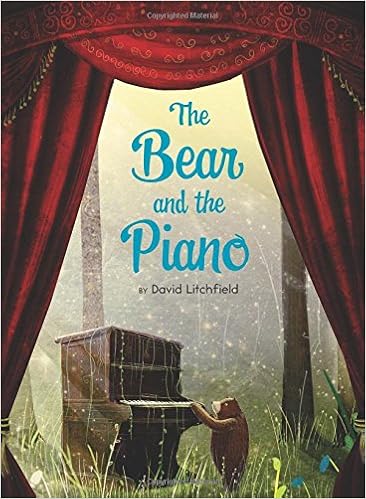
The Bear and the Piano by David Lichtfield is a book I use for plot and for theme.

Plot description:

One day, a bear cub finds something strange and wonderful in the forest. When he touches the keys, they make a horrible noise. Yet he is drawn back again and again. Eventually, he learns to play beautiful sounds, delighting his woodland friends.

     Then the bear is invited to share his sounds with new friends in the city. He longs to explore the world beyond his home, and to play bigger and better than before. But he knows that if he leaves, the other bears will be very sad . . .
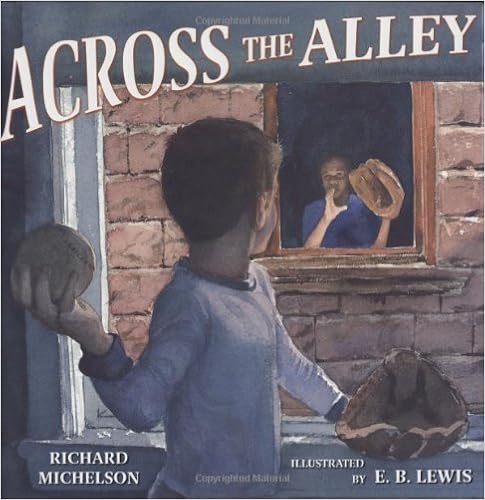
Across the Alley by Richard Michelson and E.B. Lewis is ten years old but still very relevant.  This is also a great book to add to your social justice curriculum.
Plot description:
Abe and Willie live across the alley from each other. Willie is black and Abe is Jewish, and during the day, they don’t talk. But at night they open their windows and are best friends. Willie shows Abe how to throw a real big-league slider, and Abe gives Willie his violin to try out. Then one night, Abe’s grandfather catches them—will Abe and Willie have the courage to cross the alley and reveal their friendship during the day?
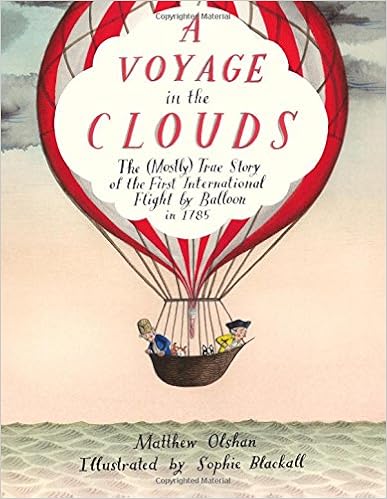
A Voyage in the Clouds by Matthew Olshan and Sophie Blackall is also on my Mock Caldecott watching list.
Plot description:
In the year and a half since the flight of the first manned balloon in 1783, an Italian has flown, a Scot has flown, a woman has flown, even a sheep has flown. But no one has flown from one country to another. John Jeffries, an Englishman, and his pilot, Jean-Pierre Blanchard, a Frenchman, want to be the first. On January 7, 1785, they set out to cross the English Channel to France in a balloon. All seemed to be going fine, until Jeffries decides the balloon looks too fat and adjusts the air valve―how hard could it be? Too bad he drops the wrench over the side of the aerial car. With no way to adjust the valve, the balloon begins to sink. Jeffries and Blanchard throw as much as they can overboard―until there is nothing left, not even their clothes. Luckily, they come up with a clever (and surprising) solution that saves the day.
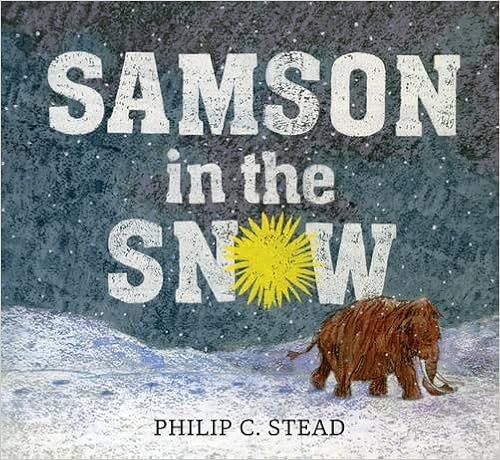
Samson in the Snow by Phillip C. Stead is beautiful for many reasons.
Plot description:
One sunny day Samson, a large and friendly woolly mammoth, encounters a little red bird who is looking for yellow flowers for her mouse friend (whose favorite color is yellow). As she flies off with the flowers, Samson wonders what it must be like to have a friend. He wonders this for so long, in fact, that he falls asleep and wakes up to a world covered in snow. In the midst of a blizzard, Samson finds and shelters the little red bird and flower-loving mouse in a tender tale of kindness and unexpected friendship.
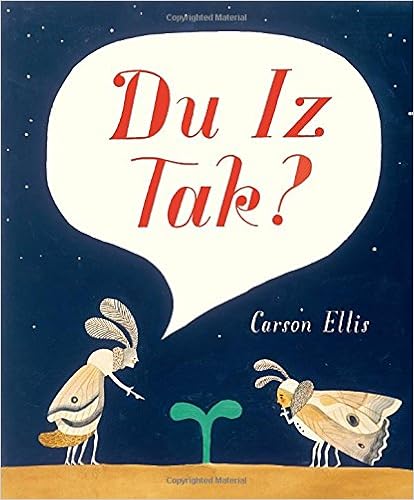
Du Iz Tak by Carson Ellis is also great for inferring.
Plot description:
Du iz tak? What is that? As a tiny shoot unfurls, two damselflies peer at it in wonder. When the plant grows taller and sprouts leaves, some young beetles arrive to gander, and soon—with the help of a pill bug named Icky—they wrangle a ladder and build a tree fort. But this is the wild world, after all, and something horrible is waiting to swoop down—booby voobeck!—only to be carried off in turn. Su! With exquisitely detailed illustrations and tragicomic flair, Carson Ellis invites readers to imagine the dramatic possibilities to be found in even the humblest backyard. Su!
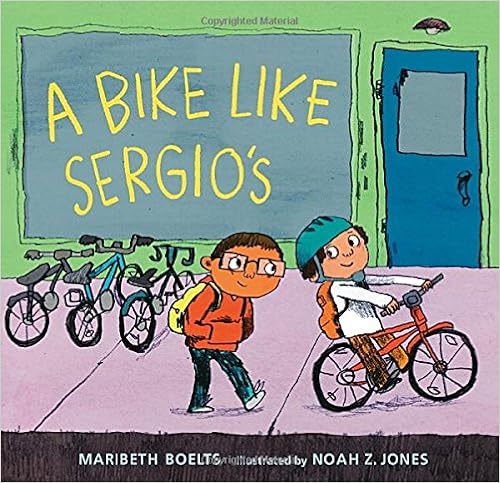
A Bike Like Sergio’s by Maribeth Boelts and Noah Z. Jones is fantastic for theme as well.
Plot description:
Ruben feels like he is the only kid without a bike. His friend Sergio reminds him that his birthday is coming, but Ruben knows that the kinds of birthday gifts he and Sergio receive are not the same. After all, when Ruben’s mom sends him to Sonny’s corner store for groceries, sometimes she doesn’t have enough money for everything on the list. So when Ruben sees a dollar bill fall out of someone’s purse, he picks it up and puts it in his pocket. But when he gets home, he discovers it’s not one dollar or even five or ten—it’s a hundred-dollar bill, more than enough for a new bike just like Sergio’s! But what about the crossed-off groceries? And what about the woman who lost her money?
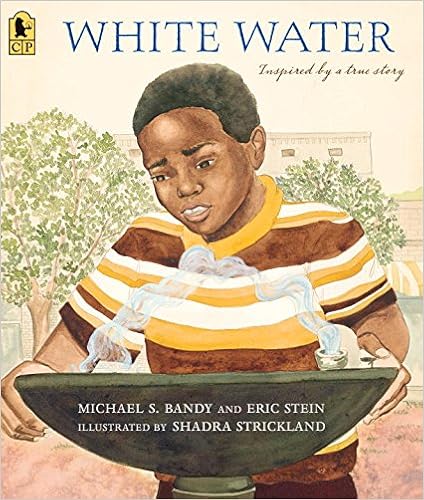
White Water by Michael S. Bandy, Eric Stein, and Shadra Strickland is another great book to discuss social justice.
Plot description:
It’s a scorching hot day, and going into town with Grandma is one of Michael’s favorite things. When the bus pulls up, they climb in and pay their fare, get out, walk to the back door, and climb in again. By the time they arrive in town, Michael’s throat is as dry as a bone, so he runs to the water fountain. But after a few sips, the warm, rusty water tastes bad. Why is the kid at the “Whites Only” fountain still drinking? Is his water clear and refreshingly cool? No matter how much trouble Michael might get into, he’s determined to find out for himself.
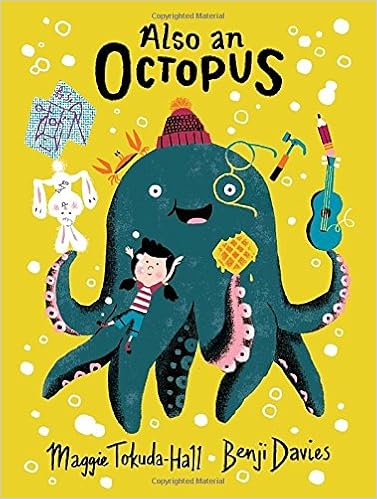
Also an Octopus by Maggie Tokuda-Hall and Benji Davies is one of the most perfect picture books for plots, this is the whole purpose of the book!
Plot description:
It begins with an octopus who plays the ukulele. Since this is a story, the octopus has to want something—maybe to travel to faraway galaxies in a totally awesome purple spaceship. Then the octopus sets out to build a spaceship out of soda cans, glue, umbrellas, glitter, and waffles. OK, maybe the octopus needs some help, like from an adorable bunny friend, and maybe that bunny turns out to be . . . a rocket scientist? (Probably not.) But could something even more amazing come to pass?
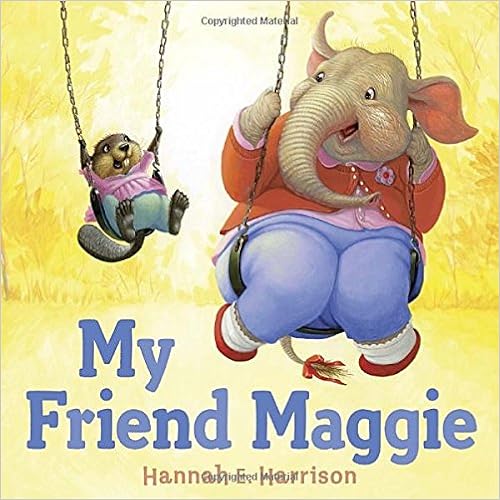
My Friend Maggie by Hannah Harrison is just a must-add in general, this picture book is great for theme, plot and just kindness overall.
Plot description:
Paula and Maggie have been friends forever. Paula thinks Maggie is the best—until mean girl Veronica says otherwise. Suddenly, Paula starts to notice that Maggie is big and clumsy, and her clothes are sort of snuggish. Rather than sticking up for Maggie, Paula ignores her old friend and plays with Veronica instead. Luckily, when Veronica turns on Paula, Maggie’s true colors shine through.

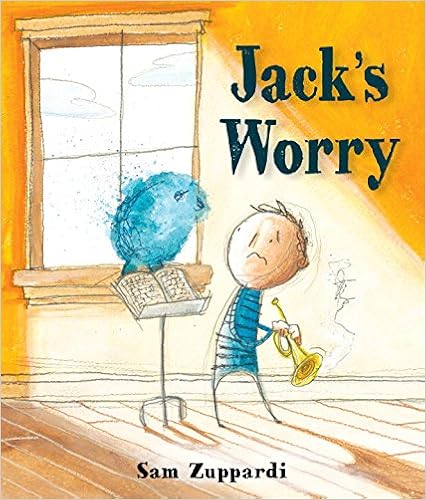
Another fantastic picture book to discuss problems and anxiety is Jack’s Worry from Sam Zuppardi.  I love the illustrations of how Jack’s worry follows him around and how he ends up solving it.  Many children would benefit from this book in their classrooms.

Plot description:
Jack loves playing the trumpet, and for weeks he’s been looking forward to taking part in his first concert. But on the morning of the big day, Jack finds he has a Worry. And his Worry starts to grow. Even when Jack’s mother calls him for a special breakfast, even when he hides under the bed or runs around the yard, his Worry follows him. Suddenly, when it’s almost time to leave for the concert, Jack finds it’s all too much. For anyone who’s ever been afraid of failing at something new, this book offers just what’s needed to shrink a Worry down to size.

Jacob’s New Dress by Sarah and Ian Hoffman, illustrated by Chris Case.  being yourself can be hard when you society will judge you but this book is a must add for any classroom.

Plot description:

Jacob loves playing dress-up, when he can be anything he wants to be. Some kids at school say he can’t wear “girl” clothes, but Jacob wants to wear a dress to school. Can he convince his parents to let him wear what he wants?

To see a list of all of our favorite books for many different things, please go here.

being a teacher, global, Reading

Audience Needed – Silly Poetry Videos

Tomorrow my amazing 7th graders will start practicing their speaking skills through silly poetry performances.  In 7th grade we take speaking pretty seriously, after all, being able to  communicate well and with intent is something you will need to be successful in life.

While I give my students feedback, while they perform in front of each other, while they rate themselves, it just doesn’t add a lot of punch to their performances.  This is where you maybe come in.  Would your class or kids  like to be our audience and leave us some feedback?

It is really quite simple; sign up below by filling in the form and wait for an email from me next week.  You will be given a link to a class’ video and also a survey.  We will ask you to tell us how we did, how our eye contact was and whether we have things to work on.  That’s it.  The feedback you give will help my students grow as public speakers.

being a teacher

My ITEC Ignite – The Least We Can Do

I swore after ISTE 2015 that I would never do another Ignite.  They are so hard to do.  They are personal.  Nerve-wracking.  Sometimes push me to almost throw up as my nerves get so messed up that I am not sure how I will even stand to do it.  And yet…I have seen powerful ignites.  I have seen what the power of five minutes can be.  I have seen the real impact that someone speaking for a mere five minutes can have on the children we teach.

So when I was asked by ITEC to do an Ignite, I was torn.  Say yes and spend hours tormenting myself, or graciously decline feeling like I have done enough.  I said yes.  I then was stumped.  What do you do an Ignite on when you already feel like you pour your heart out…

The answer came to me a morning when Facebook reminded me of just how far we have come.  Of just how lucky we are to have the life we live.  When a picture of Augustine, our youngest daughter born almost 10 weeks early, popped up in my feed I remembered just how terrifying it is to have a premature baby.  Just how much it changes you.  Just how much ut shapes your future life as an educator, whether you mean for it to happen or not.

So with Augustine in mind, but also the job I love so much, I present to you my ITEC Ignite.  I have published the script already but here it is live…Thank you so much to the Dads in Ed podcast for inviting me to do one.  Here is a link to see it 


//www.ytcropper.com/embed/7R581a9b2a0bd7d/loop/noautoplay/via ytCropper

Be the change, being a teacher, Reading

A Quiet Moment

http-www-pixteller-com-pdata-t-l-563824

Life is full right now.  Full of so many wonderful things.  Full of so many privileges, but also challenges, things that will make me grow as a person, as a teacher, as a human being trying to be a better human being.  One of my privileges is to get to teach a class with some pretty incredible kids in it.  They are bouncy, creative, loud at times.  Sometimes they need reeling in that can take more than few minutes and yet every day as they walk out, although I am a little bit tired, I cannot wait for them to come back.

Today, the day after Halloween, I did not know what to expect.  After all, one child had declared to me the day before that really all school should just be cancelled the week of Halloween.  As a mother witnessing my own children’s lethargy this morning, I had to wonder what the day would bring.  Would these boys even be ready for anything?  Would it be a day of wasted time?  As the day grew on and the kids seemed to wake up from their tiredness, I started to ponder just how loud the end of the day would be?  Where would the crescendo hit?

The bell rang, the kids arrived and we settled in as we so often do around our table, ready to do something together.  I pulled out my Demonstration Notebook (thank you Kate and Maggie Roberts for this idea).  I had the lesson ready on how to stretch out theme, for the kids to try so we did what we do so many times in a week.  We read a picture book.

Yet this time, when I chose it I knew I needed a powerful punch.  I knew that if I were to counteract the craziness of the day after Halloween then it would have to be an extraordinary book, so I read aloud the picture book Ida, Always.  This book with its happy polar bears on the cover is one of the best I have read this year.  It also happens to have an easily identifiable theme.  As I read the book, my emotions got the better of me.  You see, my middle daughter’s name is Ida as well.  She is four.  She is not a polar bear, nor is she sick, and yet, every time I read this picture book, I cry.  And not just misty-eyed  maybe there are tears in there but still turning pages, no, tears down my cheeks, having to stop the read aloud.  I thought I could make it today, after all, how often do you cry in front of your student.  I thought wrong.  At first, the boys clearly did not know what to think of their otherwise happy teacher sitting there with tears.  And yet as they starred in silence, I started to see their own eyes and the tears that were forming there.

These kids.  These wonderfully rambunctious kids.  These kids that sometimes make me feel like I am not doing enough and will never be enough.  They cried too.  Not all, but some.  They sat there in solidarity with me.  They asked why this book was so emotional for me.  And as I explained they all nodded, they got it.  One kid took the book from me and continued to read aloud.

As the book ended, we discussed why sad books are okay at times.  No one laughed.  No one pointed a finger.  No one called each other a name.  Instead we just shared the moment, shared this vulnerable moment and then went on with our lesson.

At times, we only see the loudest parts of the children we teach.  We only see the parts that they work so hard to show.  We forget that what we see is not the full story and it never will be.

In our moment today I was reminded not just of the power of picture books, but of the power of vulnerability in our classrooms.  How for students to dare to share who they are as human beings, we must also show ourselves.  Even if that means stopping our read aloud because we cannot form the words.

I don’t know if we will ever cry together again over the fate of a polar bear, but it doesn’t really matter, because today we did, and today we grew.  Not further apart but closer together.  Sometimes those moments come right at the very right time.  Sometimes they come when we least expect them.

I am currently working on a new literacy book.  The book, which I am still writing, is tentatively Passionate Readers and will be published in the summer of 2017 by Routledge.  I also have a new book coming out January, 2017 called Reimagining Literacy Through Global Collaboration, a how-to guide for those who would like infuse global collaboration into their curriculum.    So until then if you like what you read here, consider reading my book Passionate Learners – How to Engage and Empower Your Students.  Also, if you are wondering where I will be in the coming year or would like to have me speak, please see this page.