being a teacher, being me, building community, end of year

Take the Time

For in the end it is not what we got done that matters, it is how we felt doing it. pernille ripp

There seems to be no greater rush in school then these last few precious days before we say goodbye, before our time is up.  I look at my own to-do list and wonder just how much will actually get to done.  The pressure of it all nips at my heels as I wonder whether my students could possibly speak a little bit faster as they deliver their end of year speeches.  Will we get through them all?  We have so much to do still.

Yet, as I listened today to a boy share his message of hope and forgiveness.  To another who shared the value of friendship.  To one who decided to challenge our racial beliefs, and one that made me cry (actually two did) because they stood up there and spoke their truth, I knew what I had forgotten.  To take the time.

To take the time to say goodbye the proper way.

To take the time to laugh.

To share memories and stories.  To take the time and not feel guilty all of the time for all of the things we didn’t get to do.

Take the time to remember all of the great and all of the not so great.

Take the time to remember the very best books, projects, or whatever else you may have shared.

To take the time to ask just a few more questions so that you can grow over the summer.

To take the time to thank you students for the journey you have been on.

May we never forget to be grateful for the things we take for granted, for the community we create, for the memories we make.

May we never take for granted that our year, while tough at times, was still a success and that all of those students did actually grow, even if it was not as much as we had hoped.

May we never forget that for a brief moment in time we were a part of the future by being a part of a child’s life.

So take the time to say goodbye and don’t worry so much about the to do.  Because in the end it is not what we got done that matters, it is how we felt doing it.  SO take the time to take the time and don’t let your guilt consume you.

If you like what you read here, consider reading my book Passionate Learners – How to Engage and Empower Your Students.  Also, if you are wondering where I will be in the coming year or would like to have me speak, please see this page.

being a teacher, Reading

Warning: This Will Get Stuck in Your Head

I first fell in love with the music (and videos) of Emily Arrow when Mr. Schu ran a contest for the picture book Louise Loves Art.  Be one of the first 5 classes to tweet out a picture of kids singing along and win a copy of the book.  I had heard of Emily Arrow before but for some reason had never clicked on her videos.  I wasn’t sure how my students would react, after all, they are sometimes way too cool to get a little silly, but that day I realized what a genius Emily Arrow and her music is.  As I played her infectious tune and watched my 7th graders, yes 12 and 13 year olds, dance and sign along, I knew that I had to share Emily Arrow and her talent with as many people as possible.

Emily Arrow is the real deal; her love of picture books flows through her songs, which entice us to read the books just one more time.  My own children are hooked as well and even my husband who has a notoriously picky style of music will play the songs and smile broadly.  You simply cannot help but sing along as the music starts to play.  Yet the genius of Emily Arrow is not just her songs, it is the videos she creates to go along with them.  This is why my students have acted out jazz hands and drawn in the air.  And this is why my students asked if they could please send her some questions, so we did, and she answered them!  Thank you Emily Arrow; we are so thankful you are sharing your genius with the world.

1.  What is your favorite song to sing?

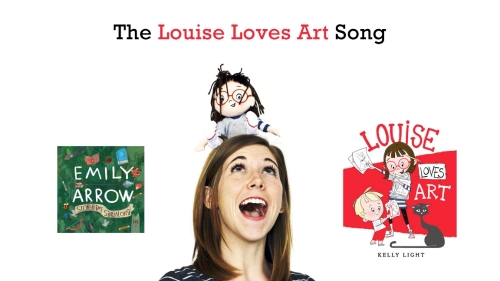
I love to sing the Louise Loves Art Song (inspired by the book by Kelly Light) because I love when the audience echoes the lyrics in the chorus. Check out the video too!

2.  What inspired you to do this type of music?

I decided to create kidlit tunes (songs inspired by books!) because I was a music teacher for students in Kindergarten through sixth grade for three years!

3.  How do you come up with the ideas for the videos?

I try to think of a way to use the colors, ideas, and feelings from the song and/or book in the video. Then I think of two or three places to record parts of the video that have something to do with the song. The brainstorming is soooo much fun for me!

4.  What has been your favorite video to make?

I loved making the NO, NO, GNOME video because I got to hang out with my pal Ashlyn Anstee all day.


5.  How do authors and illustrators react to your songs?

One time, one sent me an illustration in the mail as a gift. One time, one cried! It’s always different but I always want them to feel appreciated for the work they do creating their amazing stories.

6.  What are some songs you are working on?

I’m working on a fun song about a wizard, one about a kid who’s a cactus, and another that’s about friendship called Zoomba Zoo as a collaboration with illustrator Zoey Abbott Wagner!

7.  How do you keep your imagination on the outside?

Love this Louise-y question! Writing songs is an awesome way to share what’s on my mind in the world. And I write LOTS of lists in medium-sized notebooks. I use about a notebook a month full of thoughts and ideas and to-dos!

So do yourself a favor; go check out Emily Arrow’s music on her website, order her cd, buy the books, and of course, watch the videos.  I promise you won’t regret it…jazz hands!

Be the change, being a teacher, ideas

Why Not You?

http---www.pixteller.com-pdata-t-l-413088

I have spent more minutes talking to Charter Spectrum in the last few months than I care to remember.  Apparently our internet is determined to make me not work every night and Charter continues to say there is nothing wrong.  As I spoke to the kind lady on the line tonight, I finally told her that I could not understand how this could be acceptable.  Her response; well, this is how it is with every internet provider.  Little did she know she would inspire me to blog, because this is what we hear over and over in our schools.  In education.  In our teaching.  “This is how it is..This is how we have always done…This is how it works.”

How often have those very words stopped our grand ideas?  How often have they stopped us from taking a risk?  From trying something new?  From being the first?  Or even from being the second?  How often has routine, tradition, and “just fine” ideas stopped us from doing something new?

Evolution happens when something changes.  It happens when someone takes a risk, even a small one, and tries something new.  Creativity is based upon risk taking, invention, and new ideas.  So if we say we want schools to be relevant.  If we say we want schools to work for all children.  If we say we want schools that will foster innovation and help students dare to be more, then why not you?  Why not let yourself be the one that tries something new?  That tries an idea that might not work?  Why not you and your ideas?  And why not now?

If you like what you read here, consider reading my book Passionate Learners – How to Engage and Empower Your Students.  Also, if you are wondering where I will be in the coming year or would like to have me speak, please see this page.


being a teacher, being me, Literacy, Reading, summer

Parents – How to Help Your Child Love Reading Over the Summer

I know many of us educators (and those at home) have been working hard all year to try to cultivate or protect a love of reading in our learners.   Now with warmer temperatures and summer beckoning for the Northern Hemisphere comes the real test; will kids keep reading over the summer?  Is what we did enough?  Did we lay enough of a foundation, get them excited, get them hooked so that the next few weeks or months will not put them in a reading drought?  While time will truly be the judge of how the work might pay off, here are a few ideas that may help depending on the age of the learner.

Have a to-be-read list.  All year we have cultivated ours, trying to add as many titles as possible so that when the students leave our classrooms they have something to help guide them when they are either at the library or at the bookstore.  This is especially important for our “fragile” readers, those who have just discovered that books and reading may be for them after all and need a constant diet of amazing books.  But really all kids should have one, not just some.  Even if school has not created a to-be-read list it is not too late to make one!  Browse the displays at the library or at the book store and write it down somehow. Keep the list on you because you never know when you come across an opportunity to find more books.

Visit places where books are present.  We go to the library a lot; when it is too hot and the pool is not open, when it is stormy, when we are tired.  We also go to our local book store and browse.  Accessing book, touching books, getting excited about books and anything that we can read is vital to keep the desire alive.  If you are not able to go places where there are books, ask your child’s teacher if you may borrow a big stack of books from them if you promise to bring them back.  I have often lent books to families over the summer as a way to help them keep reading.

Make it social.  I love reading a great book and then talking to others about the book or even better passing the book on to them (as long as they give it back).  Make reading a social aspect of your summer; have reading “parties” where kids can discuss books, create a book swap with other families, scour garage sales for long-lost favorites.  Offer up yourself to read with your learner or get more than one copy of a book (if you have access to them) so that others may join in the reading.  Too often as parents we think we should read all of the books our child is reading and while that can be a fun bonding experience, it may be more powerful if you can get a friend of your child to be a reading partner.

Use audio books.  I love that I can borrow audio books from our library – the entire Harry Potter series has been the backdrop to our commute for the past 4 months.  When your children are in the car, put on an audio book.  Have a copy of the book ready if  anyone wants to keep reading and you have reached your destination.  With all of the research coming out correlating audio books with further reading success this is a winning situation.

Find great books.  Get connected online to communities like #Titletalk, #BookADay, or Nerdy Book Club to get ideas of what to read next.  I am constantly adding to my wish list due to these two places.  Use the professionals like librarians,booksellers and teachers.  Also, ask other parents what their kids are reading, create a Facebook page to share recommendations or simply use you own page, anything to find out what great books are available.

Create a routine.  We read every night and sometimes even in the morning (as well as throughout the day but then again we may be slightly book obsessed).  Helping your child create a routine where reading is a natural part of the day mean that they will create ownership over the habit, thus (hopefully) inspiring further reading.

Allow real choice.  I have seen some parents (and schools) require learners to read certain books over summer, but summer is meant to be guilt-free reading.  Where we reach for those books we cannot wait to read because they will suck us right in, where we fill up our reserves so we can perhaps finally tackle that really challenging book that we have been wanting to read.  Where we explore new books because we want to.  Too often rules and expectations infringe on the beauty of summer reading; falling into a book’s pages and not having to come up for air until it is done.  That also goes for reading things that may be “too easy” or “too hard” – I devour picture books, graphic novels and all thing “too easy” in the summer, as well as trashy beach reads and Danish crime mysteries.  I refuse to feel guilty about my choices in reading, because that is never what reading is about.

Have books everywhere.  Again, this depends on how many books you have access to, but leave books wherever your kids go.  I have books in the car, in their rooms, in the kitchen, living room, etc.  That way the books seem to fall into their hands at random times; stopped in traffic, quiet time before lunch, a sneak read before falling asleep.  It is a luxury to have books in our house and so we try to make them as visible as possible.

Celebrate abandonment, but ask questions.  When a child abandons a book, this is a great thing.  They are learning that this book is not for them and they can use their energy for a book that will be for them.  But ask questions so that they may think about what type of book they might like.  So they can think about what type of reader they are and want to be.  Make sure that there are other books they want to read as well so that they can keep trying to find great books.

Be invested and interested.  This does not mean that you ask your child to write reports about what they read, in fact, I would be very careful as to what type of work goes along with reading over the summer beside reading, but do ask questions.  Ask whether they enjoy the book or not.  What they plan on reading next.  Read along with them or beside them.  Make reading a part of your life so it can become a part of theirs.

Keep it fun.  Too often, especially if our child is not a well-developed reader, we can get rather nervous as parents and think that we must keep them on a regimented reading program at all costs.  That we must have them write about reading or track it somehow.  Have them read, yes, but keep it light and fun.  The last thing we want to do is to make reading a worse experience for them or adding more stress to your family.

What other ideas do you have?

If you are wondering why there seems to be a common thread to so many of my posts as of late, it is because I am working on two separate literacy books.  While the task is daunting and intimidating, it is incredible to once again get to share the phenomenal words of my students as they push me to be a better teacher.  Those books will be published in 2017 hopefully, so until then if you like what you read here, consider reading my book Passionate Learners – How to Engage and Empower Your Students.  Also, if you are wondering where I will be in the coming year or would like to have me speak, please see this page.


being a teacher, books, Literacy

What Every Teacher of Reading Should Do According to my Students

http---www.pixteller.com-pdata-t-l-407224.jpg

I have watched in amazement day upon day as our 7th graders have fallen into reading.  Have become still.  Have been whisked away to other worlds with their books in their hands and nothing to do but read.  I have listened as they have spoken of books, have handed them to each other, have recommended and requested.  Have been in competition with one another to read the book first, have asked me for that one book that they just can’t seem to find.

I have watched as my 118 learners became readers.  Not that they weren’t before, well some weren’t, but now; books are a part of who they are, at least in the 45 minutes we share.  Readers who were dormant are now awake.  Readers who were resistant are now in a fragile dance with books that entice them to keep reading.  Readers who already read have found bigger challenges to keep themselves engaged.  And I am so grateful.  Because these kids gave me a chance  and I now see the difference as we race toward the end.

So today I asked them; what do you wish every teacher would do for you as a reader and they told me, and then they told me to tell the world.

They loved all the books.  Can you blame them?  It is hard not to want to read when there are books calling your name everywhere you look.  We speak of the need of school libraries and I wholeheartedly agree, but we also need classroom libraries filled with books to reach every reader.  Books that they know can come home with them to be devoured, however long it takes.

They loved all of the book talks.  And not just from me, but from each other.  These 1 to 2 minute talks made all of the difference because they now knew what books they wanted to read next.

They loved their to-be-read list.  Inspired so long ago now it seems by Donalyn Miller, our to-be-read list is a part of who we are.  With us almost every day as we fill it with potential titles to keep us afloat in a sea of choices.  It becomes the one thing I ask them to take with them as they leave so they can keep reading over the summer.

They loved the 10 minutes of reading.  As one child wrote, “I think that the 10 minutes of reading at the beginning of class really helped me slowly enjoy reading throughout the year.”  While I wish I could have given them more, the daily expectation of 10 minutes of reading, meant that they had to find a book that they actually wanted to read.  The routine became the norm as I watched them fold into their books, their minds opened up to the new world awaiting.

They loved the challenge.  Having a goal of 25 books or more meant that they knew the expectation was to read and to read more than they had before.  And so they tried and many reached it, but they all (almost) read more than they had thought they could.  And not just the quantity but the quality of books too.  I read Teri Lesene’s Reading Ladders and it has reverberated through our classroom; how will you challenge yourself to become a better reader?  Over and over they tell me what they are doing because of this conversation.

They loved the abandoning.  We spoke of wild book abandoning and celebrated when we got to know ourselves better.  We tell kids to only read good books but then tell them in our next breath that they must stick with a book once they have started it.  Children should never feel guilty when they stop reading a book that does not work for them, they should feel fine as they search for the next book to fall in love with.  So let them abandon nut have them think of why they are giving it up.  That way they can use it as an opportunity to find out more about themselves as a reader.

They loved the conversations.  Although I went periods of time without conferring, and it is something many requested more of, I am so thankful I came back to it because it made a difference.  Having even 2 or 3 minutes every couple of weeks where a child knew all of my attention was on them and their reading identity meant that they had to start thinking about it more.  And so they did, and we discussed, and together we fine-tuned what they needed, what I could do for them, but more importantly; I got to know them and through relationships books can be shared.  So find the time to speak with your students about the books they are reading.  Hold them accountable and let them know you care.  I am so thankful for all of the moments we shared in our hushed talks.

They loved my book love.  Having a teacher that loves books, who may be a crazy book lady, in fact, did make a difference.  Because they knew it was okay to love something as much as that.  To care about fictional characters.  To cry when you get to that page.  It was okay to get excited when the next installment came out, or to abandon because you knew something else was waiting for you.  Being crazy about books is contagious in the best possible sense.  So share your love, be excited, and get a little crazy; they need you to be that person.

They loved the choice.  We can roll out the research, we can roll out the studies, but we can also just ask the kids.  With choice comes investment and engagement.  With choice comes a chance at creating their own reading identity.  With choice comes discovery.  ANd choice will lead to more reading.

And so as the final books trickle in and my library once again overflows with books waiting to be read, I realize that perhaps we were successful after all.  That while every child may not LOVE reading (yet), they do not hate it more.  That this year, at least, may have made a difference in their journey toward becoming an adult that reads.  I can only hope.

If you are wondering why there seems to be a common thread to so many of my posts as of late, it is because I am working on two separate literacy books.  While the task is daunting and intimidating, it is incredible to once again get to share the phenomenal words of my students as they push me to be a better teacher.  Those books will be published in 2017 hopefully, so until then if you like what you read here, consider reading my book Passionate Learners – How to Engage and Empower Your Students.  Also, if you are wondering where I will be in the coming year or would like to have me speak, please see this page.

being a teacher, books, organization, Reading

Small Ideas for a Better Organized Classroom Library

With 12 days left of the school year, they trickle in.  Some worn and tattered, others still as crisp as the day they entered our room.  Found in lockers, backpacks, discovered under beds and pulled after being accidentally shelved on personal bookshelves, our books are coming home.  The shelves of the library filling back up and all of our bins bursting at the seams.  So as I did another round of shelving, I put them back so I can assess our inventory, I realized that the organization of texts needed a little bit of attention.  That some of our categories were simply too large to really be useful.   After some inspiration from Penny Kittle – are you listening to the Book Love Foundation Podcast yet – and also from my colleague awesome Reidun, I had a few ideas for what we needed; goodbye gigantic shelf of one particular genre; hello sub genres.

So what has changed in our library the past few weeks?  (To see what else I do for library organization, go here).

Better picture book organization.  Our collection is vast, I am not sure how many we have, but I do know that it was taking me a good 10 minutes to find the particular book I needed at any given time.  Since I know that the students like to grab and put them back quickly, I devised a simple system; every picture book gets a letter corresponding to the author’s last name on its spine.  That’s it.  Now they are filed by the subgroup of the letter, however not alphabetically within the letter, and finding that one really great book is super easy.

Better non-fiction categories.   My students have not gravitated much toward non-fiction and I am partly to blame.  I read it but do not book talk it much and our non-fiction section was vast but not organized.  I re-arranged the bins, added all of our historical fiction bins to the same area and then introduced the following sub-genres:

True Tales – for all of those crazy but true stories of epic events that do not center around a single person.

Life Stories – for all of the extraordinary stories about unknown people.

Biographies – Different from life stories as they tend to center around famous people.

Learn Something – Want to learn about coding?  Dinosaurs? Sharks?  Archaeology or Atheism?  There is a book in this bin for you.

World War II and War History – I have separate bins for these because they tend to be a popular topic.

Better realistic fiction categories.  Another massive collection of texts, yet there are so many differences in books.  Some of the new sub-categories introduced were:

Death & Dying – A very popular topic in our library; three bins worth to be exact.  The students actually cheered when I told them of this new section – Thank you Ms. Bures for the idea.

The High School Experience – books centered around being a high school student in all of its sometimes glorious messiness.

Personal Struggles – Thank you everyone for all of the great suggestions of names for this category.  These are the books that have to do with eating disorders, suicide, sexual identity and any other struggle that a teen may go through.

Nature & Survival – When nature plays a key part to the plot, the story goes in here.

Other sub categories include Animals and Sports.  I will ask students what else we need.  I debated doing a relationship one, but fear that the label itself will steer some students away from the genre.  I am pondering this one still.

To place by author or not?  While I created a few new author bins, I am now wondering if I should dissolve them.  I have noticed that many of my students will not even glance at an author bin unless they already love that author.  But if all of the author’s books are in a bin by themselves then a student does not come across them unless someone book talks them.  So, perhaps I should not have author bins at all?  I would love to hear your thoughts on this.

Next up fantasy and science fiction.  While I already created a Fantasy & Fairy tales bin (because I love Rump and A Tale Dark and Grimm so much), I know I want to add realistic fantasy, dragons, magic, and other sub-categories as well.  Same goes for science fiction, sub categories there will be space adventure, and dystopian texts among others.  My first step though is to ask the students what they would like.

All books are stamped on the inside cover with a genre designation underneath them.  So a book may have RF/D&D written in sharpie in it, meaning that it goes in any of the 3 Death & Dying bin.  I am not worried about which bin since they are all the same category.

While this is not a brilliant new idea, I thought I would share it because I wish I had thought about doing it sooner.  I am excited to continue to go through our library, continuing to make books attractive and easily found by the students, because in the end that is what all of this is about; shelving the books quickly so they can leave our classroom quickly, happily nestled in the hands of an excited potential reader.

If you are wondering why there seems to be a common thread to so many of my posts as of late, it is because I am working on two separate literacy books.  While the task is daunting and intimidating, it is incredible to once again get to share the phenomenal words of my students as they push me to be a better teacher.  Those books will be published in 2017 hopefully, so until then if you like what you read here, consider reading my book Passionate Learners – How to Engage and Empower Your Students.  Also, if you are wondering where I will be in the coming year or would like to have me speak, please see this page.