being a teacher, Literacy, Reading

Will You Help Me With Research on Student Book Abandonment Habits

Book abandonment and its effect on love of reading has been on my mind for a long time it seems.  Chalk it up to the fact that I am writing a book that falls into the literacy realm, to the fact that I am abandoning books like crazy myself, or that my students reading habits seem to vary seemingly from day to day.  Whatever the cause, I cannot help but wonder; what leads a child to abandon a book?  And how does book abandonment shape their future reading identity?

So as I try to gain more insight from my own students, I also would love if other students would help out.  Would you be willing to have your students (or own children) take my short survey?  It should take less than 10 minutes if even and should be fairly easy for students to take.  I imagine they may need to be n 3rd grade or up due to the questions but you may be the judge of that. The answers will probably be used in some way in my future writing since I have a feeling it will offer us insight into the minds of students and how we can use the act of book abandonment as a way to fuel change in our reading instruction and student reading identity.

Thank you so much.  Please share with as many colleagues as possible, if you would, I am looking for answers from as many kids as possible. If you would prefer the link to the service, it is right here https://docs.google.com/forms/d/15h2VKhC1t2SJc0V1_6IY4-9oBLDx4dkN1d2361vKMDs/viewform

aha moment, being a teacher, being me, books, Literacy, Reading

When Reading Becomes a To-Do

I have been in the longest reading slump of my adult life this winter.  Books have been picked up and tossed aside.  My iPad and I have entered a new relationship level as I have committed to beat all levels of Candy Crush Jelly Saga.  I spent an entire plane ride to California thinking about how I should read and then not actually doing any reading.  Both ways.  And I have abandoned book upon book, only to feverishly cram the shortest book down in a half an hour so that I could my students that I was still reading.

What caused this reading disenchantment?  Pressure.  Pressure to find the perfect book for the Global Read Aloud.  Pressure to find an engaging story to beat the last engaging story I finished.  Pressure to read more than I read the week before.  Pressure to meet my goal.  Pressure to like a book that everyone else liked.  And yes, even pressure to read some of the mountain of books that sits next to my bed waiting to spill out of the bookshelves at the slightest movement.  Good thing, earthquakes are rare in Wisconsin.

On Monday, I realized that I loathed reading.  That I would have no problem not really reading for the next year or so.  That reading and I could certainly break up and I could fake it for a while, after all I did not really have to read all those books, I could just read their reviews and pass them off to students.  Yet, in that stark realization I found my key to salvation; reading had become a chore rather than something I do for pleasure.  Reading had been added to my to-do list right beside folding the laundry and answering email.  So I knew it it was time to reclaim my reading life.  To not let this one completely self-indulgent pleasure fade out of my life.  And since last night, I have gratefully sunk into the pages of a self-selected perfect for me book and rekindled  my love slowly, page by page, minute by minute.  There is still hope for me, I am not a lost cause, because deep down, I love reading.

Yet, I wonder about our students who loathe reading.

Whose fragile relationship with reading is one marred by well-meaning intentions from their teachers that tried to change their mind.  Who will gladly accept whatever book you hand them because then at least you will stop bugging them.  Who stare at a book not as a welcome friend but as a chore, a to-do, rather than a to-love.  Who are told what to read because they do not know how to find a book by themselves.  Who are limited in their choice because they certainly cannot read that book, whatever that book may be.

I worry about the kids who do not know that reading can be something incredible and therefore go through life eagerly awaiting the day that no adult will tell them to read.  Who cannot wait to fake read their way through the next book they are forced to read.  What a skill they can perfect right under our noses.

What will ever snap them out of their loathing when the things we do to help only cause them to hate it more?  When we tell them to stick with a book rather than abandon it, when we tell them to always write about their reading or log their minutes and don’t forget the parent signature.  When we tell them to find books at their level even if their heart calls out for another.  What will break them out of their pattern of reading not for enjoyment, not for fun, not for exploration, or self-preservation, but instead for the-teacher-said-I-had-to.  Will they know that reading is meant to be an act of love?  Of dreaming?  Or will they simply count the days when reading disappears from their to-do list never to return.

I fell in love with reading because I was given the space to grow as one.  I was given the trust to pick my books and to abandon them as well.  To not produce after I read but instead be given more time to read.  I fell in love with reading not because a teacher told me I had to but because my heart longed for the pages of a book.  Can our students hear their hearts in our classrooms or does our teaching get in the way?  I think it is time we stopped and listened.

If you like what you read here, consider reading my book Passionate Learners – How to Engage and Empower Your Students.  Also, if you are wondering where I will be in the coming year or would like to have me speak, please see this page.

Be the change, being a teacher, challenge, global, Student

1 School 1 World – What Did We Learn #1S1W

Sometimes my crazy ideas get ahead of my own brain in all of the best of ways, such was the case of 1 School 1 World , a social media initiative that was meant to showcase schools around the world using a common hashtag #1S1W.  I wanted my students to see not just how we are different, but more so how we are all the same.  And so  I shared the idea with the world and today, February 22nd,schools around the world participated.

As I showed my students the stream of pictures throughout the day, we couldn’t help but marvel at so much.  The sun in New Zealand, the sheep in Australia, the gym in Denmark, the wooden tables of Serbia.  We saw the differences, sure, but we also saw so much of the same.  It turns out that many of our classrooms look like they could be in the same school.

Yet, as the day went on, we started to notice not just how alike we were but also the incredible differences there were in school buildings, activities done, and even technology showcased.  As we tweeted out asking people to show us pictures of their libraries, one person responded that their school did not have one due to money.  That was a sobering notion for many kids.

And this is what stopped my heart today and what continues to run through my head tonight.  While this day was meant to share our learning environments, it also inherently shared our privileges; schools that have the tools to share in the first place.  Teachers that have the ability to show off their environments without the fear of being in trouble with administration or school boards.  Buildings that were mostly well kept and learning environments that were inviting to students.  Yet, we all know that this is not what learning looks like for many students, not just across the world, but right here in the USA.

There were voices missing, which I expected, but I did not expect how hard it would hit me once again just how lucky I am to teach in a district that is well-funded and community supported in many ways.  There are so many teachers that do not have that privilege.  There are so many kids that do not have that reality.

So as I digest the many images together with my students, I plan to ask them to look at how we are similar, how we are different, but then I also plan on asking them to look for the missing images.  For the schools that are not represented in these pictures.  For the kids that are not represented.  To see if they can figure it out. To see what they will come up with.   This will be the seed for further exploration.  This will be the seed that somehow will carry us forward.  To what I am not sure, but we know that a change in society can start with us, but not if we don’t start the conversations.

And if you joined today; thank you.  Sometimes all it takes for us to get to know each other is a simple hashtag.  Keep connecting.  Keep sharing.  Keep discussing and then do something about what you see.  We teach the future of the world, let’s never forget that.

To see the Storify of all of the pictures I could find, go here.

Thank you Ben Wilkoff for pulling 400 or so pictures and putting them in Google photo.

being a student, being a teacher, being me, punishment

When We Don’t Just Punish

http---www.pixteller.com-pdata-t-l-317325

He stares at me in silence, eyes cutting through me like knives.  He turns his back, message sent loud and clear; conversation over, nothing resolved.    And I feel my heart beat faster, my judgment gets cloudy and part of me wants to punish.  Wants to give a consequence.  How dare you turn your back, how dare you refuse, how dare you not do as you are told.

I could send him out, I could call the principal.  I could take away, I could call home. I could punish, many probably would, yet I know that it wont solve, it wont make it better. I need a solution and that wont come from a phone call, a detention, public shaming through a behavior chart, or a lost privilege.  In fact, it won’t come from corporal punishment either although some states still seem to think so.  The answer doesn’t lie within the punishment. It hardly ever does.

So when we don’t punish a child, when we don’t force them into behaving, then what?  When we lose the easy way out, and trust me punishing a child is always the easy way out, then what do we do?  We worry, we reflect, we reach out to to others, and we don’t give up.  We search for answers that may not be easily found and we realize just how inherently human we are.  That it is hard to work with students who seem to take pleasure in finding every one of our buttons and then pushing them over and over.  Just waiting for our reaction, waiting for when we will give up and finally dole out a punishment.  That sometimes, even when you have been teaching for a while, you do not have all of the fixes and that when you are working with human beings there are no easy answers.

His back glares at me, seemingly waiting for my response, and so I clear my throat, clench my fist and say, “I am here if you need me” and I walk away.

That day I didn’t solve the problem.   Complicated situations always take more time.  In fact, I wonder if I ever will, but I know that if I had punished, if I had gone down my list of what to do that someone taught me in college, that child would not have changed.  He would have dug his heels in and fought me harder.  Because sometimes the kids that push us away.  Sometimes the kids that fight us the hardest.  Sometimes the kids that seem like they hate us with every fiber of their being are the ones that need us the most.  Even if they find the hardest way to show it.

So I will continue to take deep breaths, knowing that tomorrow brings a new day.  To realize that perhaps this is personal because it really is, because in the defiance is a test of relationship; how far can I push before the love is gone.  How far can I go before this teacher finally snaps.

I am only human but within my own humanity I find my answer; don’t give up.  Keep trying.  Stay the course.  Don’t punish but continue to be there.  Continue to try.  Sometimes simply not giving up is the only answer we need.

If you like what you read here, consider reading my book Passionate Learners – How to Engage and Empower Your Students.  Also, if you are wondering where I will be in the coming year or would like to have me speak, please see this page.


being a student, being a teacher, student choice, student voice

When We Forget to Ask – On Student Privacy and Sharing All the Good

http---www.pixteller.com-pdata-t-l-314014

I was schooled in student privacy the first time I asked to take my students online.  Protect, teach, and keep them safe were drilled into me as we connected and explored the online world.   I thought I pretty much  knew what I couldn’t share; all the sensitive or bad stuff, and thought I knew what I could share; all the good stuff.  I thought all of my students wanted to share their blogs.  That all of my students wanted their accomplishments made public.  That when they did well they, of course, they wanted the world to know.  After all, we are a culture driven by success stories.

Yet, year after year my thinking has been challenged.  First by a 4th grader who told me she had no need for a certificate stapled to her math test as it made something private public.  Then by a 5th grader that dared to ask why I assumed he would want his blog to be public.  And finally, last year by a 7th grader who told me to tell the world that no one else had the right to know that she was on the honor roll.

Every time a student has challenged me, I have learned something.  Every time they have stood up for their own privacy, I have been reminded of my own flippancy.  Every time, I feel the urge to share all of the good I remember that I do not automatically have the right, that the students also have the right to say no, that that is not just something we leave up to parents.

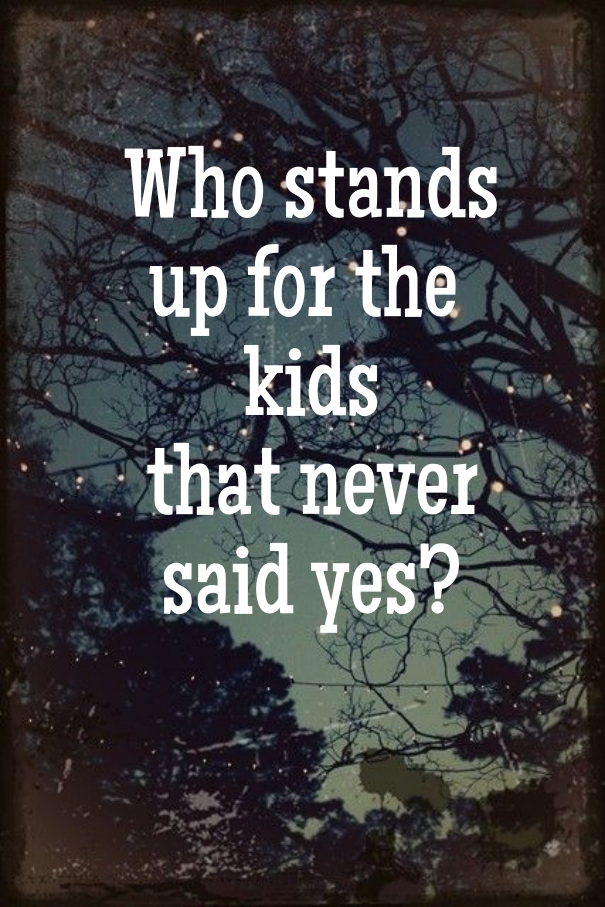
So I speak for my students who challenged me to rethink my stance in privacy.  I speak for those kids that asked me to think before I shared.  Not just for the parents who said no, but for the kids that never said yes.

So before you publish that honor roll.

Before you make that blog public.

Before you move their clip to the positive zone or give them that point (“Ding!”) or hand them that award.

Before you tweet that picture, or print it, or email it, or share it with the world.

Before you use that student example (name redacted of course).

Before you share that great learning moment with the world.

Before you share what a kid has done.  Even if it was amazing.

Please ask them if you may.

Please ask them if they would be alright with the whole world (potentially) seeing their thoughts, their work, their accomplishment.

Please ask them if they would like the attention that may come from it or if they would rather not be celebrated publicly.

And if they say no, respect it.

We assume that every kid wants to be praised in public.

We assume that every kid wants to be honored in public.

We assume that every kid wants to share their great grades in public.

But we don’t know every kid.

So ask them first.

Their answer may surprise you.

I know it certainly surprised me.

If you like what you read here, consider reading my book Passionate Learners – How to Engage and Empower Your Students.  Also, if you are wondering where I will be in the coming year or would like to have me speak, please see this page.


administration, Be the change, being a teacher, being me

When A School Becomes Toxic – What Can We Do to Change School Culture?

http---www.pixteller.com-pdata-t-l-311457

When you walk into a school you can usually feel the culture right away.  Is this a building where teachers love to teach?  Where students thrive?  Is there a feeling of family in the air or something else?  A building’s culture is often invisible and yet it can be one of the most important components of what makes a school great.  In fact, I fell in love with Oregon Middle School because of the feeling of family I encountered in my very first interview.

So what happens when a school’s environment turns toxic?  Where mistrust and anger become commonplace?  What do we do when we find ourselves in the type of school where all we want to do is shut the door and teach in peace, too tired to deal with everything else?  Well, there are a few things we can do.

We can make sure we are not the ones being toxic.  Yes, it is hard to let go of anger.  Yes, it is hard to not get upset.  And yet, we also make a choice every day of whether or not we want to add more negativity or not.  We make a choice, it is not made for us, and sometimes we have to make it again and again throughout the day as we try to stay positive.

We can build others up.  Why not point out the positive that you see.  Just as negativity is contagious, so is positivity.  You may be the only one noticing great things but give a compliment, leave a note, do something that shows you notice the great that is happening around you and speak up.

We can choose to trust a new person.  We often only extend the trust to those we know well and everybody else in a building we are not quite so sure of.  But how about we assume that there must be more people in the building that are there because they also love teaching and kids?   Purposefully extending your circle of trust means that your “inner” circle will grow, which means there are more people you can vouch for internally.  It may not seem important but it certainly is.

We can watch each other teach.  I know nothing about what goes on in other classrooms but instead of being ok with that, I have asked if I can come watch others teach.  I have also opened up my door to anyone that would like to come in.  Yes, it is hard to feel like you are being judged but we can also assume positive intent.

We can have courageous conversations.  If someone is seemingly negative at all times, ask them why.  Yes, this may be super uncomfortable for all of us but a simple question can go a long way.  Often we establish a pattern of unhealthy venting and don’t know it ourselves.  Someone calling us out, even gently, can be all we need to see our habit.

We can focus on what we can change.  There are many things in my state that upset me, there are even decisions in my district that I may not agree with, and yet, when I cannot change things I let them go.  Why anyone wants to carry anger with them every day they teach beats me.

We can make new friends.  Often we stick to the same people in our teaching circle at school, why not extend that circle right along with the trust?  Stop by someone’s room and ask them a question, seek out someone new to sit by at the staff meeting, volunteer for a new committee.  Something to meet new people.  A toxic environment often comes from not knowing each other, so break that barrier down one person at a time.

We can refuse to give power to the toxicity.  In our silent agreement, when we nod, when we spread the stories that tear others down we are complicit in spreading toxicity.  When we agree rather than ask questions, when we stand and listen, we are complicit in the spread of toxicity. So walk away, don’t agree, speak up.  If you do not want a toxic environment then do something about it.  Shutting your door is the easy way out.

Sometimes the toxicity comes straight from the top, so administrators, this is for you.

You can be the voice of reason.  Seek out both sides of the story before you judge, don’t have favorites, and leave your own emotions out of it.  Just like teachers at times will side with students that they like, so will administrators, and that sends a very strong message to everyone in a school.

You can check your own interactions.  If the interactions you are having with teachers are more negative than positive, think of how that affects the students.  While there are always tough conversations to be had, how they are approached can make or break a school culture.

You can be positive.  I work for one of the most positive administrators I have ever met.  Every day, no matter what, she has a positive attitude, even in the hardest situations.  This makes a difference and it sets the tone.  Our culture is one where people welcome and teachers feel valued.  If an administrator always looks mad, tired, or stressed it spreads to everyone else.

You can respect privacy.   As an administrator, you probably have way more information than any teachers and especially about other teachers.  That is part of your job, and so part of your job should also be to keep that private.  I have heard horror stories of administrators sharing private things that greatly influenced how others saw a teacher.  Be mindful of what you share and who you share it with.

You can initiate hard conversations.  I think too often administrators are not quite sure how to approach a toxic person or situation, and I get it, it can get really messy really quickly.  But at the end of the day, if we don’t talk about a problem it will never get away.  So we can allude, circle, and kind of talk about it, or we can face the problem head on and try to get somewhere with it.

You can ask for feedback.  My administration just held a two-day listening session where anyone was welcome to come and discuss whatever they wanted.  That sets the tone for the level of trust they place in us; they want to hear what we have to say even if they have no solution.  Simply opening up the door and asking for genuine feedback sends a powerful message about where you are in your administration journey; are you trying to grow or are you good with where you are.

A toxic culture can arise quickly but can take years to combat.  And while it would be nice to simply point the finger to one person and accuse them of being the main culprit, we all have a role in it.  From those that continue to spread negativity by venting their frustrations, to those of us that choose to shut our door and forget about the rest of the school; we are all complicit.  So take a long hard look at yourself, after all that is the only person we can control, and make sure that what you bring to your school is really what you meant to bring.  I know we all have bad days, but some times those bad days become bad years without us even realizing it.  A school’s culture is never too late to fix; but it does take a decision to do something about it.  And that decision can be made by us. Every single day.


If you like what you read here, consider reading my book Passionate Learners – How to Engage and Empower Your Students.  Also, if you are wondering where I will be in the coming year or would like to have me speak, please see this page.