One of the main texts we use to guide our reading instruction is the amazing Notice and Note: Strategies for Close Reading by Kylene Beers and Robert Probst. This book provides us with the foundation for having deeper reading conversations and a common language as we develop our thoughts. While the book has excellent text ideas to use as mentor texts, I thought it would be nice for my students to use picture books on the very first day of a new strategy before we delve into the longer text excerpts. I have therefore looked for picture books I could use with the different strategies and will publish posts as I have them for the 6 different strategies since I cannot be the only one looking for ideas.
The first post was on Contrast & Contradictions, then followed Aha Moments, then Tough Questions, and now Words of the Wiser – a great strategy for noticing when life advice is given. I loved revisiting some older picture books but also finding some new favorites to share. Again, there are definite repeats here from the other lists, perhaps at the end, I will compile a list of picture books that can be used to teach more than one signpost.
The aha moment is mixed in with words of the wiser from Emmanuel’s mother and is embedded into the story. This is a good book to use when it may not be as obvious.
I have had a Peter H. Reynolds book on every list so far, I am pretty sure you can teach all 6 signposts using his books. The North Star will always be one of my favorites.
Many of Patricia Polacco’s books can be used for words of the wiser, here I chose Mr. Wayne’s Masterpiece.
Zero by Kathryn Otoshi is a picture book that can be used for many things, teaching words of the wiser is definitely one of them.
When the students wonder when they will finally get tall, this is a great book to pull out You’ll Grow Soon, Alexby Andrea Shavick and Russell Ayto has great wisdom.
Our Gracie Aunt by Jacqueline Woodson is the book I am using with my students to teach the strategy. It is a beautiful story that will start discussion in our classroom for sure. Each Kindness also by Woodson is another amazing example. In fact, many of her books can be used for this strategy.
We seem to be run by the rules of what came before us. We seem to be trying to uphold traditions that were started all in the spirit of becoming better reading teachers. And yet, I think it is time for us to break some rules, to become reading warriors, and to speak up and say no; this is not what reading will look like in our classroom. This is not the reading experience that my students will have, this is not what will make students fall in love with reading. So I present you with some rules that seem to perpetuate much of our reading instruction and encourage you to break them just like I have and so many others before me.
Rule number 1: You must read X number of pages before you abandon a book.
I used to enforce this; give it 30 pages, give it 50, then I read the False Prince and I told them to keep reading to page 88 where it gets so, so so good. But that is not how adult readers read. I sometimes abandon books after a chapter, after a page, after a paragraph. I listen to the voice inside that tells me that there is just something wrong, that this book is slowing down my reading love and that it is not the right fit at this particular moment. In our classroom, we practice free book abandonment, but we also reflect on why we are giving up on a book. It offers students a wonderful chance to learn more about their own reading identity. So when we see a child serial hop from book to book, don’t stop them, instead ask them why. And when they tell you that they don’t like the book, ask them why again.
Rule number 2: You must read a book from every genre.
I used to have students read books from certain genres so that they had been exposed to them all, and yet, most students hated it. So now instead I make sure that our book shopping is varied, that I book talk many genres, and also that they have access to many genres. There is no requirement to read outside of a genre, but only gentle recommendations. We need to celebrate the students that have identified themselves as lovers of a certain genre, after all we do as adults, rather than force them into thinking that somehow they are not true readers because they are not exposing themselves.
Rule number 3: You must fill out a reading log.
My biggest problem (and I have several!) with reading logs is that it inherently shows students that we do no trust them. By asking them to record how much they have read outside of our classrooms, we are telling them that their word is not enough. When we ask parents to sign, our message is even stronger; you may have said this but I only know it is true because your parents agreed to sign this. Is that really what we want to tell our students? And as a parent who has forged her signature on a summer reading challenge, I can tell you, I would do it again if it means that my child does not have to distill her love of reading books into minutes or pages. Her reading love deserved better than that.
Rule number 4: Reading is only something you do with your eyes.
I used to tell students that for a book to count for their book challenge that it had to be read. And reading means they do it with their eyes. Now I know that reading can also be auditory, whether by listening to an audio book or being read aloud to. That students can still experience a deep connection with a text even if their eyes have not processed it, and that audio books level the playing field for so many of our students who feel like they are bad readers. Reading is many things, let’s make sure that in our rush to define it, we do not alienate the students that need alternative methods the most.
Rule number 5: You must only read books at your level.
Levels were never meant to confine or define a child, but instead meant as a tool for a teacher to select text for guided reading instruction. Yet our obsession with placing children in boxes has made levels prevalent in our schools and in the minds of students. If our goal is to create students who identify as readers outside of our classrooms then they need to know themselves as readers. They need to know what they prefer, what they can read, and also what type of book they need at that very moment. That changes based on their life, and not just their growth, just like it does for us adults. Having students select books based on a level robs them of the chance to figure this out, and in turn, counteracts everything we are trying to teach them.
Rule number 6: You are too old to read this book.
If I only read books that fit my age then I would never read a YA or children’s book again, and that goes for our students as well. Reading books that may be too young is a way for students to relax, to build confidence, and to read a book they feel like reading. How often does our helpful rules really just hinder a child from reading?
Rule number 7: You must create something after you finish a book.
When I finish a book, I often hand it to a friend. Sometimes I book talk it to my class, sometimes I write a review, other times I quietly place it in a bin. I do not write a journal entry, I do not create a book report, nor do I make something to show off the theme. When students finish a book they should have an opportunity to discuss the book, to recommend it to a classmate, to share their love of it with the world, if they want. They should not have to choose from a long list of projects to prove that they, indeed, did read it.
Rule number 8: Picture books are for little kids.
Every day, almost, we read a picture book in our classroom. In fact, picture books are serious business here, as I use them to teach students how to infer, how to closely read, how to think deeply about a text and then be able to discuss it with others. We use them as mentor texts as we work on our writing craft. We use them as we build our community. And yes, we use them because picture books make the world a better place and they remind students that reading is meant to be fun and magical. A student told me the other day, “Mrs. Ripp, I am not so sure picture books are for little kids anymore…” And I knew exactly what he meant, because a text that rich should not just be reserved for young kids.
Rule number 9: Graphic novels are not real books.
Graphic novels can be just as complex as the hardest chapter books. In our classroom, graphic novels can be a lifeline; a way to reach the kid that swears they will never love reading, a way to reach a child that cannot get through a chapter book. I have students using graphic novels to find the signposts from Notice and Note at the moment. I have students finally connecting on a deep level with a book that happens to be in the format of a graphic novel. I am so thankful to all of the authors out there creating these magnificent books that prove once again to my students that great books do not just look like one thing.
Rule number 10: You must reward reading.
Reading is it’s own reward to quote the fantastic Teri Lesesne. The minute you attach a reward to reading you have diminished the act of reading itself. Think hard about the stickers, the prizes, the special events based on pages read and instead find a way to celebrate the very act of reading by getting more books, by finding more time to read.
Rule number 11: You must not judge a book by its cover.
I do it all the time. We all do. What we need to teach kids though is that covers are not the only way we should judge a book. That even if a book has a terrible cover, which some amazing books truly do, that they then should move on to checking it in other ways; by reading the back, by skimming a few pages, by asking a friend. For students to see us as reading role models we must not hide the true habits we have but instead celebrate them and share what we do. Students do not need to see how we pretend adults pick books, instead they should see how we really pick books, and that includes judging a book by its cover.
I could have gone on, but these are the rules that stood out to me. I shudder at how many of these I have had in my own classroom and am grateful to the people that have shown me a better way. We can create classrooms where students fall in love with reading, the choice is ours.
I could say that I am an amazing teacher. That what I do is not something others could do. That the way I connect with kids is a special talent that only I have developed, and that if you buy my book you could perhaps learn how to teach just like me, that some of my amazing “me-ness” will surely go your way. I could say that I have discovered the one way to be great and all you have to do is try to be more like me.
But I would be lying. (And making a fool out of myself in the process).
Because there are days when I am not so great. There are children that I do not connect with. There are moments when no matter what I try it all falls apart and one of my teammates steps in and saves the day. Saves the lesson. Saves the student. I am a better teacher because of those I teach with. I am a better teacher because of the students that teach me.
You see, being a teacher is not about us. It is not about the great things that we can do. It is not about all of the things that we will teach. It is not about what will work best for us, nor how we will change the world. It is about the kids.
It is about what they will do. What they will learn. How they will change our world. How I get to be a part of the process but I am only as great as my students.
And we seem to forget that at times. We seem to forget it when we share the stories that do not highlight what our students are doing, but instead what we have done. When we advocate not what is best for children, but what is best for ourselves and hope that children may benefit as well. When we teach the way we would like to learn, and forget to ask the students what they need.
It is a balance and it is hard to keep at times. I know I am guilty like so many others. Yet, in this public way, I renew my promise to keep it about the kids. To keep it about what they need, what they want, and what they dream for.
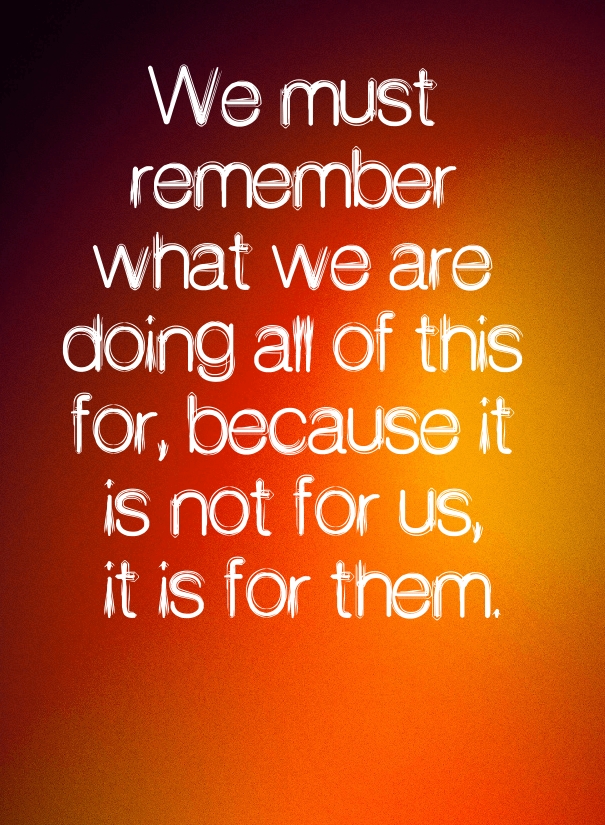
I am not the greatest teacher, I have so much to learn, and I cannot forget that. We must remember what we are doing all of this for, because it is not for us, it is for them. And that is how it should always be. May we never forget that. May I never forget that.
On Sunday night, I cried in my airplane seat. I held the book in my hands and cried not because it was sad, but because it was so true. Because the words I had just finished reading made me think about my own privilege, about the conversations Brandon and I will never have to have with our son, Oskar. About the thousands of boys whose everyday life can be changed in a single second. And how I have no idea what to do about it other than continue to ask questions, continue to have the conversations in our classroom, and continue to place books like this in the hands of my students even if they make me feel so incredibly uncomfortable. Because this book should do exactly that. And not only that, it should make us weep at the society that we live in and the ways that we perceive each other. It should make us angry and ashamed.
So today, I handed the book to another teacher and then promptly ordered another copy. I know that for some of my students it is too mature, but for others it will be the book that they pass on from kid to kid. It will be the book that makes them question the society that we live in, and for that I am so grateful. We need books like this. We need to cry in our airplane seats more often at the injustice that we participate in.
It struck me as hard as a hammer. 6th period Friday. The fourth time I was teaching this lesson. The fourth time I had students go through the discussion questions, do the turn and talk, and then come back together. It hit me so hard that I instantly cringed a little bit, because why in the world I hadn’t thought of this sooner? If only I had listened to that little nagging voice we all have inside, if only I had tuned in as it screamed, “Stop talking, Pernille. Stop interrupting their conversations. Stop rushing them through what you think they need to get through and let them speak to each other.”
And yet, after only a minute of talking, I felt the ticking time. I saw the hands moving as class slowly trailed away and so I kept interrupting them. Guiding them to the next thing that we had to do. Telling them to finish up So that we had the entire foundation laid. So that I could place a check mark in my planner and move on to the next thing, knowing that we had done everything we were supposed to and gotten to the end of the text. Yet, this is exactly what we should not be doing in our classrooms.
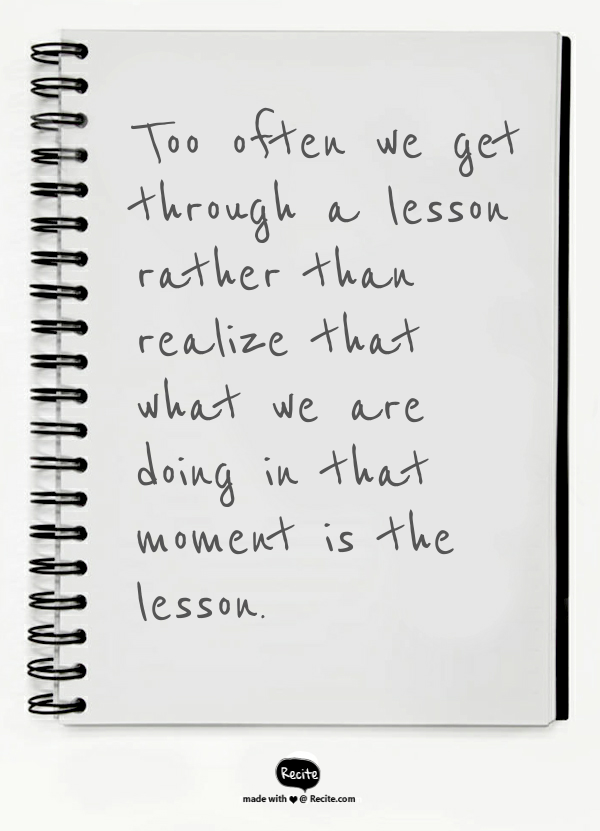
Too often, we rush. Too often, we hurry so that we can cover things. Too often we get through a lesson rather than realize that what we are doing in that moment is the lesson; is the point of school. We say we want students who speak up and exhibit deep thinking, yet then limit this very thing as we teach. We must slow down. We must stop our incessant teacher talk, our incessant interruptions as we guide and mold and let students think, then let them speak. And when they are done speaking let them sit in the silence for just a moment so they can be sure they are completely done speaking.
Teaching is not about getting through. Teaching is not about getting things done. Teaching is not about completing every single lesson we had planned so we can say that we did it, we followed the path and now we have taught. Now our students have learned. It is about the path we take to get there. The exploration we have along the way. The time we give to our students to speak so that we may listen.
So in that 6th hour on Friday, I finally stopped speaking. I finally stopped interrupting them and just let them speak. Those who ran out of words looked at me expectantly waiting for me to start again, but then saw how others were still going in their conversations and that spurred them on to keep speaking. I bounced from group to group, not interjecting, but listening instead. Nodding and smiling as I saw them start to become what I hope they will be; kids that have an opinion, kids that have a voice. After a few more minutes, a child asked a question so good that I knew we could discuss this as a class. And so we did. And I didn’t interrupt. I didn’t shape the conversation. I let them speak and they loved it. Because it was about them and not me. Their learning and not just my teaching. Just the way it is supposed to be.
I am packing right now, on my way to the Mt. Lebanon school district in Pennsylvania, where I get to have the immense honor of working with their elementary staff for a whole day. My focus for the day is, of course, all about creating passionate learners – everything I have written about in my book, and I cannot wait to see the thinking, discussion, and ideas that will happen. I always get so inspired working with other teachers as well, what a great way to spend a Monday.
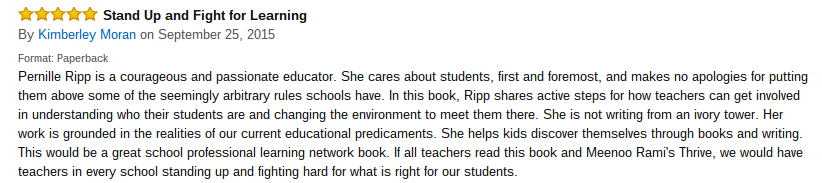
In the spirit of learning from others, I thought it would be great to give away a physical copy of my book Passionate Learners – How to Engage and Empower Your Students. I will even sign the winning copy! All you have to do to enter is leave a comment and tell me why you would like to read the book. (Your email does not need to be included as long as you put it in the comment box). I will pull a winner this Friday night, October 9th and will then send you the book.
So what is my book about? Here is the excerpt from the back.
Would you want to be a student in your own classroom? In Passionate Learners: How to Engage and Empower Your Students, author Pernille Ripp challenges both novice and seasoned teachers to create a positive, interactive learning environment where students drive their own academic achievement. You’ll discover how to make fundamental changes to your classroom so learning becomes an exciting challenge rather than a frustrating ordeal. Based on the author’s personal experience of transforming her approach to teaching, this book outlines how to:
• Build a working relationship with your students based on mutual trust, respect, and appreciation.
• Be attentive to your students’ needs and share ownership of the classroom with them.
• Break out of the vicious cycle of punishment and reward to control student behaviour.
• Use innovative and creative lesson plans to get your students to become more engaged and intellectually-invested learners, while still meeting your state standards.
• Limit homework and abandon traditional grading so that your students can make the most of their learning experiences without unnecessary stress.





 Pernille Ripp