When I first moved back to Denmark, I had the privilege of working in marketing—a completely different field from teaching, but somehow familiar. Everything was new: teams, assignments, routines. It was exhilarating, exhausting, and, unexpectedly, deeply thought-provoking when I considered my work as a teacher.
One of the first things I had to learn, fast, was how to ask questions. I knew very little, every day I was surrounded by people who knew far more than I did, even those fresh out of school. My gut and past experience were all I had to rely on. And so I asked questions—constantly. Not because I wanted to seem smart, but because I wanted to learn, to understand, to avoid assumptions that could lead me completely astray.
Even now, I ask a lot of questions. I would rather ask and realize I already know, than assume and be wrong. It’s a habit I try to bring into my classrooms every day.
We tell our students the same thing: ask questions, share your ideas, don’t be afraid. And yet, we also know it’s not easy. It’s hard to speak up when everyone else is silent. It’s hard to admit you don’t know something, especially when you’re unsure if your peers will be kind—or if they even care. And in a world dominated by AI answers, misinformation, and polarizing rhetoric, the courage to wonder, to experiment, and to be wrong can feel more vulnerable than ever.
This is why we continue to focus on questioning as a core part of learning. Not just the act of asking, but creating spaces where students feel safe enough to risk it. Where curiosity is valued above correctness. Where play and collaboration make questioning something natural, not intimidating. Because the ability to ask, to wonder, and to explore ideas is not just a classroom skill—it’s an essential part of growing up in a world that constantly challenges what we know and what we believe.
So how about a few ideas that do just that?
Curiosity is at the heart of all learning—and asking questions is the brave part of that. When we give students the space to wonder, to take risks, and to speak up, we’re teaching them far more than facts. We’re teaching them how to think, how to explore, and how to navigate a world that often values certainty over wonder.
As teachers, our job is to make that bravery feel possible. By using play, collaboration, and experimentation, we can help every child see that their questions matter, their ideas are valued, and their curiosity is worth showing—even when it feels scary. Because when students feel safe enough to wonder, that’s when real learning happens—and the joy of discovery follows them long after they leave the classroom.
For the past 3 years, I have been sharing resources on my Patreon, with that being shut down, I figured I would share some of them here. This is one of my latest posts, I hope it is helpful.
If there one thing that is constant in education, it’s change. I think it’s what drew me to be a teacher in the first place, besides the kids, of course. Education is full of change. New ideas, new programs, new expectations—always something new to implement, improve, or undo. And yet, we rarely stop to ask:
What’s actually working?
Not in a “let’s be grateful” way. Not to ignore what’s broken. But in a real way—naming the things that are making a difference for kids right now and figuring out how to keep them from disappearing.
Because the best things in education? They don’t vanish because they stop working. They vanish because no one gets to protect them.
Five steps to protect your real best practices
Instead of just naming problems, try this instead:
1️⃣ Name It
What’s actually making a difference right now?
Not “what should be working” or “what’s supposed to work”—but what’s really helping kids learn, feel safe, or stay engaged?
This could be:
• A structure that supports all learners
• A routine that fosters belonging
• A teaching practice that engages even the hardest-to-reach kids
Think about your classroom, your team, your school. What’s worth protecting?
2️⃣ Figure Out Why It Works
• Is it because of a system in place?
• A shared school-wide effort?
• A few committed teachers holding it together?
If something only works because a few people are giving 200%, it’s fragile. The goal isn’t just to notice what works—it’s to understand why it works.
3️⃣ Ask: Is This Replicable?
Would this still work if new teachers joined? If leadership changed? If budgets shifted?
If the answer is no, then it’s not protected.
Good practices should outlast the people who start them. If what’s working is too dependent on individuals, it’s time to build structures that make it sustainable.
4️⃣ Make a Plan to Protect It
The best ideas don’t survive unless someone fights for them. So, as a team, ask:
• What do we need to keep this going?
• Who needs to see its value so it’s supported long-term?
• How do we make sure this isn’t just an “extra,” but a part of how we do school?
If something is working, it should be built into your school’s foundation. Not just something you “hope” stays.
5️⃣ Keep It Visible
The next time a new initiative rolls in, a funding shift happens, or a schedule changes, pull out this list and ask:
❓ Will this change threaten what’s already working?
❓ How do we keep what’s good while making space for new ideas?
We lose the best things in education when no one names them, protects them, and reminds people why they matter. So make the list. Keep it visible. Use it to push back when needed.
Your Turn
What’s working in your school right now that must be protected? How do you make sure it lasts?
Try this with your team. Then come back and tell me what showed up.
For the past 12 years, I have shared everything I could think of on this blog, on social media, and working with other educators. Every lesson shared, every question answered, every request sent to me has connected me to so many of you; I have been so grateful for your support of me, the Global Read Aloud, and the work I do.
For 12 years, I have worked tirelessly to help create change in education, to try to lighten the load as much as possible, and to continue this important work. And while that work will continue it is time for it to eveolve a little bit to give you an opportunity for more direct interaction so today I have also launched my Patreon page.
What will this community entail?
It will give us a way to collaborate in a new way, where you don’t have to wait for your district or school to hire me or be able to attend an event, but instead allow you to reach out, get support, and work together in accessible ways. It also will allow me to continue the work of the Global Read Aloud in a sustainable way. In fact, one of the tiers is meant as a way to just support the GRA!
Being a member will offer you access to virtual sessions, curated monthly booklists, specific breakdown of lessons and units, access to some of my presentations, as well as personal brainstorming sessions with me if you so choose. There will also be exclusive content, early access to new resources, monthly Q&As, as well as other opportunities for connections. You can even snag me for an hour-long brainstorming session for you or a small group of people!
With this access, you will get a chance to really tailor our opportunity to work together. You can have specific support from month to month, help co-create units and get the support to create change in your unique situation.
I am excited to have an opportunity to interact more organically and also be available to you for any specific questions and needs you may have.
If you find value in my work or have benefitted from it in, then I welcome you to be a part of the community on Patreon where the learning, discussion, and collaboration will continue. If you can’t, don’t worry, this page will still exist with occasional updates and 12 years of materials.
6 Tiers of Supportto Choose From
There are 6 different levels for you to choose from, they all offer unique experiences and ways to support this work. All monthly work will kick off March 1st but there are already resources there to explore and help you.
I have already published the first post and access to my curriculum map, with more content to come. I am excited for what this community will allow us to do and how we can grow together, so welcome!
I wanted to immerse my students in thought provoking TED Talks and videos as one of the new options in our final round of “Choose Your Own Learning.” Watching these videos will allow us to continue the work we have done all year on expanding our world view and discussing “Whose Voices are Missing?” as well as allow students for a chance to work on their analysis skills. Students will watch one video a day and then either write or record a response to the video. While I wanted to draw in specific non-fiction skills, I also just wanted students to have a chance to connect and respond. To see my very much work in progress assignment, go here.
While I had several videos I knew I wanted to use with students, I also knew that there were many I had not yet discovered. Enter my incredible Twitter network. I sent out the following Tweet
87 replies later, still growing, and I could not believe once again the treasure trove of incredible videos that were suggested. My gratitude runs deep and so does my penchant for sharing, so without further ado, here are many of the replies given to me with thanks to those who shared them. I am so grateful for all of you. Some are not here that were suggested more than once. I have also ones that we have used throughout the year that have started great discussion in our classroom.
Jamila Lyiscott is a “tri-tongued orator;” in her powerful spoken-word essay “Broken English,” she celebrates — and challenges — the three distinct flavors of English she speaks with her friends, in the classroom and with her parents. As she explores the complicated history and present-day identity that each language represents, she unpacks what it means to be “articulate.”
When two teenage boys robbed Matthew at gunpoint almost 11 years ago in front of his own home, he spent many years being fearful of teenagers and feeling haunted by the memory of a cold gun barrel pressed against his head. He realized that living in a state of constant fear prevented him from living his best life, so he worked tirelessly to change his mindset and learn the difference between things he could control and things he couldn’t. Decisions based in fear often result in not being in alignment with our true selves. At its core, the majority of problems seen in most media outlets are stemmed in the emotion of fear. A child is not born afraid. These emotions are imposed on them from another’s fears or caused by life experiences which results in us building both emotional and physical walls to keep out what we’re so fearful of. Being in the “flow” of life allows our natural state of being – love – to be the driving force in our decision making. Matthew works at The Ohio State University and is working to follow his life’s purpose. He has survived two instances of gun violence. He visits schools throughout Ohio and across the country to share his story – a message of hope and perseverance.
Why should a good education be exclusive to rich kids? Schools in low-income neighborhoods across the US, specifically in communities of color, lack resources that are standard at wealthier schools — things like musical instruments, new books, healthy school lunches and soccer fields — and this has a real impact on the potential of students. Kandice Sumner sees the disparity every day in her classroom in Boston. In this inspiring talk, she asks us to face facts — and change them.
On April 14, 2014, the terrorist organization Boko Haram kidnapped more than 200 schoolgirls from the town of Chibok, Nigeria. Around the world, the crime became epitomized by the slogan #BringBackOurGirls — but in Nigeria, government officials called the crime a hoax, confusing and delaying efforts to rescue the girls. In this powerful talk, journalist Stephanie Busari points to the Chibok tragedy to explain the deadly danger of fake news and what we can do to stop it.
Whales have a surprising and important job, says marine biologist Asha de Vos: these massive creatures are ecosystem engineers, keeping the oceans healthy and stable by … well, by pooping, for a start. Learn from de Vos, a TED Fellow, about the undervalued work that whales do to help maintain the stability and health of our seas — and our planet.
Children’s book author Jarrett Krosoczka shares the origins of the Lunch Lady graphic novel series, in which undercover school heroes serve lunch…and justice! His new project, School Lunch Hero Day, reveals how cafeteria lunch staff provide more than food, and illustrates how powerful a thank you can be.
Comic books and graphic novels belong in every teacher’s toolkit, says cartoonist and educator Gene Luen Yang. Set against the backdrop of his own witty, colorful drawings, Yang explores the history of comics in American education — and reveals some unexpected insights about their potential for helping kids learn.
McKenna Pope’s younger brother loved to cook, but he worried about using an Easy-Bake Oven — because it was a toy for girls. So at age 13, Pope started an online petition for the American toy company Hasbro to change the pink-and-purple color scheme on the classic toy and incorporate boys into its TV marketing. In a heartening talk, Pope makes the case for gender-neutral toys and gives a rousing call to action to all kids who feel powerless.
If you’re raised on dogma and hate, can you choose a different path? Zak Ebrahim was just seven years old when his father helped plan the 1993 World Trade Center bombing. His story is shocking, powerful and, ultimately, inspiring.
Kakenya Ntaiya made a deal with her father: She would undergo a traditional Maasai rite of passage, female circumcision, if he would let her go to high school. Ntaiya tells the fearless story of continuing on to college, and of working with her village elders to build a school for girls in her community, changing the destiny of 125 young women.
Imagine a country where girls must sneak out to go to school, with deadly consequences if they get caught learning. This was Afghanistan under the Taliban, and traces of that danger remain today. 22-year-old Shabana Basij-Rasikh runs a school for girls in Afghanistan. She celebrates the power of a family’s decision to believe in their daughters — and tells the story of one brave father who stood up to local threats.
Around the world, black girls are being pushed out of schools because of policies that target them for punishment, says author and social justice scholar Monique W. Morris. The result: countless girls are forced into unsafe futures with restricted opportunities. How can we put an end to this crisis? In an impassioned talk, Morris uncovers the causes of “pushout” and shows how we can work to turn all schools into spaces where black girls can heal and thrive.
Growing up, 18-year-old India Hawkins was taught how to maintain her hair, but not how to love her hair. A tangled history of political oppression, irresponsible advertising and unattainable beauty standards meant she spent her childhood using chemicals, heat, and protective styling to “manage” the hair that grew naturally from her head. Until one day India decided to “go natural.” But she was in for a shock; India never knew how much she was hiding behind her hair, until the day she cut it all off. In her Talk, India describes the emotional sometimes difficult journey that led her to love her hair.
When 11-year-old Haaziq Kazi first prototyped his invention to clean plastic from the surface of the ocean, it lasted for about 7 seconds before coming apart in his bathtub. But that didn’t stop him! In fact, his invention just got better and more elaborate. In this Talk, Haaziq’s enthusiasm and creativity remind us that, when it comes to solving some of earth’s biggest problems, our imagination may be one of our greatest assets.
In a culture where being social and outgoing are prized above all else, it can be difficult, even shameful, to be an introvert. But, as Susan Cain argues in this passionate talk, introverts bring extraordinary talents and abilities to the world, and should be encouraged and celebrated.
We have all changed someone’s life — usually without even realizing it. In this funny talk, Drew Dudley calls on all of us to celebrate leadership as the everyday act of improving each other’s lives.
Is there something you’ve always meant to do, wanted to do, but just … haven’t? Matt Cutts suggests: Try it for 30 days. This short, lighthearted talk offers a neat way to think about setting and achieving goals.
By turn hilarious and haunting, poet Shane Koyczan puts his finger on the pulse of what it’s like to be young and … different. “To This Day,” his spoken-word poem about bullying, captivated millions as a viral video (created, crowd-source style, by 80 animators). Here, he gives a glorious, live reprise with backstory and violin accompaniment by Hannah Epperson.
In this touching talk, Ash Beckham offers a fresh approach to empathy and openness. It starts with understanding that everyone, at some point in their life, has experienced hardship. The only way out, says Beckham, is to open the door and step out of your closet.
Where does history begin? New York’s infamous Columbus Circle memorializes the founding of a new world and perpetuates the myth of American exceptionalism, while denying the violence against Indigenous people—a will to ignorance. With a crew of Natives, we asked over 100 New Yorkers to identify the “origin” of our Native models to understand where contemporary Native lives exist in popular consciousness. The indigenous story is more accurate and a story that we all deserve to hear. Let us begin to write and speak a healing narrative that honors Native people, let us get to know each other, let us hug each other—you can and should #HugANative today.
Ron Finley plants vegetable gardens in South Central LA — in abandoned lots, traffic medians, along the curbs. Why? For fun, for defiance, for beauty and to offer some alternative to fast food in a community where “the drive-thrus are killing more people than the drive-bys.”
Speaking at LIFT 2007, Sugata Mitra talks about his Hole in the Wall project. Young kids in this project figured out how to use a PC on their own — and then taught other kids. He asks, what else can children teach themselves?
Our lives, our cultures, are composed of many overlapping stories. Novelist Chimamanda Adichie tells the story of how she found her authentic cultural voice — and warns that if we hear only a single story about another person or country, we risk a critical misunderstanding.
As a teenager, Ismael Nazario was sent to New York’s Rikers Island jail, where he spent 300 days in solitary confinement — all before he was ever convicted of a crime. Now as a prison reform advocate he works to change the culture of American jails and prisons, where young people are frequently subjected to violence beyond imagination. Nazario tells his chilling story and suggests ways to help, rather than harm, teens in jail.
MIT grad student Joy Buolamwini was working with facial analysis software when she noticed a problem: the software didn’t detect her face — because the people who coded the algorithm hadn’t taught it to identify a broad range of skin tones and facial structures. Now she’s on a mission to fight bias in machine learning, a phenomenon she calls the “coded gaze.” It’s an eye-opening talk about the need for accountability in coding … as algorithms take over more and more aspects of our lives.
Where are all the women and girls in film? Social scientist Stacy Smith analyzes how the media underrepresents and portrays women — and the potentially destructive effects those portrayals have on viewers. She shares hard data behind gender bias in Hollywood, where on-screen males outnumber females three to one (and behind-the-camera workers fare even worse.)
When he was a child, George Takei and his family were forced into an internment camp for Japanese-Americans, as a “security” measure during World War II. 70 years later, Takei looks back at how the camp shaped his surprising, personal definition of patriotism and democracy.
A simple experiment to discover what stresses high school students leads to disturbing results that soon become a story on their own. Michaela Horn shares her journey, results, and the alarming turn of events that unfolded.
Childhood is surreal. Why shouldn’t children’s books be? In this whimsical talk, award-winning author Mac Barnett speaks about writing that escapes the page, art as a doorway to wonder — and what real kids say to a fictional whale.
Brené Brown studies human connection — our ability to empathize, belong, love. In a poignant, funny talk, she shares a deep insight from her research, one that sent her on a personal quest to know herself as well as to understand humanity. A talk to share.
Comedian Michael Jr. goes Off the Cuff at live comedy show and uses this completely improv moment as a great illustration for knowing your why and purpose in life. See what happens after he asks if he can sing…
Charlie Todd causes bizarre, hilarious, and unexpected public scenes: Seventy synchronized dancers in storefront windows, “ghostbusters” running through the New York Public Library, and the annual no-pants subway ride. His group, Improv Everywhere, uses these scenes to bring people together.
In art school, Phil Hansen developed an unruly tremor in his hand that kept him from creating the pointillist drawings he loved. Hansen was devastated, floating without a sense of purpose. Until a neurologist made a simple suggestion: embrace this limitation … and transcend it.
A short documentary for the 2010 ESPN Espy awards. This year the Arthur Ashe Award for Courage was presented to Ed Thomas and family of Parkersburg, Iowa.
Maya Penn started her first company when she was 8 years old, and thinks deeply about how to be responsible both to her customers and to the planet. She shares her story — and some animations, and some designs, and some infectious energy — in this charming talk.
Child prodigy Adora Svitak says the world needs “childish” thinking: bold ideas, wild creativity and especially optimism. Kids’ big dreams deserve high expectations, she says, starting with grownups’ willingness to learn from children as much as to teach.
Rita Pierson, a teacher for 40 years, once heard a colleague say, “They don’t pay me to like the kids.” Her response: “Kids don’t learn from people they don’t like.'” A rousing call to educators to believe in their students and actually connect with them on a real, human, personal level.
In the Maasai community where Richard Turere lives with his family, cattle are all-important. But lion attacks were growing more frequent. In this short, inspiring talk, the young inventor shares the solar-powered solution he designed to safely scare the lions away.
The importance of listening, and validating the stories of others, is demonstrated through an intimate look at Pérez’s great-grandmother who emigrated from Mexico to the U.S. and moved to Los Angeles in the 1920s
Diving under the Antarctic ice to get close to the much-feared leopard seal, photographer Paul Nicklen found an extraordinary new friend. Share his hilarious, passionate stories of the polar wonderlands, illustrated by glorious images of the animals who live on and under the ice.
DJ and producer Cole Plante is only 17 years old, but he’s already worked alongside industry superstars Skrillex, Avicii and Major Lazer (to name just a few). In this combination talk and DJ set, Plante shows off his mixing magic and gives tips to aspiring DJs.
What do science and play have in common? Neuroscientist Beau Lotto thinks all people (kids included) should participate in science and, through the process of discovery, change perceptions. He’s seconded by 12-year-old Amy O’Toole, who, along with 25 of her classmates, published the first peer-reviewed article by schoolchildren, about the Blackawton bees project. It starts: “Once upon a time … “
Joseph Lekuton, a member of parliament in Kenya, starts with the story of his remarkable education, then offers a parable of how Africa can grow. His message of hope has never been more relevant.
For six months, Suki Kim worked as an English teacher at an elite school for North Korea’s future leaders — while writing a book on one of the world’s most repressive regimes. As she helped her students grapple with concepts like “truth” and “critical thinking,” she came to wonder: Was teaching these students to seek the truth putting them in peril?
THNKR is proud to present the next chapter in the riveting story of 15-Year-Old engineering prodigy Kelvin Doe. THNKR has exclusive access to Kelvin as he returns to the United States to deliver a riveting talk at TedxTeen and grapples with the impact of newfound YouTube superstardom.
Kevin Allocca is YouTube’s Head of Culture & Trends, and he has deep thoughts about silly web video. In this talk from TEDYouth, he shares the 4 reasons a video goes viral.
On any given day we’re lied to from 10 to 200 times, and the clues to detect those lies can be subtle and counter-intuitive. Pamela Meyer, author of Liespotting, shows the manners and “hotspots” used by those trained to recognize deception — and she argues honesty is a value worth preserving.
Cameron Russell admits she won “a genetic lottery”: she’s tall, pretty and an underwear model. But don’t judge her by her looks. In this fearless talk, she takes a wry look at the industry that had her looking highly seductive at barely 16 years old.
What your child reads sets the path for their own self-worth as well as how they see others. Grace Lin is a children’s book author/illustrator whose book, “Where the Mountain Meets the Moon,” received the Newbery Book Honor. She shows how the books that are not on your child’s bookshelf are just as important as those that are.
“We spend so much time listening to the things people are saying that we rarely pay attention to the things they don’t,” says poet and teacher Clint Smith. A short, powerful piece from the heart, about finding the courage to speak up against ignorance and injustice.
Why do juveniles falsely confess to crimes? What makes them more vulnerable than adults to this shocking, counterintuitive phenomenon? Through the lens of Brendan Dassey’s interrogation and confession (as featured in Netflix’s “Making a Murderer” documentary), developmental psychology professor and researcher Lindsay Malloy breaks down the science underlying false confessions and calls for change in the way kids are treated by a legal system designed for adults.
Imagine living with no significant human contact for years, even decades, in a cell the size of a small bathroom. This is the reality for those in long-term solitary confinement, a form of imprisonment regularly imposed in US prisons. In this eye-opening talk, civil rights lawyer Laura Rovner takes us to ADX, the US federal government’s only supermax prison, and describes the dehumanizing effects of long-term solitude on the mind, personality and sense of self. What emerges is an urgent case for abolishing solitary confinement — and evidence for how our tax dollars, public safety and values are implicated in it. “Prisons are administered in our name and on our behalf,” she says. “We have an obligation to bear witness.”
Aaron Huey’s effort to photograph poverty in America led him to the Pine Ridge Indian Reservation, where the struggle of the native Lakota people — appalling, and largely ignored — compelled him to refocus. Five years of work later, his haunting photos intertwine with a shocking history lesson.
In an engaging and personal talk — with cameo appearances from his grandmother and Rosa Parks — human rights lawyer Bryan Stevenson shares some hard truths about America’s justice system, starting with a massive imbalance along racial lines: a third of the country’s black male population has been incarcerated at some point in their lives. These issues, which are wrapped up in America’s unexamined history, are rarely talked about with this level of candor, insight and persuasiveness.
Why does race matter so profoundly for health? David R. Williams developed a scale to measure the impact of discrimination on well-being, going beyond traditional measures like income and education to reveal how factors like implicit bias, residential segregation and negative stereotypes create and sustain inequality. In this eye-opening talk, Williams presents evidence for how racism is producing a rigged system — and offers hopeful examples of programs across the US that are working to dismantle discrimination.
I know there are many more incredible videos out there to use, I know I discover new ones every year and have missed many here. So leave your favorite in the comments, and again, thank you to all who contributed to this list.
If you are wondering where I will be in the coming year or would like to have me speak, please see this page. I offer up workshops and presentations both live and virtually that are based on the work I do with my own students as we pursue engaging, personalized, and independent learning opportunities.I also write more about the design of my classroom and how to give control of their learning back to students in my first book, Passionate Learners.
Note: Yes, you may adapt this to fit your own needs, please just make a copy because these are my original documents. Please give credit and also do not adapt it to sell it online or in any way benefit financially beyond your salary as an educator.
We got the the news yesterday; school will be physically shut until the end of the year. The emergency remote teaching will continue. I cried when I heard. I know it seems so silly in the grand scheme of things but I miss our community so much, we didn’t say goodbye, I worry about them, the work I am assigning and everything in between. While the year is not over, it still feels so final. Who would have thought that this was it when I told them to take care of themselves and have a great weekend on March 13th?
And yet, we have also prepared for this type of teaching and learning without even knowing it would be needed. As detailed in my book, Passionate Learners, we pursue independent choice-based learning in almost everything we do all year, not by happenstance but by design. We focus on creating opportunities for students to be independent while figuring out how they learn best as individuals. We focus on choice, personalization, and giving tools for students to speak up for their needs. We do self-paced learning throughout the year and have introduced tools to them as we need. We didn’t plan to finish the year apart, but we are as ready as we could be.
The first round of choose your own learning was fairly successful. Many students appreciated the choices, many students enjoyed the opportunity to pick something that would fit their own learning needs right now and then pursue it with different levels of support from their teachers. Many students clearly showed off their learning and found it worthwhile, fairly stress free, and interesting.
As I would in our classroom, I asked for their feedback before kicking off this second round and tweaked a few things. I also added a new option for them; the daily writing exercises as a way for students to flex their writing muscles without worrying about a long piece. I added better instructions a few places, added in a check-in virtually for others. I am sure there is still much that can be done.
This second round will last a little more than two weeks hopefully. If we need to adjust we will, if we need to change it mid-flight we will. And yes, I share so that perhaps others can use it, please adapt it to your own students as this is made for the ones I know. I will try to give links here to everything that I can.
I welcome the students every time with a slide show posted in Classroom. This is where they will see me welcome them back in a video, see the choices and also make their selection on the survey toward the end. To see the slide show, go here it is short and to the point on purpose.
Three out of the five projects require a weekly meeting with me, students are simply asked to sign up on a form that looks like this.
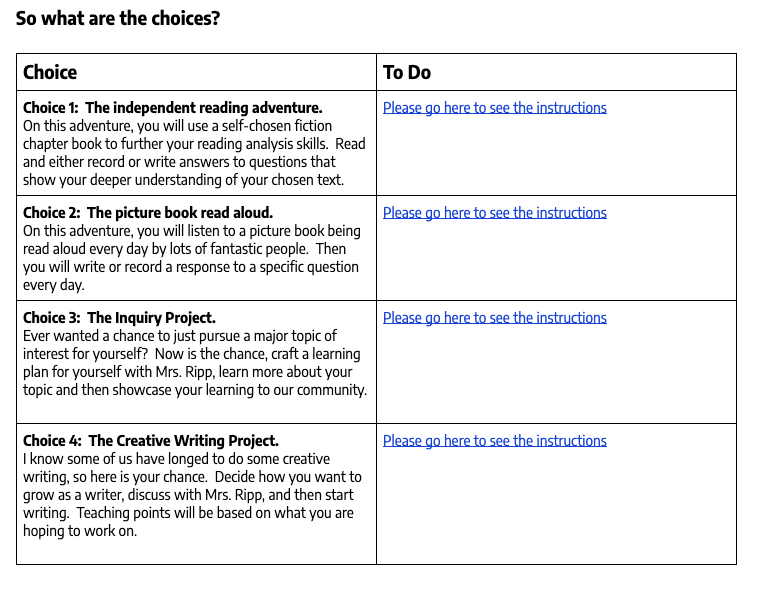
So what are the choices?
Choice 1: The independent reading adventure.
On this adventure, you will use a self-chosen fiction chapter book to further your reading analysis skills. Read and either record or write answers to questions that show your deeper understanding of your chosen text.
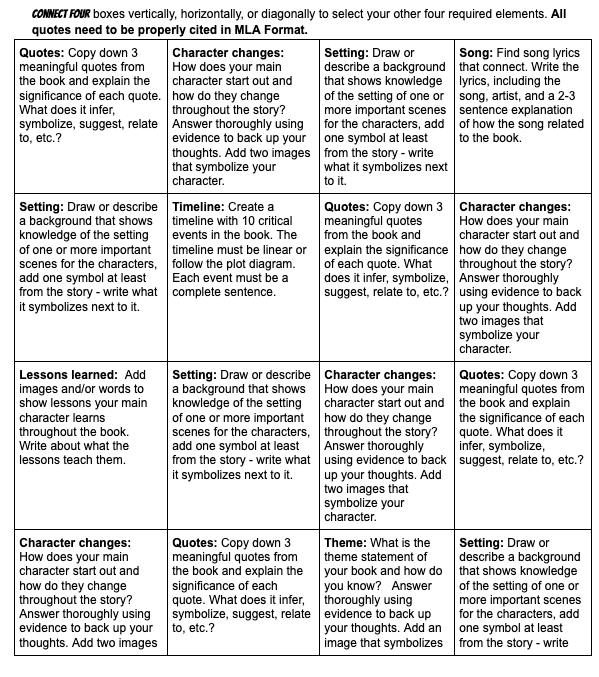
Students are given a choice board where they select 4 “boxes” to do with their book. Every box has a video to help them in case they are stuck. These are mostly lessons from me so if you use this, i would encourage you to make your own lessons for your students using language that is familiar to them.
This used to be a much more art-based project, I modified it to fit a written response, only because I am not sure if kids will have access to art materials. However, kids can still choose to illustrate and use art to answer their selected questions. All of the questions are review, so we have done this work before but they get to practice by applying it to a new book. This was inspired by the one-pager project, my colleague does and I am grateful for her work.
This required more independence from students then I think some realized and so a tweak I have made for the second round is that students need to check in once a week with me to discuss their progress.
To see the overall directions for teachers and for students to make their choice, go here
To see what students are given to do the project, go here
Choice 2: The picture book read aloud.
On this adventure, you will listen to a picture book being read aloud every day by lots of fantastic people. Then you will write or record a response to a specific question every day.
This was a popular choice the first round because a lot of students felt it was easy to manage; listen to one picture book read aloud, write a response a day. I love it because it honors the picture book read alouds we have done throughout the year, and it allowed me to gather fantastic picture book read alouds that have been shared. I tried to make sure that all choices here are following fair use and copyright guidelines as I do not want to harm any of the creators whose work is being shared. Sample questions can be seen below and the rest is found in the links.
To see the overall directions for teachers and for students to make their choice, go here
To see what students are given to do the project, go here
Choice 3: The Inquiry Project.
Ever wanted a chance to just pursue a major topic of interest for yourself? Now is the chance, craft a learning plan for yourself with Mrs. Ripp, learn more about your topic and then showcase your learning to our community.The students who chose this in the first round, really liked it and said this was easier than they thought, so don’t be afraid to try this project.
Project requirement:
Identify an inquiry question you want to pursue – remember, inquiry questions are not straight “Googleable,” they will need learning from many sources or experiences to answer.
Fill in the learning plan to show what you will be learning and how you will challenge yourself.
Do the learning on your own, checking in with Mrs. Ripp every week virtually.
Create a product of your choice to showcase your learning – you have many choices of what to create.
Independence expectations:
This is a project that will require discipline and focus. Because you will not be creating a day-to-day product, you are expected to produce a larger final learning product to share your learning.
The inquiry question you choose to pursue can be one that you already know something about or one that you know very little about, it is up to you.
There should be NEW learning though that happens throughout, not just a summary of what you already knew.
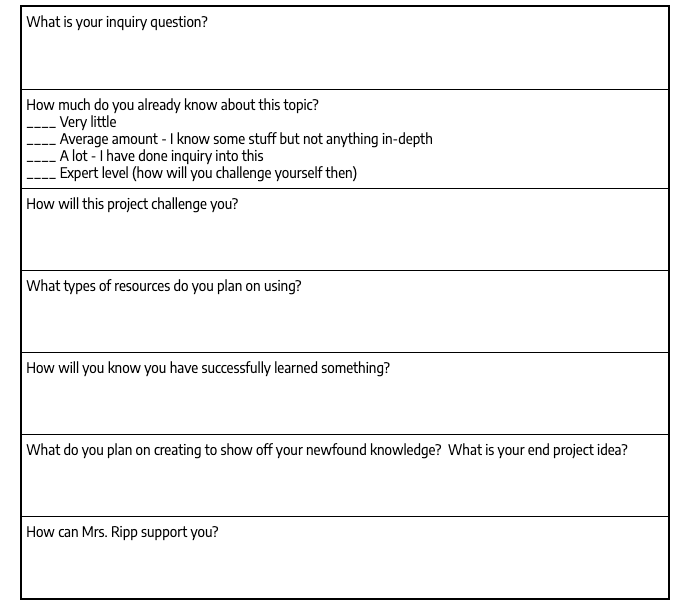
Students will be asked to do a learning plan, so I can support them if they choose this project. It looks like this:
We have done two other inquiry projects so I have seen students navigate this before, I am hoping this will give kids a chance to explore what they would like to explore rather than all of their learning choices being dictated by adults. The few students that chose this the first round loved it and I hope their enthusiam gives other students a chance to try it as well. It was wonderful to see students immersed in learning that they chose again and also thinking about how to showcase it in a way that they may not have used before.
To see the overall directions for teachers and for students to make their choice, go here
To see what students are given to do the project, go here
Choice 4: The Creative Writing Project.
Have a story to tell? Here is your chance to use dedicated time in English to pursue your own writing craft and put some of those sweet writing moves you have been working on into action. Decide how you want to grow as a writer, discuss with Mrs. Ripp, and then start writing. Teaching points will be based on what you are hoping to work on.
The few kids that chose this loved it. They loved the choice in lessons and the feedback that allowed them to write something meaningful to them. To help with lessons, students are given a video bank of lessons that they can choose from every day, as well as the option to find their own lessons and post those. They are asked to create a daily writing lesson plan so that I can see they are working. The once a week check-ins worked well as well because they were just like the writing conferences we would have in class.
Project requirement:
Identify your areas of strength as a writer – what do you already do well in writing?
Identify areas of growth in writing for yourself – how will this project challenge you?
Actively work on those areas of growth through independent study of craft techniques and conferring with Mrs. Ripp.
Choices:
If a mini-story: Produce 2 or more pages of a full story.
If a longer story (part of a larger piece): Produce a scene or chapter from beginning to end.
If poetry: 5 or more poems or a short story in prose form.
If a graphic novel or comic strips: Discuss with Mrs. Ripp
Schedule a conferring time with Mrs. Ripp each week – that is twice over the two weeks. These will be via Google Meet.
Independence expectations:
This is a project that will require a lot of discipline and focus. Because you will not be creating a day-to-day product, you are expected to produce a larger final learning product to share your learning.
The creative writing project you pursue should be meaningful to you and show growth in your writing tools.
There should be NEW learning that happens throughout, not just a summary of the skills you already have.
You will need to fill in a learning plan and submit it to Mrs. Ripp for approval. It will be posted in Classroom.
Those who chose it loved it but some chose to do poetry rather than story writing so I added some guidelines for that. I also added videos that were shared by students to our daily lesson video bank.
To see the overall directions for teachers and for students to make their choice, go here
To see what students are given to do the project, go here
Choice 5: Daily Writing Exercises.
Have you wanted to expand your writing techniques and craft? Here is your chance to be introduced to a new writing exercise a day and then trying it in your own writing.
Project requirement:
Watch the video posted for each day (preview in the table below)
Respond either in typing in the box or by submitting an image of your writer’s notebook if you are handwriting.
You will be given a separate document to record your answer in, this is what you will turn in.
I spent time pulling together ideas for stand alone writing exercises and am incredibly grateful to Amy Ludwig VanDerWater for sharing her daily writing exercises, as well as other resources out there.
I wanted this opportunity to be a way for kids to just have some fun with writing and also have a project that mirrored the manageability of the picture book choice, allowing them do one thing a day and not having to attend to a longer project. I am excited to see how this one will play out.
To see the overall directions for teachers and for students to make their choice, go here
To see what students are given to do the project, go here
A note on choices: Students will indicate their choice on the survey form – this will offer me a pathway forward so that I can send the proper resources to them. Because Google Classroom allows me to only give certain things to certain kids, I can easily provide them the next steps in their choices such as learning plans or other tools. I am encouraging them to choose something else than what they did the first round but have already discussed with one student who would like to continue working on their story. There will be exceptions made as needed in order to make sure this is meaningful to all kids.
A note on grades: You may have noticed that these projects encompass different standards, this is okay because both of these. rounds will be counted toward the same standards. I have also decided that if a child shows any kind of effort then it is an automatic “3” or higher. This is not the time for me to do deep assessment because all I am assessing then is their access to the learning, it is not fair to students, there are way too many inequities playing out for me to pretend that grades would be fair or objective. As far as if a child does not “show effort” then I will be reaching out and discussing with them.
A note on support: I will be individualizing support for my students. For some this will mean just check-ins, for others it will be sharing further resources for their learning. Most kids were successful the first round, some were not, so I will adjust support accordingly. I also have support from an incredible special ed teacher, as well as para educators that I can ask for help from.
If you are wondering where I will be in the coming year or would like to have me speak, please see this page. I offer up workshops and presentations both live and virtually that are based on the work I do with my own students as we pursue engaging, personalized, and independent learning opportunities.I also write more about the design of my classroom and how to give control of their learning back to students in my first book, Passionate Learners.
Yes, you may adapt this to fit your own needs, but please give credit and also do not adapt it to sell it online or in any way benefit financially beyond your salary as an educator.
In yesterday’s post, I mentioned how I wanted to honor the work we have already been doing in our community as we switch to virtual learning starting next week. Because this shut down of our school does not come with an end date at the moment, I am pacing out instruction by weeks rather than days. If we go back sooner than I expect, which would be incredible, then I can switch this particular project to in-class as well.
We were also given guidelines yesterday from our district; plan for about 35 minutes of learning time for each class, I have a double block but am trying to keep it to around that time still, instead with the extra time, I am hoping kids will find the time to read. Kids are not expected to sit in front of a computer all day. We have guidelines in place for making sure kids are connected to us with virtual office hours. We also need to check in if we are not hearing from kids or seeing them do any learning. We are trying to think of things we cannot even think of yet.
We are trying to keep it relevant, accessible, and not overwhelming.
We are trying to help kids continue their learning even when we are not right there with them.
So, for our students, I have created a “Choose Your Own Learning” two-week exploration. This, hopefully, continues the honoring of their individual needs and desires, while still helping them with their growth. There are different levels of independence for them to choose from, as well as choices for recording or writing their responses. There are different levels of teaching involved that will unfold once they select their choice.
From a longer letter welcoming kids into our project
Choice 1: The independent reading adventure.
On this adventure, you will use a self-chosen fiction chapter book to further your reading analysis skills. Read and either record or write answers to questions that show your deeper understanding of your chosen text.
The connect-four template we use for this.
This used to be a much more art-based project, I modified it to fit a written response, only because I am not sure if kids will have access to art materials. However, kids can still choose to illustrate and use art to answer their selected questions. All of the questions are review, so we have done this work before but they get to practice by applying it to a new book. This was inspired by the one-pager project, my colleague does and I am grateful for her work. To see the project guidelines, go here.
Choice 2: The picture book read aloud.
On this adventure, you will listen to a picture book being read aloud every day by lots of fantastic people. Then you will write or record a response to a specific question every day.
I wanted to honor the picture book read alouds we have done throughout the year, so I gathered picture book recordings for the students to listen to – one a day – and then created questions to go with it such as the one below.
While I love all of the picture books I am finding, I am still changing some of them out to have a wider representation of creators shown. I am also still working through questions, so this document is very much a work in progress. To see the project guidelines, go here.
Choice 3: The Inquiry Project.
Ever wanted a chance to just pursue a major topic of interest for yourself? Now is the chance, craft a learning plan for yourself with Mrs. Ripp, learn more about your topic and then showcase your learning to our community.
Project requirement:
Identity an inquiry question you want to pursue – remember, inquiry questions are not straight “Googleable,” they will need learning from many sources or experiences to answer.
Fill in the learning plan to show what you will be learning and how you will challenge yourself.
Do the learning on your own, checking in with Mrs. Ripp every two days.
Create a product of your choice to showcase your learning – you have many choices of what to create.
Independence expectations:
This is a project that will require a lot of discipline and focus. Because you will not be creating a day-to-day product, you are expected to produce a larger final learning product to share your learning.
The inquiry question you choose to pursue can be one that you already know something about or one that you know very little about, it is up to you.
There should be NEW learning though that happens throughout, not just a summary of what you already knew.
Students will be asked to do a learning plan, so I can support them if they choose this project. It looks like this:
We have done two other inquiry projects so I have seen students navigate this before, I am hoping this will give kids a chance to explore what they would like to explore rather than all of their learning choices being dictated by adults . To see the project guidelines, go here.
Choice 4: The Creative Writing Project.
I know some of us have longed to do some creative writing, so here is your chance. Decide how you want to grow as a writer, discuss with Mrs. Ripp, and then start writing. Teaching points will be based on what you are hoping to work on.
Project requirement:
Identify your areas of strength as a writer – what do you already do well in writing?
Identify areas of growth in writing for yourself – how will this project challenge you?
Actively work on those areas of growth through independent study of craft techniques and conferring with Mrs. Ripp.
Produce 2 or more pages in a coherent writing form, you choose the writing form.
Schedule 2 conferring times with Mrs. Ripp each week – that is 4 times over the two weeks. These can be via Google meet, email discussion, chat, or some other mode of communication.
Independence expectations:
This is a project that will require a lot of discipline and focus. Because you will not be creating a day-to-day product, you are expected to produce a larger final learning product to share your learning.
The creative writing project you pursue should be meaningful to you and show growth in your writing tools.
There should be NEW learning though that happens throughout, not just a summary of the skills you already have.
We have done creative writing in small spurts throughout the year but not enough in my opinion, so this is our chance to do it more. I am hoping this will offer up those who choose it a way to sink into their writing and create something meaningful. To see the project guidelines, go here.
A note on choices: Students will indicate their choice on a survey form – this will offer me a pathway forward so that I can send the proper resources to them. Because Google Classroom allows me to only give certain things to certain kids, I can easily provide them the next steps in their choices such as learning plans or other tools.
A note on grades: You may have noticed that these projects encompass different standards, this is okay because all of the work we are doing right now is formative as per our district guidelines. As the closing continues, we will be given updated guidelines. What this means is that when the two weeks are over for this project, I will either recycle the options and ask students to choose a different option or brainstorm further learning with my students. If we switch to live school in the middle, then once this project is done we will go back to our regular scheduled learning, which is debates and Shark Tank presentations.
A note on support: I will be individualizing support for my students. For some this will mean just check-ins, for others it will be sharing further resources for their learning. I teach 76 students, I am not sure how this will look, but we will make it work.
Want to connect with me? I am going to do a Facebook live in the upcoming week in our Passionate Readers Facebook group to take questions and share book recommendations. Join me!
If you are wondering where I will be in the coming year or would like to have me speak, please see this page.




 Pernille Ripp