aha moment, Be the change, being a teacher, books, change, Literacy, Reading, student choice, Student Engagement

So You Teach a Whole Class Novel – A Small Idea to Help

http---www.pixteller.com-pdata-t-l-296897.jpg

I spend too many hours thinking of my students love (or lack of love) of reading.  Of how the things that we do together hopefully is enough to sustain that love for words.  That this year is another part of their journey as readers, as humans who know that reading can unlock the powers of the universe.  And so I think of what is ahead.  Of whether they are truly “Wild readers” to quote Donalyn Miller.  Whether they have the stamina they need to be successful in college to quote Penny Kittle.  And whether the type of literacy instruction they will receive in the years to come will allow them to continue to love books.  To still read something that they choose.  To still see themselves as children who read for fun, not by force.

Today, as I sat next to a friend who teaches high school English, we discussed the concept of the whole class novel.  Something I have opened up for discussion here.  There are districts that mandate that the whole class novel is used for all students, no matter their comprehension ability, which is another blog post in itself, and yet, it reminds me that not everyone works in an environment that trusts its teachers to teach all students, no matter their ability.

So if you teach the whole class novel, whether by choice or force, there is a very little tweak that may make it accessible to all students.  Because if we want the whole class novel to be a vessel for deeper literature conversation and yet we have students who cannot access the text, then we must find a way for them to be successful.  The idea is simple, really.  Create different pathways to access the text by allowing students to select which method they will use.  Those pathways can be:

  1. I choose to read it on my own, ready to come to discussion.  This is the most common pathway of doing a whole class novel but it cannot be the only one.  Think of how many students where this act would be impossible.  Where they would rather defiantly not read then even try.
  2. I choose to read the book with a partner and we discuss as we read.  Sometimes when we struggle all we need is a trusted adviser to bring us through the hard parts.  We see this happen in our classrooms all of the time; students reaching out for help, and then going to back to their task renewed.  Why not let them do that formally?
  3. I choose to have it read aloud with the teacher in a small group.   Sometimes we need an adult voice to carry students through, other times you just need a community of readers to help you process the text, let alone the finer nuances behind the words.  Having a teacher at the helm and making it a read aloud means that it has no longer become an exercise of decoding, but rather one of comprehension.
  4. I choose to listen to the text.  I know some frown upon the use of audio books in our literacy classrooms, but they can be the game changer for some of our most disillusioned non-reading students.  If our goal is to use a whole class novel for students to think deeply about a text, then why not remove the barrier of the text itself?  If a child cannot read a text then the instruction of how to read it should happen with a text that they can access, not something that is far beyond their current skill level.

That’s it really.  Offering student choice in how they access the learning we must do, allows them to find success even within the most mandated curriculum.  We must remember our task at hand; to have rich discussion, so let’s make sure that all of our students can be a part of that, not just the ones that have mastered the act of reading at a certain level.

If you like what you read here, consider reading my book Passionate Learners – How to Engage and Empower Your Students.  Also, if you are wondering where I will be in the coming year or would like to have me speak, please see this page.

Be the change, being a teacher, being me

29,015 Reasons Why My Ego May Get Too Big

29,015

My Twitter follower number as of this morning at 5 AM.

29,015 people around the world who are not all people I know.  Who are not all my mother.  I have not paid for those followers.  I have not asked people to follow me.  I have not used a service nor any strategies to get that many.  I have, however, been tweeting for 6 years.

29,015 people read what I tweet.  That is a good sized town.

29,015 people care about me and my words.  Or so it seems from the number.

29,015 people and I know why it is easy to get a big head.  My students tell me I am famous.  I laugh and tell them I am “Googleable” and that there is a big difference.  And yet, in their eyes I carry power.  In some other people’s eyes, my words seem to matter more because look at how many people follow me.  Surely they cannot be wrong.

Yet, that number does not tell the whole truth.  That number easily inflates an ego, makes you think somehow that your words or ideas are more important than someone who does not have as big of a reach.  That you cannot make mistakes.  That the world is indeed a stage and all of those others are an audience waiting for your wisdom.

That little number, or likes, or favorites, or shares or whichever tool that can now seemingly measure our influence can really mess with our own sense of self importance.  And I see it happen, I see people create a divide of those who have many followers and those who have not.  As if a large number of followers somehow makes you a better human being.  A better educator. As if your words should carry more power because they have a larger audience.  That because you are connected and people respond to you, you are better than the teacher who is not connected, or who is not at your level of reach.

It is so easy to lose sight of what it really means.  I see people use their platform to promote themselves rather than keep it about the kids.  I see lines of popularity drawn in the sand, conversations not being had because we do not want to bother someone who seems more important.  I see hurt feelings, misunderstandings, and completely forgetting why we got on Twitter in the first place; the kids.  The chance to make the world better.  The chance to become better.  As if once you reach a certain follower count, you have somehow figured it all out.

But the truth is, we are not as important as our follower count can make us feel.

We are not better.  We are not perfect, nor are we always right.  We do not know all of the answers on how to solve education.  On how to be the best teachers.  We have ideas, yes, we have thoughts, yes, but we also need to remember that our words only matter if they help kids.

29,015 – writing the number makes me cringe.  Because it is not about that but others may say it is.  That I am important, because all of those followers cannot be wrong.  I am humbled by the trust that others put in me and reminded of why I tweet.  It is not to get a book deal, a speaking gig, a trending hashtag, or anything else that may be bestowed upon some with large follower counts.  I tweet, write, connect  because I realized that I could not keep on teaching the way I had and I needed to find others who could hep me.  And I found them and I am finding them as I grow.

I wish our counts were private, then perhaps we would all go back to feeling equal.  Then perhaps we wouldn’t think that we somehow deserved more attention than others.   Perhaps we can pretend and remember that we are all just educators trying to make a difference for the very children we teach.  And that is the real reason I connect.


aha moment, Be the change, being a student, being a teacher, being me, student voice

Enough with the Teacher Talk- Ideas for Getting More Student Talk

http---www.pixteller.com-pdata-t-l-295428.jpg

“I wish you would talk less…”

The comment smacks me in the face over and over as I read my 6th hour students’ feedback for the semester..  At first, I think they must be forgetting how little I speak.  How much work time I give them.  How they clearly must be wrong, because I am the queen of not speaking much.

Yet, that very next day I realize that they are right.  As I teach my 6th hour, the one right after lunch, I see how much longer I take to get directions.  How much more information I give them.  How my brain seems to work a little slower right after lunch and I am talking myself back into the lesson.  At the expense of their time.  At the expense of their attention span.  And their eyes glaze over so I speak more to get them excited  It’s a vicious cycle.

And I am not the only one speaking too much.  As I do workshops on student engagement, I keep adding m0re and more research on teacher talk versus student talk.  The research is startling; according to John Hattie teachers ask between 200 and 300 questions a day, whereas most students ask 2. 2...And those questions are typically clarification questions.

Teachers dominate classroom talk speaking anywhere between 60% to 75% of the time.  That means in an average 45 minute English class, the teacher may lead the conversation an average of 27 to 33 minutes, leaving little time for most students to speak.  And while I know I do not speak that much in any class, unless we are learning an entirely new concept, I also know that most of us think we speak a lot less than we actually do.  And I also know that the more my students seem disengaged, the louder I speak.

So what can be done to limit teacher talk.  To create an environment where students have a much bigger chance to discuss and explore?  Where every child has a voice and someone to hear it?

Own your talking.  Like I said, I thought I was quick to get to the point, apparently not.   If we won’t acknowledge that we talk too much we won’t see an impetus for change.  And if you are not sure, ask your students.

Set a timer.  I generally allow myself 10 minutes to teach a concept leaving 25 minutes for the students to work and me to do one-to-one or small group instruction (25 minutes because we start with 10 minutes of independent reading).  I thought I was pretty good at keeping it to 10 minutes but my surveys are telling me otherwise.  Time to pull the timer out again.

Have students answer in a group.  Too often, we rely on the call out question and answer, which is not the type of talk we should be trying to generate since it only allows one student to speak.  I often have students give their answers in their table groups instead and then have them share out.  I find that it opens up the classroom for much deeper discussions since many students become invested in the conversation, and it also means that students who may have been confused get a chance to try out some ideas or unscramble their thoughts.  Turn and talk also works for this.  Circulate instead and pick up on their answers that way.

Avoid the echo.  The best advice I received my first year as a teacher was to stop echoing student answers back to them and yet, I still catch myself doing it every now and again.  Our job is not to be the voice of the classroom, it is to give students a way to be the voice.  So when a child gives an answer do not repeat it, if the class did not hear it then have them ask for it to be repeated.

Change your questions.  No more call and response, instead have open-ended questions that will lead to a discussion. I know this, yet I forget at times, I will therefore be writing some big questions down on a post-it to remind me.

Just ask the question.  Too often when we ask a question, it becomes a long rambling sentence filled with anecdotes and extra information.  Yet this ends up confusing students more and we then have to repeat the question.  So get to the point and then add afterwards for those students who need it.

Stop the unnecessary repetitions.  How often do we teach to the students who do not get it rather than assume that most will?  So rather than over-explain, state the instructions and then head over and check in with those students who may not have understood.  Think of how often we explain more than necessary because we are worried that a few students may not get it while the others have?  Stop explaining so much and teach instead to those that do need it.

Stop interrupting.  How many read alouds have we interrupted to ask just one more question?  How many times have students been in the zone working and we have borken their concentration to do a quick check-in.  I think I do it because that looks like teaching to me; a busy teacher asking lots of questions.  Find the right time to interrupt, enjoy your read aloud rather than constantly model what you are thinking.  Limit it to the very best things so that students can reach a state of flow more often.

Be mentally ready after a break.  The hour that told me I spoke the most is the one right after lunch, where my brain has had a nice break and I feel more relaxed.  Yet, I often enter the classroom right when my students enter and then launch into class.  Get your brain woken up by revisiting (mentally or on paper) your main points of instructions.  Take a few minutes to wake yourself up so that you are back in teaching mode, because when we don’t we end up rambling.

Encourage student talk.  By emphasizing the importance of students speaking up, asking questions, discussing and dissecting, we can create communities where all students are heard, where all voices are part of the learning.  My amazing principal, Shannon Anderson, gave me the idea of giving each child two markers that they use when they want to speak.  All students need to have used a marker in the group before they can use their second one.  While I have not tried this yet, I want to try it for book club discussions to make sure all students feel they can speak and that not one voice dominates the conversations.

As little as we think we speak, I think it is vital to take the pulse of our classrooms every now and again.  We would all like to think that our words are dripping wisdom, but how often do we ramble on when students are ready to work?  So check yourself and your talk, ask your students, and then change your ways.  I never want to be main voice of the classroom, none of us do, but it takes changing our deep-seated ways to truly change it.  We can create classrooms filled with passionate learners but to do it, students have to have a voice.

If you like what you read here, consider reading my book Passionate Learners – How to Engage and Empower Your Students.  Also, if you are wondering where I will be in the coming year or would like to have me speak, please see this page.


aha moment, Be the change, being a teacher, challenge, global, Mieexpert

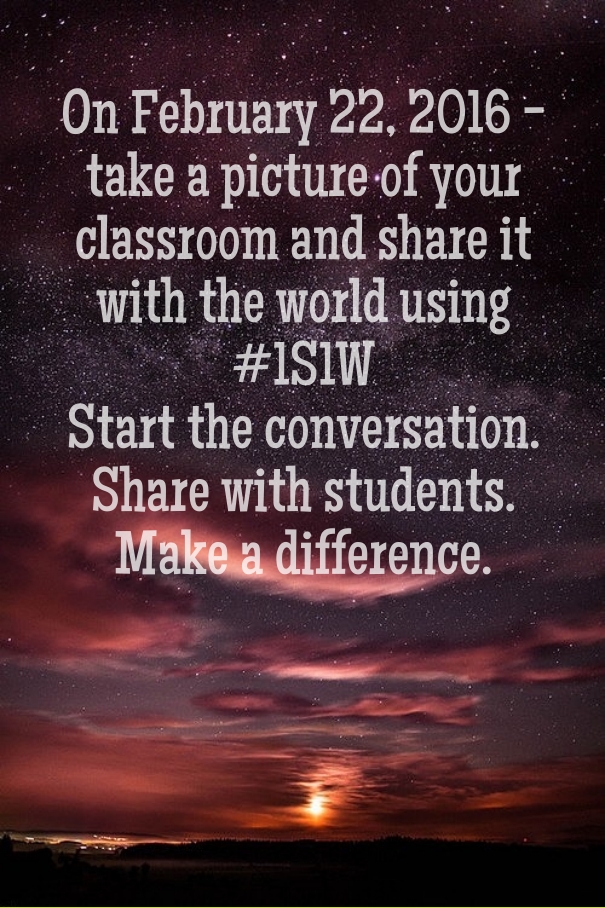
Join the 1 School 1 World Challenge Feb. 22nd #1S1W

http---www.pixteller.com-pdata-t-l-285131.jpg

Last year, my 7th graders did the “Day in the life of a student” challenge and asked students around the world to join them by showcasing pictures of their typical school day.  The conversation that it sparked as far as how similar our days could be or how very different they were was profound, while also leading to some great discussions at our school about the experience students have.

Today, I shared some of the images coming out of Detroit Public Schools  and my students had a hard time understanding that this is the reality for students only 6 hours away from us.  As we sit in our heated classrooms with nice carpet, books surrounding us, and a beautiful view of a prairie, the notion that other children even in our same state may have a different school experience is one that my students do not give much thought to.

So I propose a challenge to enlighten us all.  On Monday, February 22nd take a picture, or a few, of your classroom (you don’t need to have students in the pictures), write your location and your age group and share it on Twitter using the hashtag #1S1W (it stands for 1school1world).  That day or the next start a conversation with your students about the images you see shared.  That’s it.  Think of the images we can share to start a conversation with the very children we teach about the education that surround us here in the US and in the world.

A hashtag may not make a difference but it can start a conversation.  So sign up to stay in the loop, or just join in on February 22nd as we hopefully start a global conversation about our school, our classrooms, and our future.

aha moment, balance, Be the change, being a teacher, being me

12 Ways I Got My Life Back in Balance as a Teacher

http---www.pixteller.com-pdata-t-l-283516

I get asked often how I do it all.  How do I teach full-time, have 4 children, a happy marriage, and also write, speak, and all of those other things that I am so lucky to do without losing my mind.  And the truth is; I don’t know.  There are good days where I feel like I have succeeded in most things and there are days where I feel woefully overworked.  There is definitely a chase of balance always going on.  Yet, there are some things that have simplified my teaching life that I now take for granted.  Things that used to take up a lot of time that I no longer do or have changed to allow me to not work as much as I used to.  Because the truth is; being a teacher is a never-ending job.  Your to-do list is never done.  There will always be one more thing that should get done, one more idea to try.  Knowing that, I knew I needed to change a few things, in and out of the classroom in order to save my sanity and have a life.

I stopped grading everything.  Or at the very least I stopped grading every single thing that my students created.  Kelly Gallagher inspired me to do this specifically with what they wrote but Alfie Kohn inspired me to really think about what grades communicated to my students.  The thing is when students expect a grade/score/comment on everything they do, they will never learn to create for the sake of growth (rather than a grade) and they will not become students who can actively reflect on their own learning.  When we teach in a way where the teacher has the final word on assessment we cannot create conditions for students to take ownership of their learning.  That means that students will continue to look at us to see how they did, rather than realize where on their learning journey they are.   (To see more on my moving away from grades journey, go here.)

I stopped decorating the room.  I used to spend an inordinate amount of time refreshing the room with great new bulletin board displays, changing out student work, and lining up new visuals for the students.  Yet my students never seemed to appreciate it much or even notice it.  So by student request we formed a student bulletin board committee who took charge of what they wanted to display.  Student work is no longer displayed by me, but instead shared with classrooms around the world for feedback through Google and Skype.  Anchor charts are made with the students and then removed when we do not need them.  We now relish the bare walls that surround us as we try to create an oasis of calm in the classroom.  And the time I spent on setting up the classroom to look cute is now spent on other things.

I shut the door.  At school, we have an unspoken rule that if someone’s classroom door is shut, they are busy working.  Seldom do we interrupt them during that time.  While I adore my colleagues (I  work at an amazing school with an amazing team), I also know that once we get started on stories, most of my prep will be gone and that is not fair to my own kids at home.  So whenever I have a lot to do, I shut the door and get to work.  This way the time we are actually given at  school is used better.

I wrote down 3 things.  My to-do list is usually about 10/15 items long for various things at school and home, yet when I looked at it, I always gravitated toward the easiest things to check off, leaving the longer tasks for “later.”  Now I prioritize 3 things that must get done that day and one of them has to be a “harder” task.  Once those 3 things are done for the day I can focus on anything else I can do that day.  As for the to do lists, I keep a bullet journal that I absolutely treasure.  This method of keeping track of my life has worked  well for me and has also been a great way to keep memories fresh.  I no longer feel like the to-do list in itself is another to-do.

I stopped multi-tasking.  I thought I was the queen of successful multi-tasking until I realized how little I got done.  Research has shown that our adult attention span is now 8.25 seconds ( a goldfish has 9 seconds) and I wanted to combat that with setting better work habits.  So now when I work I close all of my tabs on the computer, turn off the TV or music,  and actually focus on getting to work.

I set a timer.  I seem to have two ways of doing work; right away or a very long time from now.  And yet, I am under deadlines for writing two new books, I have projects to look at and also lessons to plan.  So now when I dread a task or feel like I am in a writing slump, I set a timer for 30 minutes.  During that entire 30 minutes I am not allowed to do anything but work, this ties in with the no multi-tasking.  The thing is with 30 minutes that anyone can spend 30 minutes on something without losing an entire evening.  That is not very long and so it tricks my brain into thinking it is manageable.  I often find when the time is up I continue working simply because I am now in a groove.

I cut down my email replies.  In these days of instant communication, we all seem to get a lot of email.  I can only imagine what administrators must get, and I often felt the need to write lengthy replies back typically with various niceties interjected.  Yet that is not efficient, to say the least, so I now go by the two-line reply rule.  If a matter needs more than 2 lines to be addressed then I either propose a phone call or a meeting.  If it is someone I can speak to at school, I try to find them at some point to discuss, and if it does need a lengthier reply then I wait until I have the time to write it well.  I also try to be cognizant of how many emails I send in a day; are they really needed or can a quick phone call or face to face conversation handle it instead?

I stopped planning the whole lesson.  Now when I plan, I plan the initial steps and then discuss with my students as we flesh out the plan for the long run.  This means that they have input, leading to better buy in, and it also means that it becomes more personalized.  Planning with my students means that I do not have to have every single little thing figured out, leaving me more time to focus on the big picture.

I got rid of my book check-out system.  Even with the advent of electronic check out systems, it was simply one more thing to manage.  Now when students want to borrow a book, they simply borrow it.  They do not have to ask, nor do they have to write it down somewhere.  The only exception is if they borrow a hard cover book, then they write their name on a post-it and stick it on the dustcover which they then hand to me.  I keep track of them until the book is handed back and the dustcover is put back on.

I stopped committing right away.   I am very good at saying yes; if you email me a request, chances are that my instant reply would be a yes.  A yes means that I can delete the email, a yes means I know what to do.  Yet a yes also meant that I now had one more thing to do.   Now instead of answering right away, I spend time mulling it over  and really think about something before I commit to it.  This may seem simple but it has been incredible for me. By not rushing to make a decision, I preserve my energy for the things that matter the most to me.  I do not feel guilty when I have to say no because that means I get more time with my own kids.  And when I do actually say yes to something, it means I am excited to do it.  I use this approach for almost all requests that come to me, big or small.

I stopped trying every new idea.   I used to think that to be an innovative teacher I had to try every new big idea that was presented to me.  Yet, that just means that you work a lot more on things that may not fit into the vision you have.  Now, I pick and choose, I do not feel guilty that I have not gamified our classroom or created a makerspace.  We do things in a way that works for us.  That doesn’t mean I am apposed to new ideas just that I know to only pick a few and to try them out when I can.  The same goes for technology; I would rather pick a few tools to use a year and use them well then try many new ones and not know them.

I removed apps from my phone.  I removed email notifications and certain apps like Facebook and Twitter off of my phone last tear and I have not missed them.  I did not realize how much time I was spending checking in mindlessly.  I felt like I was always on, because I was.  Now when I check my email I am cognizant of the time I am using, the same goes for anythig with social media.  My own children and those I teach deserve me to be present, and I cannot be if I am constantly drawn to the ding of my phone.

Awhile ago, I wrote a post on how balance is much like a unicorn; wonderful to imagine even though it doesn’t exist.  And while I still believe that to be true, I do know that there are better ways to balance being a teacher and everything else.  So what have you done to reclaim your life from your constant to-do?

PS:  My friend Angela Watson is a master at reclaiming work time, I have much to learn from her.

If you like what you read here, consider reading my book Passionate Learners – How to Engage and Empower Your Students.  Also, if you are wondering where I will be in the coming year or would like to have me speak, please see this page.

Be the change, being a teacher, being me, new year

Do Something

http---www.pixteller.com-pdata-t-l-267255.jpg

I have always loved December 31st, the last day of the year, our oldest daughter’s birthday.  While the promise of a new year lies ahead, the old is not quite finished, not quite over and the wonder of it all hits me.  Look at all that has happened in the past year.  Look at all we have done.

And yet, there is so much still out there to accomplish.  So many changes.  So many choices to make.  Because too often we sit back and wait for others to decide, we wait for others to fix, to mend, to invent, and to create.  We wait for others to share their ideas because we are unsure of our own.  We think to ourselves, “if only…” but the words never leave our mouths.  And it’s a waste.  It is a shame.  It is our own fault that we wonder what change could really look like, what our ideas may become, when we choose to remain unsure.  When we choose to remain silent.

So my wish for the new year is a simple one; do something.  Something to make it better.  Something to make it worth more.  Don’t sit there and wait while others do, change the world yourself.  Find your comfort zone and take a small step out.

Be the change.  Be the voice.  Be the person that does.  I know I am going to try.

If you are looking for a great book club to join to re-energize you in January, consider the Passionate Learners book club on Facebook.  We kick off January 10th.