books, Literacy, Passion, picture books

My Final List of Favorite Picture Books for the Coming Year

A final post on some new favorite picture books before the year kicks off officially tomorrow.  I just received my final batch due to a grant from the Meemic Foundation who thought it was a delightful idea to purchase picture books for 7th graders.  (They have a ton of grants that are easy to write, you should totally check them out).  So without further ado, what shall we be exploring together in the coming weeks and months.

I have long been a loud fan of Bob Shea’s for a long time.  After all, he is the genius that wrote Unicorn Thinks He’s Pretty Great so I had to get Ballet Cat The Totally Secret Secret.  It is laugh out loud funny.  And the best part is that I can completely relate to the story and so will my students.  Plus this will be perfect for acting out when we act out picture books at the end of the year.  Is it bad if I have started the countdown for the next book to come out in February?

We are the shark team at our school so when a fellow picture book lover suggested I get this non-fiction picture book called Neighborhood Sharks by Katherine Roy I was sold.  Warning; this is a real book about sharks, and they eat seals, so your 6 year old may be slightly terrified.  I love the set up of this book and like I said, the illustrations are magnificent.  What an amazing way to marry facts and picture book.

I can always count on Jillian Heise for having great recommendations for picture books and this one was one of them.  Marilyn’s Monster by Michelle Knudsen is one I think many of my students will gravitate toward with its quiet message.  I know I will e using it to facilitate deeper conversations about finding our own path in the world.

Another great recommendation from fellow picture book lovers was Shaun Tan’s Rules of Summer.  This is one of those picture books I cannot wait for my students to read because I want to see their interpretation of it.  The illustrations and the text beckon you to wonder, and that is a great thing indeed.

Wild About Us by Karen Beaumont is a beautiful book in many ways.  The illustrations done by Janet Stevens pop off the page and catch your eye, but the message of the book is what really got me.  We all have things that we can pick apart, but what we do with those things is what matters.

Just finding the image of the cover of I’m Trying to Love Spiders by Bethany Barton makes me laugh.  Again an incredible non-fiction picture book that doesn’t scream non-fiction (not that there is anything wrong with non-fiction).  We read this a few times at home and then told everyone about it.  I cannot wait to see my students reaction to this book because you have to allow yourself to get a little bit silly.

Much to my surprise I was able to pick up a copy of Elwood Bigfoot Wanted:  Birdie Friends by Jill Esbaum before its supposed release date.  I love this message of the story, especially as a way to discuss with kids about what we do to try to fit in.  And let’s admit it; Elwood is a really cute and funny Bigfoot.

Boats for Papa by Jessica Bagley is one that I am looking forward to reading and sharing with my students.  The simple story is one that many of my students can relate to as well as the ambiguity of the situation.  I love how this will help us discuss and understand that there are many correct interpretations of a story.

I happen to be a fan of both Mac Barnett and Patrick McDonnell so it was only natural that I added The Skunk to our collection.  I cannot wait for the discussion of how we make decisions and how little things can affect our life in a big way.

To see the lists from this summer and other years, make sure you go here.

If you like what you read here, consider reading my book Passionate Learners – How to Engage and Empower Your Students.  The 2nd edition and actual book-book (not just e-book!) comes out September 22nd from Routledge, but rumor has it that it is out on Kindle already!

being a teacher, books, community, inspiration, Literacy, Passion

How I Select A Picture Book For Our Classroom

Yesterday a new student wandered into our classroom with his parent and younger siblings; locker drop off was happening in preparation for the first day of school.  As I looked up something for him, I heard them excitedly talk about the books in our room.  “Here’s that one that you wanted to read…Oh, do you remember this series….”  And then they saw the picture books.  After all, they are hard to miss.  Right away the comments came, “Oh, I loved this one…”  “Have you seen this one, that looks fun…”  And so forth and I smiled ever so wide, because picture books once again have proven to be a way to connect in our classroom.

But how do you pick the right ones for your classroom?  How do you know which ones to get?  I make lists, as do many others, but how do I even know which to put on the list?  I thought a few helpful tips may be in order.

I am connected.  I am a proud member of the Nerdy Book Club and through Twitter  I am connected to many picture book loving people; teachers, librarians, parents, and all of the other amazing people out there.  I follow hashtags like #Titletalk, #pb10for10 and #nerdybookclub to stay in the know.  And I tweet out asking for recommendations all of the time.

I keep a written list handy.  I have a journal book with me at all times, and while I often add books to my wishlist on Amazon, I like having the list in my bag.  I am always adding to it and will cross out as I either purchase or reject.  This also makes it easy for me to recommend books to others that they may not know about.

I read them beforehand, most of the time.  Many times we will wander to the nearest book store so that I can  browse the books before purchasing them.  How do I know that this will be a great one for our room, well there are few things I look for…

Do I react to it in any way?  A picture book doesn’t always have to have a deep message for me to react to it; was it funny, did it make me think, did it leave me with questions?  All of these are things that I look for.

Is it easy to follow?  Sometimes it takes more than one read to really get a book and while I love those books too, most of the time, I am looking for a book that my students will get rather quickly.  At least most of them.  However, I do purchase picture books to use with smaller groups that have layers we can peel away.

Is the language accessible?  Yes, I teach 7th graders but their reading development levels ranges from 2nd grade to high school, so can all students access the text or will I need to “translate” it?

What purpose does it have?  I often look for picture books that can be used as community builders, self connections, or conversation starters.  We also use them as mentor texts as we develop as readers and writers throughout the year.  But I also look for picture books that will make my students laugh, make them reconnect with being a little kid again, or help them get out of a bad mood.  I try to get a balance of all of these types of books in the hands of students.

Will we read it more than once?  Because I buy most of the picture books in my classroom, I look for enduring books that we will return to again and again.  Different things make books repeat reads; the illustrations, the phrasing, the story.  Bottom-line: it is a gut feeling most of the time.

Do we have other works by the author?  My students feel closely connected to the picture book authors and illustrators whose books we love so I try to expand our favorite collections as often as possible.  Some of our favorites are Mo Willems, Peter H. Reynolds, Ame Dyckman, Jon Klassen, and Amy Krouse Rosenthal.

Sometimes I just take a chance on a book.  Sometimes I have no rhyme or reason for  what I bring in other than a small feeling that some kid at some point will connect with it.  I never know which picture book my students will love, so sometimes I just sit back and let them explore and then pay closely attention.  Then I go out and get more of those.

And, of course, I cannot write a post discussing picture books without sharing a few of my new favorites or ones that I cannot wait to get.

Laugh out loud funny, The Pretty, Pretty Bunny by Dave Horowitz is in my first day pile for kids to choose from.

The Promise by Nicola Davies is a beautiful tale of making a difference.  This would also be great for a science classroom.

I cannot wait to get Finding Winnie – The True Story of the World’s Most Famous Bear by Lindsay Mattick.  I wonder how many students will love this tale of the real Winnie the Pooh.

Why do I have a feeling that Elwood Bigfoot: Wanted: Birdie Friends by Jill Esbaum will become a favorite of my students?

Picture books are a part of our tapestry and something that I am proud we use in our middle school.  I hope being vocal about the benefit of using picture books with older students will help others take the jump.  I got to discuss more of this in this article here.  

If you like what you read here, consider reading my book Passionate Learners – How to Engage and Empower Your Students.  The 2nd edition and actual book-book (not just e-book!) comes out September 22nd from Routledge.

Be the change, being a teacher, being me, books, Passion

It Soon Becomes A Reality

Yesterday was the 22nd of August, to us a rather milestone moment, but to the rest of the world probably not so much.  You see yesterday marked the 1 month countdown to the publication of the  2nd edition of my first book Passionate Learners – How to Engage and Empower Your Students.  And while I tend to not use this blog for self promotion, I am so proud of this book and what it might offer for others, that I am breaking my own rule today.

It seems weird to think that a book is a 2nd edition, but there is a very simple reason for it.  The book is no longer owned by its original publishing company due to differing visions and Routledge purchased the rights.  They saw something in the book that made them want to print it as an actual book, release it on Amazon, and market it to the world.  Humbling…

But I didn’t want to just re-package it.  I saw this as a chance to re-write it, to add my students voices even more, and to add what I had learned now being a middle school teacher.  So it is not the same book any more, it is so much better.

This book is for those who need inspiration to change the way they teach.  This book is for those who wonder whether you can really limit homework, limit grades, and get rid of punishment and rewards within our school system.  This book is for those that feel they are doing pretty good as teachers but really need a boost, really need to bring the classroom back to the students again.  This book is for those who like me were just fine teachers but knew there had to be a better way.

So in 1 month, I will get to hold my own book in my hands.  I will get to give it to the world and hope the world responds.  My greatest hope is that one person will read it and it will help them, that my words can make someone else’s life better.  After all, isn’t that what we hope for in our classrooms every day?

PS:  If you would like to preorder the book, please use this link.

being a teacher, being me, community, new year, Passion

Confessions of a Dream Crusher

We call ourselves the dream makers, the curiosity protectors, the people who will change education from within.  We see ourselves as open-minded, always willing to change, and always looking to do what is best for students.  We come to school on those first few days with dreams spilling out of our arms.  New ideas floating around our heads as we dream of the possibilities.  As we eagerly embark on a new journey.

Yet a few weeks in and our arms seem to be empty.  The dreams gone,  reality set in, and  we think, “Well, maybe next year will be the year we change education, maybe next year these dreams will work.”

We can blame politicians for crushing our dreams.  Sometimes we can even blame administration.  But more often than not the blame lies within our own communities, our own teams, and ourselves.   After all, how quick are we to dismiss the dreams of others before we even hear them out?  How often do we think that we know better than someone else?  How often do we make it a point to share just why something will not work.  Yet, we get upset when someone dares to tell us that our dream is impossible, that our idea will never work, but forget that we say those some words to others.

We are so quick to tsk tsk other people’s new ideas.  We are so quick to jump in with our own opinions, to share our own better ideas.  To not truly listen because in our minds we have already decided that that idea will never work.  We are so quick to burst the fragile bubbles of hope that we all bring back at the beginning of a new year.  As if bringing someone down to Earth is a good thing.

And we can blame society.  We can blame standardized testing.  We can blame the Common Core.  Or we can take responsibility for how we speak to others.  For how we judge.  For how quickly we dismiss.  We can stop crushing the dreams of others.

Schools starts in 10 days.  I will not be a dream crusher anymore.  I will not be the one that says that something cannot work.  I will not be the one that discourages others.  Instead, I will be the one that says, “How can I help?”  What will you be?

If you like what you read here, consider reading my book Passionate Learners – How to Engage and Empower Your Students.  The 2nd edition and actual book-book (not just e-book!) comes out September 22nd from Routledge.

being a teacher, being me, books, Literacy, Passion, student choice

On Hating Reading

recite-1ewom0k

I have loved reading as many years as I have lived.  Reading wove its threads throughout my life, from my mother reading aloud to me every night, to learning to read English books in the lap of my now-father, biking to our public library with a plastic bag empty waiting for the books that would fill it, and now passing my love on to my own children as they beg for just one more book, every single night.

I have brought my love of reading into the classroom, cementing that in this room we are all readers.  We all spend time finding those books that will transform us.  Finding those moments where we beg for just one more page, one more minute, and hope that the teacher will give it to us.

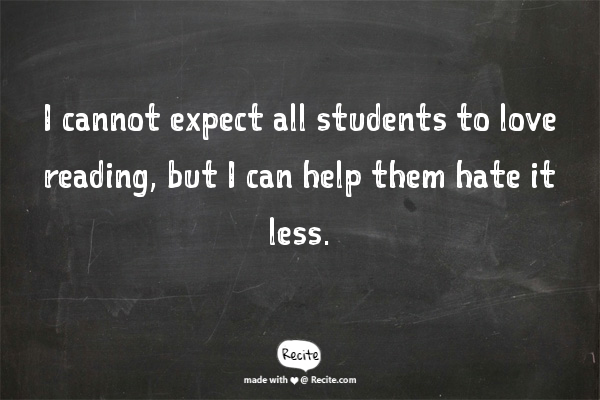
I love reading, but I do not ask all of my students to love reading.  I do not expect them to fall as madly in love with reading as I have, because if I did then I would ask them to accept the identity I have shaped for myself.  I would ask them to sometimes do something impossible.

Instead, I ask them to like it more.  To give it another chance, even if their hatred has been cemented in years of torturous reading experiences.  I make them promise me to give it a chance, a proper one, to keep their minds open as we grow throughout the year.  There are some students who will never love reading.  Who will never feel like reading is the one thing they must do every day to sustain their souls.  And yes, that makes me sad, but I also need to make sure that our classroom welcomes all students.  Even those that identify as reading haters.

So we should carry our torch for the love of reading wherever we go.  We should exude passion.  We should help each child believe that they are readers.  That books are for them.  That they too can immerse themselves in something so deeply that they almost forget to breathe.  Yet, I must remember, that if I tell a child that they must love reading, some children will rebel simply on principal.  Some children will find every reason to hate it more.  So I do not assume that all children will love reading.  I assume instead that within our short time together, I can make them hate it less.  I can change their minds, if even just a little bit.  After all, our classrooms are created by the true personalities of our students.  We must meet them where they are and help them grow on their journey.

I will never stop loving reading.  I will never stop telling my students that they are readers every single day.  Even those that don’t believe they are.  I will never stop sharing my own love of reading, but I will allow students to figure out where their emotions fall and then help them move from there.  I will see my students for who they are, even if they do not love reading. Even if I will never understand how you cannot.

If you like what you read here, consider reading my book Passionate Learners – How to Engage and Empower Your Students.  The 2nd edition and actual book-book (not just e-book!) comes out September 22nd from Routledge.

being me, Literacy, Passion, Reading, student voice

At Any Given Moment We Have the Power to Stop the Hatred of Reading

recite-io73x2

It used to astound me that my 4th graders would come to me and profess a hatred of reading.  It used to shock me to the core.  After all, these were the same kids that would ask for just one more page of our read aloud.  Who would ask me to read a picture book aloud the minute it came to our room.  Who had no problem confessing the love for the book we were sharing, but had none for the one they were reading alone.  I always thought that the next year’s teacher would surely get them on the right path even if I couldn’t.

Now I am the next year’s teacher, and their dismay of books has only grown further.  The group of children telling me that they never read outside of school has only grown.  And this is not a boy-reader problem, this is an any gender problem.  This is not something just caused by poverty, nor disengaged parents, nor reading difficulties.  I see the hatred of reading defended the most from my students who have had every opportunity to fall in love with reading.  I know I am not alone in this.  And I know I cannot wait for someone else to fix it.

So I started to dig a little deeper.  I get that they “hate” reading, but why?  What parts was it that caused so much emotion, or sometimes so little, that students would have a physical reaction to whenever we had independent reading time.  And their truths were not pretty, because the finger they pointed, pointed right at me.  Or us, as educators.

We may think that it is too easy to blame teachers for the systematic destruction of reading love in our schools, and it is, because there are forces beyond our control that have a huge part in this as well.  But part of the blame does lie with us, and that means we can do something about it.  Especially in the upper grades where reading is no longer treated as something magical, but instead merely something useful.

At any given moment, we have the power to stop ourselves from telling students what to read.  In our eagerness to shape well-rounded readers we are instead creating non-readers.  In our eagerness to make sure students are exposed to all types of books, we are limiting them from discovering their own reading identity.  Would we rather have a child that reads every single fantasy book they can come across, or a child that begrudgingly only reads a few books a year from other genres?

At any given moment, we have the power to make reading fun again.  Fun is a not a swear word in our schools.  There is nothing wrong with discovering a book that makes us laugh, or makes us wonder, or makes us think.  Reading does not always have to have a purpose.  It can be just to share a wonderful experience.

At any given moment, we have the power to stop interrupting children while we read.  To not point out every single detail.  To not have them do post-its for every thought they have.  To not have them turn-and-talk every few minutes.  Let them reach the reading zone as Nancie Atwell calls it.  And not just once in a while but most of the time.

At any given moment, we have the power to reclaim what reading should feel like in our classrooms.  To stop always using whole-class novels.  To stop furthering our own vision for what makes a reader a reader.  To stop hanging our own reading identities around the shoulders of students and wonder why it does not fit?

At any given moment, we have the power to create classrooms where reading is magical.  Where reading is celebrated.  Where reading is taught, but taught in a way that does not extinguish the love of the very thing we are trying to promote.  But we have to look at our own practices first, we have to stand up and change.  We have to ask our students what we are doing so that we can be better.  So that their love of reading does not have to survive our classrooms.  So that their hatred for reading does not have room to grow.  But it starts with us, not them.

If you like what you read here, consider reading my book Passionate Learners – How to Engage and Empower Your Students.  The 2nd edition and actual book-book (not just e-book!) comes out September 22nd from Routledge.