being a teacher, books, Literacy, Reading

How to Easily Do A Book Talk

5092270077116416.png

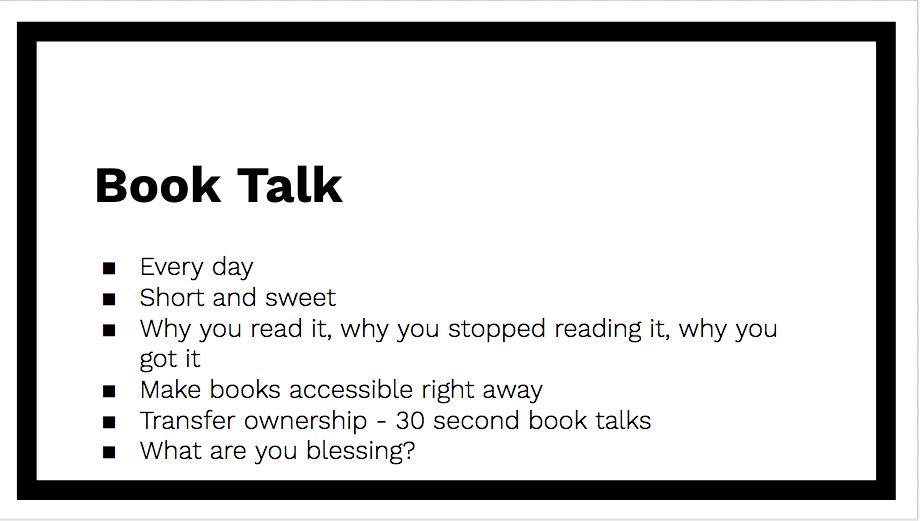
One of the pillars of our reading community is the daily book talk.  While I used to do them once in a while, I was spurred on by the wisdom of Penny Kittle to do one every single day, which I have now fully embraced for the past few years.

So in the last few years, I have done a book talk almost every single day right after we finish our independent reading.  It takes less than two minutes and is fairly simple.  I used to plan them out much more but realized that it added another level of work to my already jam-packed day and that it didn’t seem to make a difference to the students whether I did a pre-scripted one or one that was more spur of the moment.  So this is what our book talks look like now.

Preparation:

  1. Pick the text you will book talk – note this can be a chapter book, audiobook, a collection of short stories or whatever you feel like blessing as Linda Gambrell reminds us.
  2. I like to book talk a variety of new books I have read as well as older books that haven’t been discovered yet. One place I look to for inspiration is what my students have recommended in the past.
  3. Decide your angle:  Are you book talking it because you read it and it was amazing?  Because you abandoned it and need someone to prove you wrong?  Because you added it to the library but haven’t read it?
  4. Prepare your visual.  I like to project the cover of the book so that students can easily write down the tile.  I also put any genres abbreviations on the slide and whether or not is a more mature book.
  5. Have the physical book ready to hold up and hand to someone or place on a designated book talk shelf or display.

During the book talk:

  • Keep it short and sweet.  I tend to say a few sentences about the book and why I liked it/abandoned it/purchased it and then read either the first page, the inside flap or the back cover.  I love these teasers as they are already made for us.
  • Have the book ready to hand out.  The only time I break this recommendation is when I just finished a book and I want to book talk it to all of my classes.  Then I try to find extra copies beforehand, such as from our school library.
  • Students should have their to-be-read list out which is located either in their readers’ notebook or using the Goodreads app.  This is a routine expectation we start with the very first week.

Pointers:

  • Start to transfer ownership of the book talks to students fairly early on, you should not be the only one book talking a book.  I love using the 30-second book talk idea to help students become more comfortable with the format and also ensure that everyone participates.
  • If I am the one doing the book talk there is only one given, if it is students, then there can be up to three depending on their length.  Again, this is short and sweet, not the actual teaching point of the class.
  • If many students want to book talk their book, consider making it the teaching point and dedicate a lesson time for it or have them do a speech about their favorite book.
  • Keep an anchor chart or some sort of visual of which books you have book talked, not only does it provide a reminder to students about the books shared, but it also allows you to ensure that you are providing inclusive book talks that do not just fall under one genre, cultural heritage or some other category.
  • Place book talked book the same place so that students know where to find them.  We have a book tree that serves as everyone’s place to recommend books so that is where they go.
  • Check to see if there are book trailers available.  I still think the book trailer for The False Prince by Jennifer A. Nielsen has convinced more students to read the book than I ever have, and I love that book.

I have loved doing daily book talks and also getting them from students and I now see them as a vital component of any thriving reading community.  When we book talk a book it is the invitation into a relationship with that book for all of our students, what a powerful teaching tool that is.


being a student, being a teacher, Literacy, Reading, Reading Identity

On Reader Identity and Its Importance

I was asked recently why the need to focus on reader identity.  Won’t that develop normally if we just focus on skills and all of the things we do within our reading communities?  In the past, I would have said, maybe, perhaps reader identity develops no matter what we do, now, however, my answer would be a little more complicated than that.

Yes, reader identity develops in whichever way with whatever we do in our classrooms.  This is how we end up with the difference in readers.  Those who love to read, those who tolerate it as a means to a purpose, and those who cannot wait to tell us just how much they hate reading.

But to develop a meaningful reader identity, one that goes beyond the obvious questions of are you a reader or not, we have to have teaching opportunities where students can explore what their reading identity is to begin with and then chart a specific course to further explore it and grow.

That means we spend an awful lot of time self-reflecting, discussing and also setting goals so that every child has a chance to answer thoughtfully, who are they as a reader.  So that every child can leave our year together having a fuller sense of what it means for them to be a reader, particularly outside of school and our set reading environments.  This discovery is what creates lifelong readers, but it won’t just happen for all if we don’t make it a point to actually bring it into our teaching.  If we don’t actually plan for the development of all reading identities within our time together.

So where do you start?  Well, I start with a survey (it can be found here or here ) not just so I can get to know the kids but so that they can start getting to know themselves.

Then we confer: what are their reading goals?  No longer do I set the goals for kids, instead they reflect on the relationship and needs they have within reading and then set a goal.  One that is meaningful and personal to their growth.  Some need a lot of help uncovering what that is and others seem to know right away what they need to work on.  We use the 7th-grade reading challenge to help them goal set as we discuss that for some quantity of reading is a great goal, while for others it is much more about habits and developing who they are.

And then we start the work.  The reading, the lessons, the experiences that create our reading community.  Woven throughout all of that though is the need to go back and reflect on the goal they have set and to help them process their own growth.

So every time I confer.

So every time we reflect.

So every chance we get, I ask, “What are you working on as a reader?” and let their answers guide our conversation.

Those who set a goal just to set a goal are quickly helped to try to come up with a goal that is more meaningful to them.  Those who set a goal that doesn’t make sense are quickly prompted to dig deeper.  And those who set a goal that they have little way to reach on their own, well, that’s where our teaching comes in.

It is within the constant conversation always circling back to the question, “Who are you as a reader?” that our students can start to piece together their answer. That they can start to understand the identity that they carry as a reader.   That answer goes beyond their book likes, their reading minutes, their skills.  It speaks to how they handle books, now just how much they read, but when they read, how they select what to read, and what they do with it once they are done.  How they view reading within the broader scope of their lives and who they will be as readers one they leave us.

So whenever I am asked, why bother with student reading identity, I think of the students who started out simply telling me that reading was not for them but left us knowing so much more.  That reading was for them if they found the right book, had the right place and took the time to read.  That reading was for them because they had found meaningful moments within the pages of a book the previous years.  That they perhaps would even consider reading outside of class now.  This is where we see the change.  This is where we do the work.

PS:  Yup, I am still stepping back and doing less.  This post felt like I should write it so I did.  Who knows when the next one will come.


administration, being a teacher, Literacy, Reading, Reading Identity

Be a Reader Leader – What Administrators Can Do to Promote a Reading Culture

White, Black, Yellow,  Free Image

I originally wrote this post in 2015 and thought it needed an update, so here you are.

Dear administrators, whether principal, coaches, or anyone else who supports reading education outside of the classroom.

I have been pleading with teachers for a few years to please help students become passionate readers.  I have given as many ideas as I could and directed toward the great minds that inspire me as well.  I have begged at times, sharing the words of my students as proof that we teachers have an immense power when it comes to either nurturing a love of reading or killing it.  There are so many things we teachers can do that will have a lasting effect.  I even wrote a book compiling all of the lessons my students taught me when it came to creating a passionate reading community.

Discussing, learning from, and teaching other educators has been a part of my journey for many years now.

And yet, within my travels of teaching others, I am constantly reminded that it is not just the teachers that have an immense power over whether children will read or not.  That it turns out that much of that power also lies within the realm of administration.  In fact, one of the most oft-repeated statements I hear when teachers struggle to implement common sense reading components such as independent reading time is that their administrators do not support it.  Yet, I also hear of how many of you, administrators, are doing incredible things to create schools that are seen as literacy communities that cherish the act of reading and becoming readers.

And so I write this post to share some ideas that have been shared with me so that others, in turn, may grow in their craft.  So that the pursuit of a passionate reading community can truly become a community endeavor and not just lay on the shoulders of solitary educators who are trying.  What  are they doing?  What can you do to foster a love of reading school-wide?

You can believe in choice for all.  That means protecting the rights of students to read the books they choose.  To help staff support this as well by speaking about choice and making sure not to put restrictive policies in place that will hinder a child from developing their own reading identity.  That will stop a child from choosing a book they want to read.  Teachers should not be the only ones choosing books for students, please don’t put them in that position.  Instead, they should be working with students to learn how to self-select great books based on many things, not just their levels, lexile or other outside measures!

You can promote meaningful work.  For too long, packets, projects and one process for all have dominated the reading landscape.  And yet, if we ask students what turns them off from reading they tell us loudly and clearly that often it is the work that is associated with reading, not the reading itself, that pushes them away.  So look at what is attached to all of the reading students do.  Start conversations with staff about the literacy work that is contained within their classroom.  Ask the students about the reading programs they are involved in and then change your approaches based on their words.  We cannot change if we don’t ask the questions first.

You can buy books.  Research shows again and again how vital having not only a well-stocked school library but also a full classroom library is to students becoming better readers.  Students need books at their fingertips, not far away, and they need high quality, high-interest books that not only mirror their own stories but also provide windows and sliding glass doors to learn about the stories of others to quote Dr. Rudine Simms Bishop.   This requires funding, so please allocate money every year to provide more books for your teachers.  Before you purchase an expensive program to teach reading or more technology, please make sure that books have been purchased as well.

You can fight to have a librarian full-time in your building. Everywhere we are seeing libraries that have no librarians, yet a knowledgeable librarian can be the lifeblood of a reading community.  I know budgets are being slashed, but the librarian should be seen as a necessity in schools, not as an unnecessary privilege.  They are another reading adult that helps support the work of everyone in the school.

You can celebrate books read.  Not the number of minutes logged or the points gained in computer-based reading programs.  Not just those who reached an arbitrary goal set by an outside force.  How about keeping a running tally of how many books students self-selected to read and then finished?  How about you keep a display board of all of the picture books being shared in your school, yes, even in middle school and high school?  How about every child is celebrated for reaching a goal that they set themselves?  In fact, at the end of the year think of how powerful it would be if every single student gave themselves a reading award based on whichever milestone accomplishment they have reached.  Celebrations should not just be for the few, they should be for all.  Celebrate the right things, not the ones that can kill a love of reading.

You can protect the read aloud.  When schedules are made there should be time placed for reading aloud.  This should not be seen as a frill, nor as something that would be nice to fit in if only we had more time. All students at every age should encounter an adult that reads aloud fluently with expression to them every day.  It develops their minds as readers and creates community.  This should not just be reserved for special times in elementary school but should be protected throughout a child’s reading experience in school.

You can promote independent reading time.  Students reading silently is not time wasted, it is one of the most important investments we can make in our school day for any child, any age.  If you want children to become better readers, then give them the time to read.  So ensure that every child has at least one class period where independent, self-selected reading is supported and protected.  Often, this is the first thing to go when we plan curriculum especially when students are older, as we assume they will do it outside of school, yet reading statistics shows us this is not true.  Therefore, we must plan, implement, and protect it during the school day for every single child.

You can hire teachers that love reading.  And not just in the English department.  I am amazed that there are teachers who teach literacy in any capacity that do not identify themselves as readers.  This should not be happening.  Years of experience shows that students will read more if we read as well and are able to create a book community where our love of reading is a cornerstone of what we do.  Even when I taught non-literacy subjects, even when I taught science, the fact that I read for my own pleasure meant that our conversations were deeper, more engaging, and the students trusted me as a reading role model.  Plus, how powerful to have students learn within a community of adult readers.  When they can see every adult as someone who values literacy?

You can use levels for books and not for children.  Too often the levels that a child reads at becomes their entire reading identity.  Yet, that level is meant to be a teacher’s tool and not a child’s label to quote Fountas and Pinnell.  That level should be a part of that child’s reading identity but not the thing that defines them.  We should not have policies in place where students can only choose books that are at their levels, but instead, have policies that promote exploration of texts so that students have a natural chance to figure out who they are as readers.  Confining them, even if meant to be helpful, will hurt them in the long run.  And this includes leveling our school libraries and classroom libraries, a practice Fountas and Pinnell are against.

You can discuss students as individuals, not as data.  Oftentimes, programs are purchased that support reading development that spits out a lot of data.  And yet, as we are inundated with data we often lose sight of the child itself.  We start to casually label children as struggling or low readers and then don’t question how that label ends up identifying the child.  So be critical responders to the data you receive and keep the child at the front of the conversation, not the back.  One idea for this comes from Dr. Mary Howard, who encourages us to always have a picture of the child we are discussing in front of us so that we remember the whole child and not just the data points.

You can support challenging texts being used.  In order for teachers to truly create an inclusive library that mirrors the lives of all of our students, we need books that represent all of their stories.  That means we need age-appropriate books about gender identity, racism, abuse, sexual identity, religious discrimination, and other harder topics.  Yet, in many districts teachers are not protected when it comes to placing these books in the hands of children.  This creates a dangerous vacuum where only certain stories are viewed as normal, which can lead to an increase in intolerance and hate.  Establish a policy of tolerance, empathy, kindness, and understanding of others and apply it to the books that are in your school.  Support teachers if a book is challenged.  Understand the urgency of these stories being present in the classroom so that we can create a more understanding world.

You can support and promote the need for two types of reading experiences.  For too long we have focused on the development of reading for skills, not for the love of reading.  Yet, we need both types of experiences in order to fully develop as readers.  Actively support your teachers in creating both types of reading experiences within their day and create a community-wide discussion of how to promote liking reading more, not just which lessons are needed to further their reading skills.

You can build a school-wide reading community.  Celebrate books together, have book announcements, book giveaways, and have every staff member have a “just read” poster outside of their classroom or office.  Give out book recommendations to students as you see them.  Pass out books to those who need them.  Host book clubs for staff and parents.  Highlight the readers in your community and yes, highlight your own reading.

You can have tough conversations.  Part of my job as a teacher is to grow and learn and while I think that most of my ideas are solid, I wish an administrator would have questioned me when I had students do reading logs and forced book reports a few years back.  While the push-back may be hard to swallow, it certainly would have made me think.  However, within those tough conversations, please do listen to the teacher as well.  What are they basing their decisions on?  Perhaps they are the ones who are right, perhaps not, but ask the questions and keep the bigger goal in mind; students who like to read!

What else can you do to create a school where the love of reading flourishes?

You can be a guest read alouder.

You can have books in your office for students to read.

You can share your own reading life by displaying your titles outside your office.

You can make assemblies and other fun events that celebrate literacy.

You can bring in authors.

You can promote reading literacy projects like The Global Read Aloud or Dot Day.

You can ask students what they are reading whenever you see them.

You can institute school-wide independent reading time.

You can speak out against poor literacy decisions being made within your district.

You can ask your teachers for ideas on how to grow as a reader leader.

You can ask your students what they need and then implement their wishes when possible.

You can ensure that your most vulnerable readers are placed with the best teachers.

You can promote the use of picture books at every level.

You can support new ideas within literacy practice, even if they fall outside of a program you may be implementing.

You can keep fidelity to the kids, and not the program to quote my incredible assistant superintendent, Leslie Bergstrom.

You can provide audiobook subscriptions.

You can actively develop your own reading identity and then share that journey with others so that they can see that there is not just one way to be a reader.

You can reflect together with your staff on what may be hindering the love of reading from growing and then do something about.

You can believe that every person is a reader on a journey.

You can send your teachers to professional development with the likes of Kylene Beers, Cornelius Minor, Sara Ahmed, Kate Roberts, Donalyn Miller, Penny Kittle, Kelly Gallagher and any other of the incredibly talented literacy experts that inspire us all.

There are so many things that fall within your realm, please help us teachers (like my principal Shannon Anderson does) protect the love of reading that students have and nurture it as we teach.  You can choose to create passionate reading environments or you can support decisions that smother them.  The choice is yours.

books, picture books, Reading

My Favorite Picture Books of 2018 (So Far)

Every year I post an end of the year favorite book list but I thought this year, inspired by Colby Sharp, I thought it would be fun to add the titles as I discovered them.  Now, these may have come out in 2018 or simply have been read by me in 2018.  So here you are, in no particular order, my favorite picture books of 2018.  To follow along with these live follow me on Instagram.

The list of favorite chapter books for 2018, can be found here.

To see all of our favorite books through the years, go here.

Fiction

Image result for the very last castle


Image result for forever or a day

Image result for i am loved nikki giovanni

Image result for the rabbit listened

Image result for dear girl

Image result for what if picturebook

Non-Fiction

between the lines.jpg

cute.jpg

being a teacher, books, Literacy, Reading

My Favorite Books of 2018

Every year I post an end of the year favorite book list but I thought this year, inspired by Colby Sharp, I thought it would be fun to add the titles as I discovered them.  Now, these may have come out in 2018 or simply have been read by me in 2018.  So here you are, in no particular order, my favorite books of 2018.  To follow along with these live follow me on Instagram.

PS:  My Favorite Picture Books of 2018 can be found here.

Middle Grade or Younger

Lu by Jason Reynolds

Wicked Nix by Lena Coakley and illustrated by Jaime Zollars

Stella Diaz Has Something to Say by Angela Dominguez

Meet Yasmin! by Saadia Faruqi  (Author), Hatem Aly (Illustrator)

Wonderland by Barbara O’Connor (Author)

The Benefits of Being an Octopus by Ann Braden  (Author)

Courage by Barbara Binns

Minrs 3 by Kevin Sylvester (Final book of the Minrs trilogy)

Amal Unbound by Aisha Saeed

Beatrice Zinker, Upside Down Thinker by Shelley Johannes

Ghost Boys by Jewell Parker Rhodes 

Greetings from Witness Protection by Jake Burt

The Night Diary by Veera Hiranandani

Rebound by Kwame Alexander

The Wild Robot Escapes by Peter Brown

Enginerds by Jarrett Lerner

Winnie’s Great War by Lindsay Mattick and Josh Greenhut, art by Sophie Blackall

The Science of Breakable Things by Tae Keller

Ivy Aberdeen’s Letter to the World by Ashley Herring Blake

Lions and Liars by Kate Beasley

Tight by Torrey Maldonado

Mac B. Kid Spy  by Mac Barnett illustrated by Mike Lowery

Louisiana’s Way Home by Kate DiCamillo

Harbor Me by Jacqueline Woodson

The Unicorn Rescue Society by Adam Gidwitz, illustrated by Hatem Aly

The Endling by Katherine Applegate 

Front Desk by Kelly Yang

Graphic Novels

7 Generations – A Plains Cree Saga by David Alexander Robertson and drawn by Scott A. Henderson

Ms. Marvel Vol. 1: No Normal (Ms. Marvel Series) by [Wilson, G.]

Ms. Marvel by G. Wilson and drawn by Adrian Alphona

Last Pick by Jason Walz

Escape from Syria by Samya Kullab and Jackie Roche

Mary’s Monster by Lita Judge

Speak – The Graphic Novel by Laurie Halse Anderson

The Prince and the Dressmaker by Jen Wang

Click by Kayla Miller

All Summer Long by Hope Larson

Be Prepared by Vera Brosgol

The Unwanted: Stories of the Syrian Refugees


Young Adult

A Very Large Expanse of Sea by Tahereh Mafi

Odd One Out by Nic Stone

Internment by Samira Ahmed – won’t release until March 2019 – must pre-order

Dry by Jarrod Shusterman and Neal Shusterman

The Skin I’m In by Sharon Flake

Darius the Great Is Not Okay by Adib Khorram  (Author)

The Marrow Thieves by Cherie Dimaline

Dread Nation by Justina Ireland

One of Us is Lying by Karen McManus

Love, Hate, and Other Filters by Samira Ahmed

Girl Made of Stars by Ashley Herring Blake

You Bring the Distant Near by Mitali Perkins

The Poet X by Elizabeth Acevedo

Children of Blood and Bone by Tomi Adeyemi

The Wicked Deep

The Wicked Deep by Shea Ernshaw

Stalking Jack the Ripper by Kerri Maniscalco

Tradition by Brendan Kiely

Day of Tears by Julius Lester

The Fandom by Anna Day

Give Me Some Truth by Eric Gansworth

Tyler Johnson Was Here by Jay Coles

#Murdertrending by Gretchen McNeil

Trail of Lightning by Rebecca Roanhorse


Non-Fiction

First Generation by Sandra Neil Wallace and Rich Wallace, illustrated by Agata Nowicka

Dog Days of History by Sarah Albee

#NotYourPrincess – Voices of Native American Women edited by Lisa Charlieboy and Mary Beth Leatherdale

Hey, Kiddo by Jarrett J. Krosoczka

Two Truths and a Lie – Histories and Mysteries by Ammi-Joan Paquette and Laurie Ann Thompson

being a teacher, Literacy, Reading, Reading Identity

On Real Reading and the Kids We Teach

I asked our oldest daughter, Theadora, how many books she thought she had read this year.  Crestfallen and quiet she answered four.  Four?  I asked, confused.   How can you only have read four?  She reads all of the time, never without a book, always asking to read just one more page before the lights are turned off.

Don’t you mean real books, mom?

Real books? I said.  What are real books?  I mean all books, graphic novels included.

She lit up.  Fifty, Mom, maybe more, at least fifty though.

Fifty books for a child who didn’t think they would ever be a reader because reading was just too hard.

Fifty books for a child who has been in reading intervention for four years.

Fifty books for a child who wasn’t sure that she would ever get through a whole book on her own, at least not one with a lot of pages.

Thea is a voracious reader, and yet, if you were to believe some adults, all of that reading she does doesn’t really count.  If I were to listen to some adults, some teachers, then all of those graphic novels wouldn’t count as real reading because they had pictures in them.  Because they were too easy.  Because they were silly.

I would have to tell Thea that all of those books she loves aren’t real books and that it is time for her to read something real.  To read something hard.  To grow up a little.

Could you imagine?

Yet, this happens to so many kids in so many schools.  When they come to us proudly bearing their Captain Underpants, their Diary of A Wimpy Kids, their manga, we take one look and tell them that in this school, we need to read real books.  That this year, they need to grow as a reader.  That this year it is time to get serious as a reader.

We tell them it is time to try something else or else they will not really grow.

Thea became a reader because of Dav Pilkey.  Because of Dogman.  Because of finding a book where she could decode the images and then decode the words, synthesize the two and come up with meaning.  I will never forget the look on her face when she declared herself a reader.  Her teachers may not know that, there is so much we don’t know,  and I think of how many teachers do not understand the journey that some kids have been on to finally identify as readers.  That some teachers may not see just how big of a mountain becoming a reader has been to climb.  And so we dismiss their journey in the finality of our words as if real reading is only when a book is devoid of pictures or doesn’t make you laugh.

When we tell a child that the book they are reading is too easy, we have no idea how hard it just might be for them.

When we tell a child that the book they are reading is not challenging them, we have no idea just how much work they may be doing.

When we tell a child that it is time for them to try something else, we have no idea just how much they have tried before they finally had success with the book they are reading.

What if we instead reveled in their success?

What if we instead encouraged them to keep reading “easy” books knowing that at some point they will choose something else?

What if we instead told them how glad we are that they know themselves enough as a reader to know that this book, that this series is a great fit for them.

What if we instead gave them more books?  More time?  More appreciation for the work they are doing so that they could see their own success.

We are so quick to tell kids to challenge themselves.  We are so quick to dismiss their entire reading experiences.  We are so quick to tell them that what real readers do without realizing the damage our words may have.  It has to stop.

Thea is still a vulnerable reader.  A reader who finds comfort, courage, and strength within the pages of a graphic novel.  She grows her confidence in bursts and once in a while she branches into a book with no pictures.  She is on a journey.  My job is to support that journey, not destroy it through my well-meaning intentions.

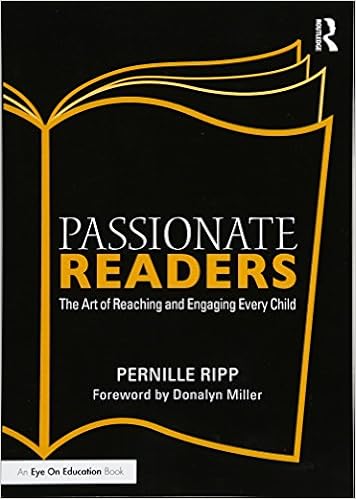
If you like what you read here, consider reading my newest book, Passionate Readers – The Art of Reaching and Engaging Every Child  Also consider joining our book club study of it, kicking off June 17th.  This book focuses on the five keys we can implement into any reading community to strengthen student reading experiences, even within the 45 minute English block.  If you are looking for solutions and ideas for how to re-engage all of your students consider reading my very first book  Passionate Learners – How to Engage and Empower Your Students.      Also, if you are wondering where I will be in the coming year or would like to have me speak, please see this page.