For our entire 4th quarter, we are diving into identity and how it fits within our social comprehension guided by the work of the incredible new book from Sara K. Ahmed, Being the Change. As we start to look at how our identity shapes our actions, I thought a safe spot to start with would be within the pages of picture books. After all, some of my students are not yet ready to share parts of their identity and so looking at the lives of others before we turn inward is a more welcoming path.
I was thrilled to be able to pull so many great nonfiction picture books to have the students read, discuss, and reflect on. The questions we will use to spark conversation include:
- What can you infer about their character traits based on their actions?
- What can you infer about their identity and what they value?
- What do you think motivated them to do what they did?
- How do these actions fit into the world from a historical standpoint?
Here are some of the books we are using

A Boy, a Mouse, and a Spider–The Story of E. B. White by
When young Elwyn White lay in bed as a sickly child, a bold house mouse befriended him. When the time came for kindergarten, an anxious Elwyn longed for the farm, where animal friends awaited him at the end of each day. Propelled by his fascination with the outside world, he began to jot down his reflections in a journal. Writing filled him with joy, and words became his world.

Joan Procter, Dragon Doctor: The Woman Who Loved Reptiles by
Back in the days of long skirts and afternoon teas, young Joan Procter entertained the most unusual party guests: slithery and scaly ones, who turned over teacups and crawled past the crumpets…. While other girls played with dolls, Joan preferred the company of reptiles. She carried her favorite lizard with her everywhere–she even brought a crocodile to school!
When Joan grew older, she became the Curator of Reptiles at the British Museum. She went on to design the Reptile House at the London Zoo, including a home for the rumored-to-be-vicious komodo dragons. There, just like when she was a little girl, Joan hosted children’s tea parties–with her komodo dragon as the guest of honor.

Midnight Teacher: Lilly Ann Granderson and Her Secret School by
In Mississippi in the mid-1800s, it was illegal for enslaved people to learn to read and write. Getting caught meant thirty-nine lashes with a whip as punishment. But this did not stop Lilly Ann Granderson, an enslaved woman herself. She believed in the power of education. To share her knowledge with others, she started a midnight school. In a small cabin hidden in a back alley, Lilly Ann held her secret classes. Every noise in the dark was a reminder of the punishment she and her students faced if they were found out. But the chance to learn was worth the risk. Over the years, Lilly Ann taught hundreds of enslaved people to read and write. Many of her students went on to share their knowledge with their families. Some started secret schools of their own. Others forged passes to escape to freedom in the North. Based on a true story, Midnight Teacher is an inspiring testament to a little-known pioneer in education.

Dorothea Lange: The Photographer Who Found the Faces of the Depression by
Before she raised her lens to take her most iconic photo, Dorothea Lange took photos of the downtrodden from bankers in once-fine suits waiting in breadlines, to former slaves, to the homeless sleeping on sidewalks. A case of polio had left her with a limp and sympathetic to those less fortunate. Traveling across the United States, documenting with her camera and her fieldbook those most affected by the stock market crash, she found the face of the Great Depression

Jane’s heart ached for the world, but what could she do to stop a war?
This energetic and inspiring picture book biography of activist Jane Addams focuses on the peace work that won her the Nobel Peace Prize. From the time she was a child, Jane’s heart ached for others. At first the focus of her efforts was on poverty, and lead to the creation of Hull House, the settlement house she built in Chicago. For twenty-five years, she’d helped people from different countries live in peace at Hull House. But when war broke out, Jane decided to take on the world and become a dangerous woman for the sake of peace.
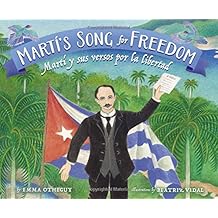 Martí’s Song for Freedom / Martí y sus versos por la libertad (English and Spanish Edition) by
A bilingual biography of José Martí, who dedicated his life to the promotion of liberty, the abolishment of slavery, political independence for Cuba, and intellectual freedom. Written in verse with excerpts from Martí’s seminal work, Versos sencillos.

Trudy’s Big Swim: How Gertrude Ederle Swam the English Channel and Took the World by Storm by
On the morning of August 6, 1926, Gertrude Ederle stood in her bathing suit on the beach at Cape Gris-Nez, France, and faced the churning waves of the English Channel. Twenty-one miles across the perilous waterway, the English coastline beckoned. Lyrical text, stunning illustrations and fascinating back matter put the reader right alongside Ederle in her bid to be the first woman to swim the Channel―and contextualizes her record-smashing victory as a defining moment in sports history. Time line, bibliography, source notes.
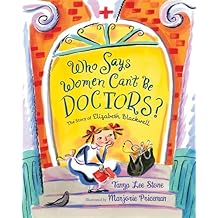 Who Says Women Can’t Be Doctors?: The Story of Elizabeth Blackwell by
In the 1830s, when a brave and curious girl named Elizabeth Blackwell was growing up, women were supposed to be wives and mothers. Some women could be teachers or seamstresses, but career options were few. Certainly no women were doctors.
But Elizabeth refused to accept the common beliefs that women weren’t smart enough to be doctors, or that they were too weak for such hard work. And she would not take no for an answer. Although she faced much opposition, she worked hard and finally―when she graduated from medical school and went on to have a brilliant career―proved her detractors wrong. This inspiring story of the first female doctor shows how one strong-willed woman opened the doors for all the female doctors to come.
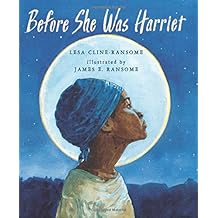
We know her today as Harriet Tubman, but in her lifetime she was called by many names. As General Tubman she was a Union spy. As Moses she led hundreds to freedom on the Underground Railroad. As Minty she was a slave whose spirit could not be broken. An evocative poem and opulent watercolors come together to honor a woman of humble origins whose courage and compassion make her larger than life.

Chef Roy Choi and the Street Food Remix (Food Heroes) by
Chef Roy Choi calls himself a “street cook.”
He wants outsiders, low-riders,
kids, teens, shufflers and skateboarders,
to have food cooked with care, with love,
with sohn maash.
“Sohn maash” is the flavors in our fingertips. It is the love and cooking talent that Korean mothers and grandmothers mix into their handmade foods. For Chef Roy Choi, food means love. It also means culture, not only of Korea where he was born, but the many cultures that make up the streets of Los Angeles, where he was raised. So remixing food from the streets, just like good music—and serving it up from a truck—is true to L.A. food culture. People smiled and talked as they waited in line. Won’t you join him as he makes good food smiles?

Miss Mary Reporting: The True Story of Sportswriter Mary Garber by
While sitting in the bleachers of a Soap Box Derby in the 1950s, Mary Garber overheard two African-American boys in the following exchange: “See that lady down there?” asked one boy. “That’s Mary Garber. She doesn’t care who you are, but if you do something good, she’ll write about you.”
Mary Garber was a pioneering sports journalist in a time where women were rarely a part of the newspaper business. Women weren’t even allowed to sit in the press boxes at sporting events, so Mary was forced to sit with the coaches’ wives. But that didn’t stop her.
In a time when African-American sports were not routinely covered, Mary went to the games and wrote about them. Garber was a sportswriter for fifty-six years and was the first woman to receive the Associated Press Sports Editors’ Red Smith Award, presented for major contributions in sports journalism. And now, every year the Association of Women in Sports Media presents the Mary Garber Pioneer Award in her honor to a role model for women in sports media.

Mama Miti: Wangari Maathai and the Trees of Kenya by
Through artful prose and beautiful illustrations, Donna Jo Napoli and Kadir Nelson tell the true story of Wangari Muta Maathai, known as “Mama Miti,” who in 1977 founded the Green Belt Movement, an African grassroots organization that has empowered many people to mobilize and combat deforestation, soil erosion, and environmental degradation. Today more than 30 million trees have been planted throughout Mama Miti’s native Kenya, and in 2004 she became the first African woman to win the Nobel Peace Prize. Wangari Muta Maathai has changed Kenya tree by tree—and with each page turned, children will realize their own ability to positively impact the future.

Maria Salomea Sklodowaska was born on November 7, 1867. Her family called her Manya, but the world would remember her by another name: Marie Curie, one of the greatest scientists who ever lived.
In a time when few women attended college, Marie earned degrees in physics and mathematics and went on to discover two elements: radium and polonium. She also invented a new word along the way: radioactive. This book celebrates her momentous achievements while also educating its readers about her scientific accomplishments and their implications.
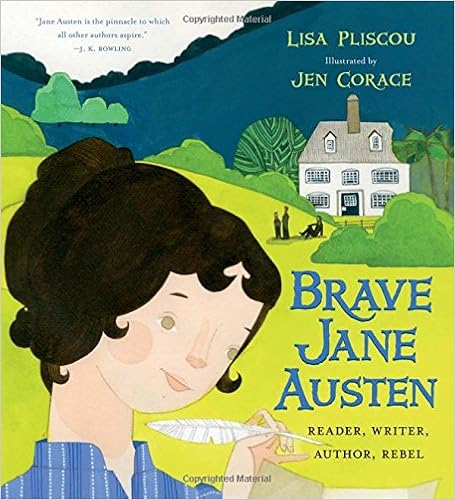
Brave Jane Austen: Reader, Writer, Author, Rebel by
Born in the late 1700s, Jane Austen was a smart, creative girl in a house full of boys, all of whom could aspire to accomplish many things as adults while girls were raised primarily to become good wives. Jane didn’t have much opportunity to go to school but she read everything she could, including all the books in her father’s study. And before long, she began to write her own stories, filled with funny, clever, and inventive characters.

Harlem’s Little Blackbird: The Story of Florence Mills by
Born to parents who were both former slaves, Florence Mills knew at an early age that she loved to sing, and that her sweet, bird-like voice, resonated with those who heard her. Performing catapulted her all the way to the stages of 1920s Broadway where she inspired everyone from songwriters to playwrights. Yet with all her success, she knew firsthand how prejudice shaped her world and the world of those around her. As a result, Florence chose to support and promote works by her fellow black performers while heralding a call for their civil rights. Featuring a moving text and colorful illustrations, Harlem’s Little Blackbird is a timeless story about justice, equality, and the importance of following one’s heart and dreams.

The Legendary Miss Lena Horne by
You have to be taught to be second class; you’re not born that way.
Lena Horne was born into the freedom struggle, to a family of teachers and activists. Her mother dreamed of being an actress, so Lena followed in her footsteps as she chased small parts in vaudeville, living out of a suitcase until MGM offered Lena something more—the first ever studio contract for a black actress.
But the roles she was considered for were maids and mammies, stereotypes that Lena refused to play. Still, she never gave up. “Stormy Weather” became her theme song, and when she sang “This Little Light of Mine” at a civil rights rally, she found not only her voice, but her calling.

Sonia Sotomayor: A Judge Grows in the Bronx / La juez que crecio en el Bronx by
Before Supreme Court Justice Sonia Sotomayor took her seat in our nation’s highest court, she was just a little girl in the South Bronx. Justice Sotomayor didn’t have a lot growing up, but she had what she needed — her mother’s love, a will to learn, and her own determination. With bravery she became the person she wanted to be. With hard work she succeeded. With little sunlight and only a modest plot from which to grow, Justice Sotomayor bloomed for the whole world to see.
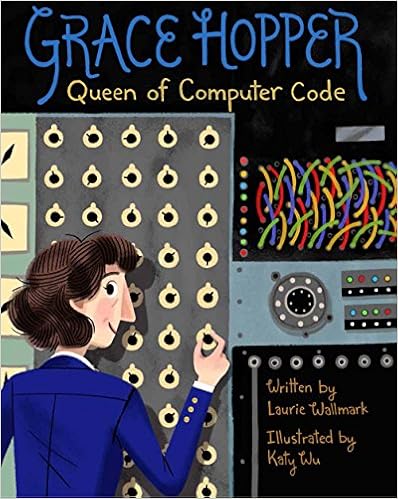
Grace Hopper: Queen of Computer Code (People Who Shaped Our World) by
Who was Grace Hopper? A software tester, workplace jester, cherished mentor, ace inventor, avid reader, naval leader—AND rule breaker, chance taker, and troublemaker. Acclaimed picture book author Laurie Wallmark (Ada Byron Lovelace and the Thinking Machine) once again tells the riveting story of a trailblazing woman. Grace Hopper coined the term “computer bug” and taught computers to “speak English.” Throughout her life, Hopper succeeded in doing what no one had ever done before. Delighting in difficult ideas and in defying expectations, the insatiably curious Hopper truly was “Amazing Grace” . . . and a role model for science- and math-minded girls and boys. With a wealth of witty quotes, and richly detailed illustrations, this book brings Hopper’s incredible accomplishments to life.

Ruth Bader Ginsburg: The Case of R.B.G. vs. Inequality by
To become the first female Jewish Supreme Court Justice, the unsinkable Ruth Bader Ginsburg had to overcome countless injustices. Growing up in Brooklyn in the 1930s and ’40s, Ginsburg was discouraged from working by her father, who thought a woman’s place was in the home. Regardless, she went to Cornell University, where men outnumbered women four to one. There, she met her husband, Martin Ginsburg, and found her calling as a lawyer. Despite discrimination against Jews, females, and working mothers, Ginsburg went on to become Columbia Law School’s first tenured female professor, a judge for the US Court of Appeals, and finally, a Supreme Court Justice.

To the Stars!: The First American Woman to Walk in Space by
Kathy Sullivan wanted to go everywhere. She loved blueprints and maps. She loved languages and the ocean. She didn’t like the question, “What do you want to be when you grow up?” She wanted to explore and do exciting things that girls weren’t supposed to be able to do. Only men had the exciting jobs.
Kathy liked fishing and swimming; flying planes and studying science. That’s what she liked and that’s what she decided to do with her life. She followed her heart and eventually became a NASA astronaut and the first woman to walk in space. Kathy wanted to see the whole world and so she did: from space!
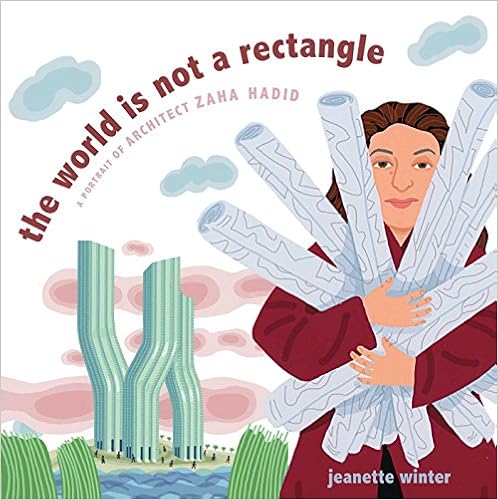
The World Is Not a Rectangle: A Portrait of Architect Zaha Hadid by
Zaha Hadid grew up in Baghdad, Iraq, and dreamed of designing her own cities. After studying architecture in London, she opened her own studio and started designing buildings. But as a Muslim woman, Hadid faced many obstacles. Determined to succeed, she worked hard for many years, and achieved her goals—and now you can see the buildings Hadid has designed all over the world.

Radiant Child: The Story of Young Artist Jean-Michel Basquiat by
Jean-Michel Basquiat and his unique, collage-style paintings rocketed to fame in the 1980s as a cultural phenomenon unlike anything the art world had ever seen. But before that, he was a little boy who saw art everywhere: in poetry books and museums, in games and in the words that we speak, and in the pulsing energy of New York City. Now, award-winning illustrator Javaka Steptoe’s vivid text and bold artwork echoing Basquiat’s own introduce young readers to the powerful message that art doesn’t always have to be neat or clean–and definitely not inside the lines–to be beautiful.

Danza!: Amalia Hernández and Mexico’s Folkloric Ballet by
Danza! is a celebration of Hernández’s life and of the rich history of dance in Mexico. As a child, Amalia always thought she would grow up to be a teacher, until she saw a performance of dancers in her town square. She was fascinated by the way the dancers twirled and swayed, and she knew that someday she would be a dancer, too. She began to study many different types of dance, including ballet and modern, under some of the best teachers in the world. Hernández traveled throughout Mexico studying and learning regional dances. Soon she founded her own dance company, El Ballet Folklórico de México, where she integrated her knowledge of ballet and modern dance with folkloric dances. The group began to perform all over the country and soon all over the world, becoming an international sensation that still tours today.

Emmanuel’s Dream: The True Story of Emmanuel Ofosu Yeboah by
Born in Ghana, West Africa, with one deformed leg, he was dismissed by most people—but not by his mother, who taught him to reach for his dreams. As a boy, Emmanuel hopped to school more than two miles each way, learned to play soccer, left home at age thirteen to provide for his family, and, eventually, became a cyclist. He rode an astonishing four hundred miles across Ghana in 2001, spreading his powerful message: disability is not inability. Today, Emmanuel continues to work on behalf of the disabled.

The Girl Who Buried Her Dreams in a Can: A True Story by
All the girl ever wanted was an education. But in Rhodesia, education for girls was nearly impossible.
So she taught herself to read and write with her brother’s schoolbooks and to count while watching cattle graze.
When the girl became a young wife and mother, she wrote her goals on a scrap of paper and buried them in a can—an ancient ritual that reminded her that she couldn’t give up on her dreams.
She dreamed of going to America and earning one degree; then a second, even higher; and a third, the highest. And she hoped to bring education to all the girls and boys of her village.
Would her dreams ever come true?

Diego Rivera: His World and Ours by
This charming book introduces one of the most popular artists of the twentieth century, Diego Rivera, to young readers. It tells the story of Diego as a young, mischievous boy who demonstrated a clear passion for art and then went on to become one of the most famous painters in the world.
Duncan Tonatiuh also prompts readers to think about what Diego would paint today. Just as Diego’s murals depicted great historical events in Mexican culture or celebrated native peoples, if Diego were painting today, what would his artwork depict? How would his paintings reflect today’s culture?

The Kid from Diamond Street: The Extraordinary Story of Baseball Legend Edith Houghton by
Beginning in 1922, when Edith Houghton was only ten years old, she tried out for a women’s professional baseball team, the Philadelphia Bobbies. Though she was the smallest on the field, soon reporters were talking about “The Kid” and her incredible skill, and crowds were packing the stands to see her play. Her story reminds us that baseball has never been about just men and boys. Baseball is also about talented girls willing to work hard to play any way they can.

Keep On! The Story of Matthew Henson, Co-Discoverer of the North Pole by
Many know the story of Robert Peary’s great 1909 expedition to reach the North Pole. Yet few people know that Peary was joined on this grueling, history-making journey by fellow explorer Matthew Henson. Henson was born just after the Civil War, a time when slavery had been abolished, but few opportunities were available for black people. Even as a child, he exhibited a yearning for adventure, and at the age of only thirteen, he embarked on a five-year voyage sailing the seven seas and learning navigation, history, and mathematics. Henson’s greatest adventure began when he accepted an invitation from Robert Peary to join his expedition to the North Pole. The team endured storms, shifting ice, wind, injuries, accidents, and unimaginable cold. Finally on April 1, Peary, Henson, and four Inuit men began the final 133-mile push to the Pole.

Moses: When Harriet Tubman Led Her People to Freedom by
This poetic book is a resounding tribute to Tubman’s strength, humility, and devotion. With proper reverence, Weatherford and Nelson do justice to the woman who, long ago, earned over and over the name Moses.

Between the Lines: How Ernie Barnes Went from the Football Field to the Art Gallery by
Ernie Barnes was an NFL football player who longed to make art. Finally his dream came true.
When Ernie Barnes was growing up in North Carolina in the 1940s, he loved to draw. Even when he played as a boy with his friends he drew with a stick in the mud. And he never left home without a sketchbook. He would draw families walking home from church, or the old man on the sofa. He drew what he saw.
But in the segregated south, Ernie didn’t know how to make a living as an artist. Ernie grew tall and athletic and became a football star. Soon enough the colleges came calling. Still, in his heart Ernie longed to paint. Would that day ever come?
Ernie Barnes was one of the most important artists of his time known for his style of elongation and movement. His work has influenced a generation of painters and illustrators and can be found in museums and collections, such as the African American Museum in Philadelphia and the California African American Museum.

Harvesting Hope: The Story of Cesar Chavez by
Cesar Chavez is known as one of America’s greatest civil rights leaders. When he led a 340-mile peaceful protest march through California, he ignited a cause and improved the lives of thousands of migrant farmworkers. But Cesar wasn’t always a leader. As a boy, he was shy and teased at school. His family slaved in the fields for barely enough money to survive.
Cesar knew things had to change, and he thought that–maybe–he could help change them. So he took charge. He spoke up. And an entire country listened.

The Youngest Marcher: The Story of Audrey Faye Hendricks, a Young Civil Rights Activist by
Nine-year-old Audrey Faye Hendricks intended to go places and do things like anybody else.
So when she heard grown-ups talk about wiping out Birmingham’s segregation laws, she spoke up. As she listened to the preacher’s words, smooth as glass, she sat up tall. And when she heard the plan—picket those white stores! March to protest those unfair laws! Fill the jails!—she stepped right up and said, I’ll do it! She was going to j-a-a-il!
Audrey Faye Hendricks was confident and bold and brave as can be, and hers is the remarkable and inspiring story of one child’s role in the Civil Rights Movement.

Maya Lin: Artist-Architect of Light and Lines by
You may be familiar with the iconic Vietnam Veterans Memorial. But do you know about the artist-architect who created this landmark?
As a child, Maya Lin loved to study the spaces around her. She explored the forest in her backyard, observing woodland creatures, and used her house as a model to build tiny towns out of paper and scraps. The daughter of a clay artist and a poet, Maya grew up with art and learned to think with her hands as well as her mind. From her first experiments with light and lines to the height of her success nationwide, this is the story of an inspiring American artist: the visionary artist-architect who designed the Vietnam Veterans Memorial.
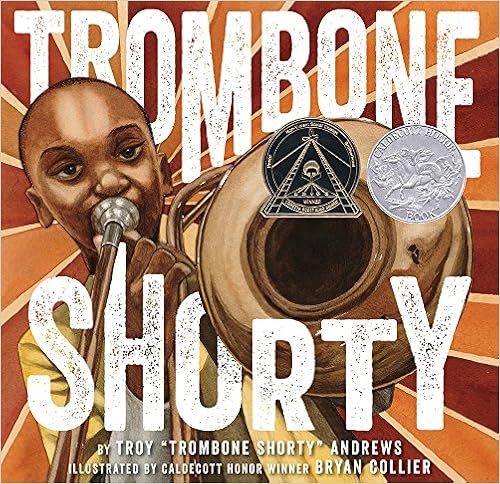
Hailing from the Tremé neighborhood in New Orleans, Troy “Trombone Shorty” Andrews got his nickname by wielding a trombone twice as long as he was high. A prodigy, he was leading his own band by age six, and today this Grammy-nominated artist headlines the legendary New Orleans Jazz Fest.
Along with esteemed illustrator Bryan Collier, Andrews has created a lively picture book autobiography about how he followed his dream of becoming a musician, despite the odds, until he reached international stardom. Trombone Shorty is a celebration of the rich cultural history of New Orleans and the power of music.
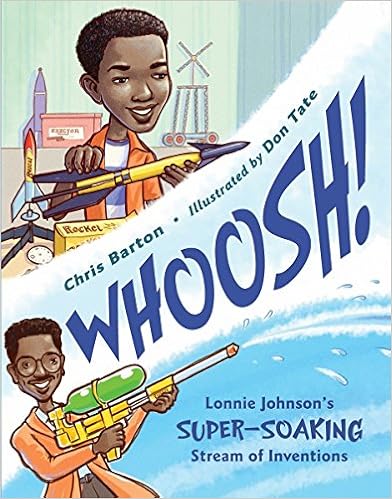
Whoosh!: Lonnie Johnson’s Super-Soaking Stream of Inventions by
You know the Super Soaker. It’s one of top twenty toys of all time. And it was invented entirely by accident. Trying to create a new cooling system for refrigerators and air conditioners, impressive inventor Lonnie Johnson instead created the mechanics for the iconic toy.
A love for rockets, robots, inventions, and a mind for creativity began early in Lonnie Johnson’s life. Growing up in a house full of brothers and sisters, persistence and a passion for problem-solving became the cornerstone for a career as an engineer and his work with NASA. But it is his invention of the Super Soaker water gun that has made his most memorable splash with kids and adults.

Shark Lady: The True Story of How Eugenie Clark Became the Ocean’s Most Fearless Scientist by
Eugenie Clark fell in love with sharks from the first moment she saw them at the aquarium. She couldn’t imagine anything more exciting than studying these graceful creatures. But Eugenie quickly discovered that many people believed sharks to be ugly and scary―and they didn’t think women should be scientists.
Determined to prove them wrong, Eugenie devoted her life to learning about sharks. After earning several college degrees and making countless discoveries, Eugenie wrote herself into the history of science, earning the nickname “Shark Lady.” Through her accomplishments, she taught the world that sharks were to be admired rather than feared and that women can do anything they set their minds to.

From the time she was two years old, Jazz knew that she had a girl’s brain in a boy’s body. She loved pink and dressing up as a mermaid and didn’t feel like herself in boys’ clothing. This confused her family, until they took her to a doctor who said that Jazz was transgender and that she was born that way. Jazz’s story is based on her real-life experience and she tells it in a simple, clear way that will be appreciated by picture book readers, their parents, and teachers.

Alan loves animals, but the great cat house at the Bronx Zoo makes him sad. Why are they all alone in empty cages? Are they being punished? More than anything, he wants to be their champion—their voice—but he stutters uncontrollably.
Except when he talks to animals…
Then he is fluent.
Follow the life of the man Time Magazine calls, “the Indiana Jones of wildlife conservation”as he searches for his voice and fulfills a promise to speak for animals, and people, who cannot speak for themselves.

Because Bobbi Gibb is a girl, she’s not allowed to run on her school’s track team. But after school, no one can stop her–and she’s free to run endless miles to her heart’s content. She is told no yet again when she tries to enter the Boston Marathon in 1966, because the officials claim that it’s a man’s race and that women are just not capable of running such a long distance. So what does Bobbi do? She bravely sets out to prove the naysayers wrong and show the world just what a girl can do.
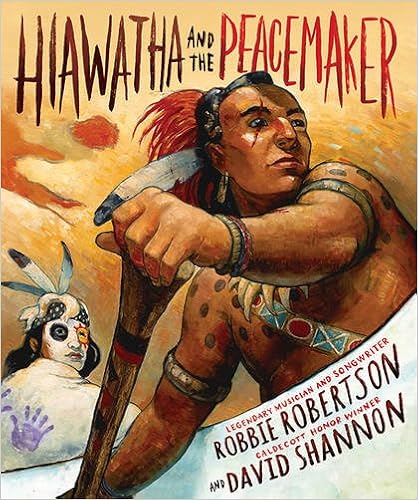
Hiawatha and the Peacemaker by
Born of Mohawk and Cayuga descent, musical icon Robbie Robertson learned the story of Hiawatha and his spiritual guide, the Peacemaker, as part of the Iroquois oral tradition. Now he shares the same gift of storytelling with a new generation.
Hiawatha was a strong and articulate Mohawk who was chosen to translate the Peacemaker’s message of unity for the five warring Iroquois nations during the 14th century. This message not only succeeded in uniting the tribes but also forever changed how the Iroquois governed themselves—a blueprint for democracy that would later inspire the authors of the U.S. Constitution.

Malcolm Little: The Boy Who Grew Up to Become Malcolm X by
Malcolm X grew to be one of America’s most influential figures. But first, he was a boy named Malcolm Little. Written by his daughter, this inspiring picture book biography celebrates a vision of freedom and justice.
Bolstered by the love and wisdom of his large, warm family, young Malcolm Little was a natural born leader. But when confronted with intolerance and a series of tragedies, Malcolm’s optimism and faith were threatened. He had to learn how to be strong and how to hold on to his individuality. He had to learn self-reliance.
And there you have it, just a few of the books we will be suing to discuss identity, motivation, and character.
If you want to see more of our favorite books, go here.










 Pernille Ripp