being a student, being a teacher, Personalized Learning, student choice

A Small Idea for More Choice in Our Curriculum

It never fails; spring break hits and all of a sudden it seems there is very little time left of the school year.  The students feel it as they grow more restless, eager to explore more, not as satisfied with the same old routine.  We feel it as educators, too.  We feel the sheer panic of not having done enough, not having taught enough, not being enough.

So I wanted to do a review of the standards we have covered.  I wanted to give the students way more choice.  While choice and student voice is huge component of what we do, it can sometimes feel lost in the background as we create projects together and try to dig deeper into our learning.  So I wanted to facilitate more small group and I wanted to be able to meet the needs of more students.  I wanted to be more for more of my kids as they really stretch their legs, and their minds.

So on a plane ride home from Texas, it finally fell into place.  A short “Choose your adventure” type of paper where all of the students could choose whatever they needed for the 5 standards.  (We actually have 7 but 2 of them will be  explored in May).  They didn’t have to get a bingo.  They didn’t have to pick anything in particular.  They just had to pick one from each standard after deciding what they needed the most.  Every standard gets 2 days of work-time in class, students can change their minds to their needs, and the best part has been that the two incredible special education teachers that are also in our classroom in various hours are also teaching.  Utilizing their knowledge and ideas is something I have really wanted to do for a long time, but had a hard time figuring out how to do.  This has done just that.
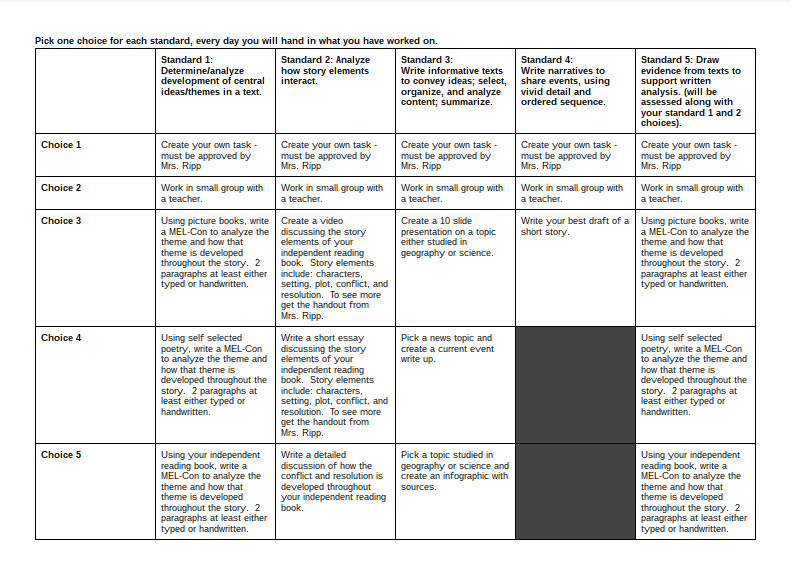
My Standards Review - Google Docs.clipular

So how has it been?  Kind of amazing actually.  Students are more in tune with what they need and want.  They are getting to work with others if they would like, they are coming up with some creative ideas when they want, or they are getting the support they feel they need.  In fact, I asked a group of kids if this was helpful and they all gave me an enthusiastic yes!  I have loved the smaller groups, the one-on-one teaching that I have been able to do, as well as seeing the success that they are experiencing.

While my mission as a teacher is to provide as much choice in learning as possible, in whichever area is needed, sometimes it is hard to wrap my head around personalizing learning more when I teach so many students.  This small breakdown of skills and choices has helped us do just that and is making me think about every thing I teach.  What other units can be made into something like this?  Where else can we provide opportunities that fit the needs of students better?  I hope this inspires you to maybe do something similar.

If you like what you read here, consider reading my book Passionate Learners – How to Engage and Empower Your Students.  Also, if you are wondering where I will be in the coming year or would like to have me speak, please see this page.

being a teacher, being me, Literacy, Reading, Reading Identity, student choice

Let My Students Read

My friend John Spencer had shared this on Facebook tonight

As I got ready to share the quote myself, the comment below it caught my eye…

“It’s also the job of the school to push children to read books that challenge them and take them out of their comfort zone.
Diary of a Wimpy Kid, Big Nate, and Captain Underpants are fine for kids to read and enjoy at home, but teachers should not permit them in the classroom. They provide no educational benefit.”

And I knew I couldn’t stay silent.  I knew I had to respond even though I try to not get into it with anyone on Facebook.  Even though I didn’t know the commentator and that I might be opening myself up to an argument I don’t feel like having as I wind down on a Sunday night.  But when something like that is said, I have to say something back.  After all, Diary of a Wimpy Kid, Big Nate, and yes even Captain Underpants all reside in my 7th grade library.  Their covers are torn and tattered, they are often replaced.  They are loved by many, myself included, and not because they are easy to read, but because they make students fall in love with reading.

So I took a deep breath, pushed my snark aside and wrote this reply…

Not true at all, for some students a book like Diary of A Wimpy Kid is the first time they have felt like they were a reader at school. Our job is not to be gatekeepers of which books students read but instead provide them with successful reading experiences in whichever books they choose so that they will continue to read. Then we can help them stretch into more challenging texts.

But what I really meant to say is that we must not censor.

That we must not think we know better when it comes to what a child needs to read any day.

That instead of judging we should support.

That we must create environments where students choice in books will be celebrated and discussed rather than dismissed and banned.

That it is not our job to be the gatekeepers for our students as Teri Lesene has said so many times.

That if a child is choosing to read books like those mentioned then they have a reason for it, even if that reason is that they do not know what else to read.  Our job as teachers is to help them discover why they love the books so much and then expose them to more, just like we would with any book that a child chooses to read.

I speak for the child that this year has read Diary of a Wimpy Kid every chance he got, always turning the page, rereading and laughing every time with joy when he came to beloved sections.  He tells me how long he spends reading, how it is his favorite thing to do, how every time he revisits that same old book, he discovers something new.

I speak for the child that never felt like a reader until Dav Pilkey created Captain Underpants and they finally had a character they could relate to.

I speak for the child that has always reverted back to these books until 2 weeks ago when he asked if he could read All American Boys because he had heard it was so good and now is 40 pages in and tells me it is the best book ever.  Even if he not quite sure what is going on. Even if we had to go back a few pages and get a few things straight.  Diary of a Wimpy Kid may not have been as demanding as All American Boys but those books made him feel safe.  Like he could be a reader in our classroom.  Like he could be a success story, just like everyone else.

It takes a great book to make a child believe that they too can be a reader and for many of our students that great book has been Diary of a Wimpy Kid.  Why anyone would want to take that away from students beats me.

So do not tell me those books do not belong in our classrooms.  Do not tell me that my students should not be allowed to read them in school.  Do not tell me which books do or do not provide an educational benefit.

If my job as a teacher is to get students to read, then by golly those books, and any other books I can think of, will help me do just that.

I did not become a reader when I could read Huckleberry Finn, I became a reader when I chose to read.

So let our students choose to read.  Whatever that may look like.  As good teachers we know what to do.  We know how to challenge them.  How to make them reflect on their journey as readers.  How to help them stretch into harder books and protect them when they get too far out of their comfort zone.  Let our students fall in love with books so that we can help them discover more books.  So that they will leave our classrooms and choose to read, even when they are busy.  Even when life gets hard.  Even when school is over.  Let our students fall in love with reading so that they will choose to be challenged, and not because a teacher forced them to, but because they felt they were ready.

I owe so much to Jeff Kinney, Dav Pilkey and Lincoln Peirce.  I think many of us do.

If you are wondering why there seems to be a common thread to so many of my posts as of late, it is because I am working on two separate literacy books.  While the task is daunting and intimidating, it is incredible to once again get to share the phenomenal words of my students as they push me to be a better teacher.  Those books will be published in 2017 hopefully, so until then if you like what you read here, consider reading my book Passionate Learners – How to Engage and Empower Your Students.  Also, if you are wondering where I will be in the coming year or would like to have me speak, please see this page.


being a student, being a teacher, student choice, student voice

When We Forget to Ask – On Student Privacy and Sharing All the Good

http---www.pixteller.com-pdata-t-l-314014

I was schooled in student privacy the first time I asked to take my students online.  Protect, teach, and keep them safe were drilled into me as we connected and explored the online world.   I thought I pretty much  knew what I couldn’t share; all the sensitive or bad stuff, and thought I knew what I could share; all the good stuff.  I thought all of my students wanted to share their blogs.  That all of my students wanted their accomplishments made public.  That when they did well they, of course, they wanted the world to know.  After all, we are a culture driven by success stories.

Yet, year after year my thinking has been challenged.  First by a 4th grader who told me she had no need for a certificate stapled to her math test as it made something private public.  Then by a 5th grader that dared to ask why I assumed he would want his blog to be public.  And finally, last year by a 7th grader who told me to tell the world that no one else had the right to know that she was on the honor roll.

Every time a student has challenged me, I have learned something.  Every time they have stood up for their own privacy, I have been reminded of my own flippancy.  Every time, I feel the urge to share all of the good I remember that I do not automatically have the right, that the students also have the right to say no, that that is not just something we leave up to parents.

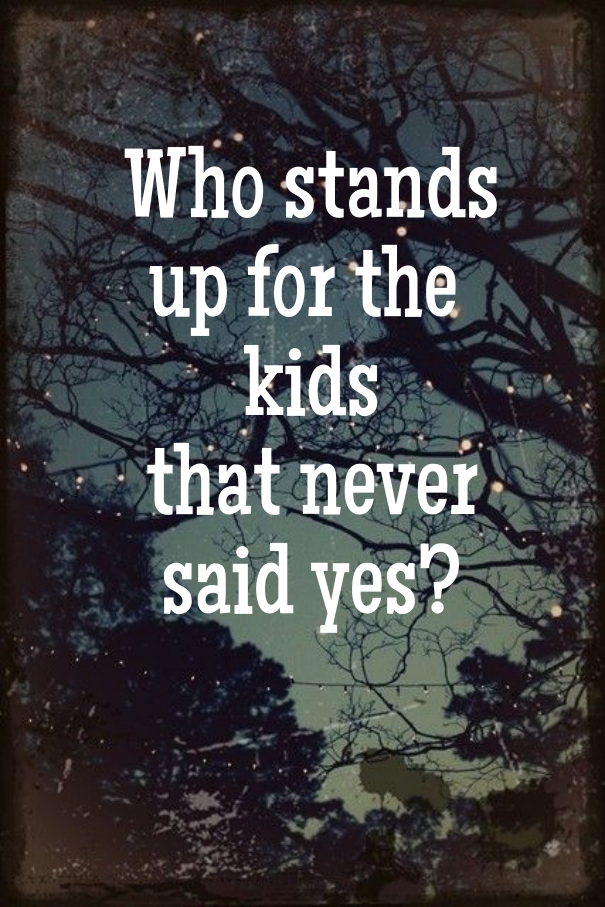
So I speak for my students who challenged me to rethink my stance in privacy.  I speak for those kids that asked me to think before I shared.  Not just for the parents who said no, but for the kids that never said yes.

So before you publish that honor roll.

Before you make that blog public.

Before you move their clip to the positive zone or give them that point (“Ding!”) or hand them that award.

Before you tweet that picture, or print it, or email it, or share it with the world.

Before you use that student example (name redacted of course).

Before you share that great learning moment with the world.

Before you share what a kid has done.  Even if it was amazing.

Please ask them if you may.

Please ask them if they would be alright with the whole world (potentially) seeing their thoughts, their work, their accomplishment.

Please ask them if they would like the attention that may come from it or if they would rather not be celebrated publicly.

And if they say no, respect it.

We assume that every kid wants to be praised in public.

We assume that every kid wants to be honored in public.

We assume that every kid wants to share their great grades in public.

But we don’t know every kid.

So ask them first.

Their answer may surprise you.

I know it certainly surprised me.

If you like what you read here, consider reading my book Passionate Learners – How to Engage and Empower Your Students.  Also, if you are wondering where I will be in the coming year or would like to have me speak, please see this page.

 

aha moment, Be the change, being a teacher, books, change, Literacy, Reading, student choice, Student Engagement

So You Teach a Whole Class Novel – A Small Idea to Help

http---www.pixteller.com-pdata-t-l-296897.jpg

I spend too many hours thinking of my students love (or lack of love) of reading.  Of how the things that we do together hopefully is enough to sustain that love for words.  That this year is another part of their journey as readers, as humans who know that reading can unlock the powers of the universe.  And so I think of what is ahead.  Of whether they are truly “Wild readers” to quote Donalyn Miller.  Whether they have the stamina they need to be successful in college to quote Penny Kittle.  And whether the type of literacy instruction they will receive in the years to come will allow them to continue to love books.  To still read something that they choose.  To still see themselves as children who read for fun, not by force.

Today, as I sat next to a friend who teaches high school English, we discussed the concept of the whole class novel.  Something I have opened up for discussion here.  There are districts that mandate that the whole class novel is used for all students, no matter their comprehension ability, which is another blog post in itself, and yet, it reminds me that not everyone works in an environment that trusts its teachers to teach all students, no matter their ability.

So if you teach the whole class novel, whether by choice or force, there is a very little tweak that may make it accessible to all students.  Because if we want the whole class novel to be a vessel for deeper literature conversation and yet we have students who cannot access the text, then we must find a way for them to be successful.  The idea is simple, really.  Create different pathways to access the text by allowing students to select which method they will use.  Those pathways can be:

  1. I choose to read it on my own, ready to come to discussion.  This is the most common pathway of doing a whole class novel but it cannot be the only one.  Think of how many students where this act would be impossible.  Where they would rather defiantly not read then even try.
  2. I choose to read the book with a partner and we discuss as we read.  Sometimes when we struggle all we need is a trusted adviser to bring us through the hard parts.  We see this happen in our classrooms all of the time; students reaching out for help, and then going to back to their task renewed.  Why not let them do that formally?
  3. I choose to have it read aloud with the teacher in a small group.   Sometimes we need an adult voice to carry students through, other times you just need a community of readers to help you process the text, let alone the finer nuances behind the words.  Having a teacher at the helm and making it a read aloud means that it has no longer become an exercise of decoding, but rather one of comprehension.
  4. I choose to listen to the text.  I know some frown upon the use of audio books in our literacy classrooms, but they can be the game changer for some of our most disillusioned non-reading students.  If our goal is to use a whole class novel for students to think deeply about a text, then why not remove the barrier of the text itself?  If a child cannot read a text then the instruction of how to read it should happen with a text that they can access, not something that is far beyond their current skill level.

That’s it really.  Offering student choice in how they access the learning we must do, allows them to find success even within the most mandated curriculum.  We must remember our task at hand; to have rich discussion, so let’s make sure that all of our students can be a part of that, not just the ones that have mastered the act of reading at a certain level.

If you like what you read here, consider reading my book Passionate Learners – How to Engage and Empower Your Students.  Also, if you are wondering where I will be in the coming year or would like to have me speak, please see this page.

being a student, being a teacher, being me, questions, student choice, Student dreams, student driven, student voice, Student-centered

A Most Important Question


http---www.pixteller.com-pdata-t-l-281535.jpgAsking my students to reflect, to give feedback, to set goals and try to peek into their minds has been a mission of mine for the last many years.  The questions I ask change, but the purpose does not; to create a better educational experience for them.  To create a classroom they actually want to be a part of.  To find out how I can change so that I can be a better teacher.

For all of the questions I have asked, and it has been a lot so far,  there is one that stands out.  One that has given me the most significant answers.  One that has led me to question myself and what I focus on in the classroom, day after day, student upon student.

And it is one of the simplest ones indeed.

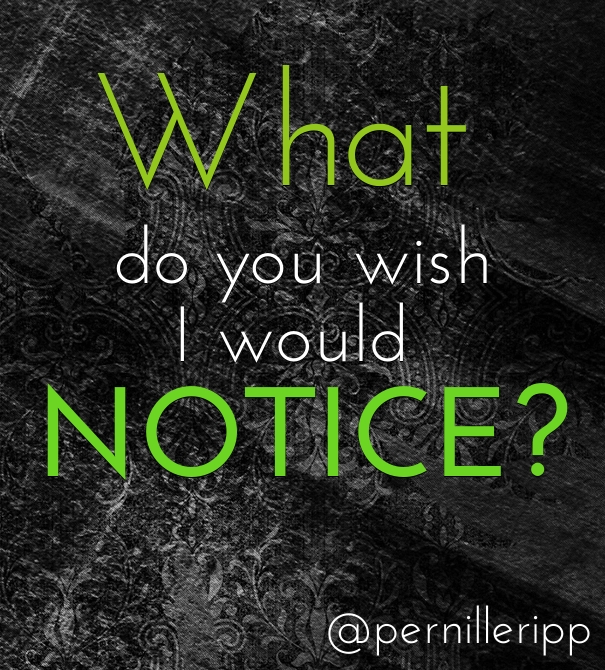
What do you wish I would notice?


Tucked at the end of the survey, when they are already thinking, when they have already shared.

Some write nothing, some say I am noticing what I need to.  But then there are the others, those whose answers always stop me, change me, and sometimes even keep me up at night.

I wish Mrs. Ripp would notice how hard I am trying.

I wish she would notice that I am funny.

I wish she would notice how tired I a.

How I need help.

How I don’t know what to say.

How shy I am.

And I am grateful for their answers, for their faith in me to now begin to notice so that I can be better.  So that we can be better.  So that school can be about them again, just the way it was meant to be.

If you like what you read here, consider reading my book Passionate Learners – How to Engage and Empower Your Students.  Also, if you are wondering where I will be in the coming year or would like to have me speak, please see this page.
being a teacher, books, Literacy, picture books, Reading, student choice

Our Top Picture Books of 2015

For the past 3 days, my 7th grade students have been furiously discussing the their favorite picture books as we get ready for the Caldecott awards.  While we have not voted for our top 3 yet, I thought it would be worthwhile to share our all of our favorite picture books from 2015.  What I love the most is the care that the students are putting into their conversations surrounding their selection, looking beyond the “What a great story!” and really searching for picture books that will leave a long lasting impression instead.  Note, some of these are sadly ineligible for the award since the illustrator does not reside in the US, nor are they a citizen.  So if you are looking to boost your picture book collection, start with some of these incredible books.

The Skunk – story by Mac Barnett, Art by Patrick McDonnell

Strictly No Elephants – Story by Lisa Manchev, Art by Taeeun Yoo

Strictly No Elephants Art and Story by Jessixa Bagley

Drum Dream Girl – Story by Margarita Engle, Art by Rafael Lopez

Frederick’s Journey: The Life of Frederick Douglas – Story Doreen Rappaport, Art by London Ladd

Sidewalk Flowers – Story by Jon Arno Lawson, Art by Sydney Smith

Sad, the Dog – Story by Sandy Fussell, Art by Tull Suwannakit

Marilyn’s Monster – story by Michelle Knudsen, Art by Matt Phelan

I Don’t Like Koala – Story by Sean Ferrell, Art by Charles Santoso

The Night World – Story and Art by Mordicai Gerstein

Lenny and Lucy – Story by Philip C. Stead, Art by Erin E. Stead

Waiting – Story and Art by Kevin Henkes

Little Bird’s Bad Word – Story and Art by Jacob Grant

I’m Trying to Love Spiders – Story and art by Bethany Barton

To the Sea – Story and Art by Cale Atkinson

Elwood Bigfoot: Wanted Birdie Friends – Story by Jill Esbaum, Art by Nate Wragg

Float – Story and Art by Daniel Miyares

The Bear Ate Your Sandwich – Story and Art by Julia Sarcone-Roach

Henry Hyena, Why Won’t You Laugh? – Story by Doug Jantzen, Art by Jean Claude

Beautiful Hands – Story by Kathryn Otoshi, Art by Bret Baumgarten

If You Plant A Seed – Story and Art by Kadir Nelson

Pom Pom Panda Gets the Grumps – Story and Art by Sophy Henn

Growing Up Pedro – Story and Art by Matt Tavares

Voice of Freedom: Fannie Lou Hamer: The Spirit of the Civil Rights Movement – Story by Carole Boston Weatherford, Art by Ekua Homes

Water is Water – Story by Miranda Paul, Art by Jason Chin

Last Stop on Market Street – Story by Matt De La Pena, Art by Christian Robinson

Toys Meet Snow – Story by Emily Jenkins, Art by Paul O. Zelinsky

Finding Winnie: The True Story of the World’s Most Famous Bear – Story by Lindsay Mattick, Art by Sophie Blackall

The Only Child – Story and Art by Guojing

I cannot wait to see which books are in the top!

To see other favorite books in our classroom, go here