being a teacher, being me, books, Literacy, student choice, Student dreams

I Was Born A Reader

http---www.pixteller.com-pdata-t-l-232670.jpg

Some days I feel like I was born to read. To fall in love with stories.  To think deeply about the books that I carry in my heart, to get so consumed by the tale of someone else’s life that there is nothing that can penetrate my wall of immersion.  On other days, reading is the furthest thing from my mind as I watch my house fill up with dirty clothes, my children’s arms eagerly awaiting another hug, a song, some help.  Reading moves further away when the to-do’s pile up, the stacks of paper start to scatter, and my brain cannot seem to slow down.   That is when I am my most vulnerable as a reader.  When the world is too busy and sitting down with a book seems to be too much of a luxury.  I lose touch with the power of reading, but not for long, never for long.

So I continue to come back to books whenever I can.  I get through the things that have to get done so my ears can hear my to-be-read pile calling.  It is not hard for me to find  book, it is hard for me to choose which one next.  It is not hard for me to find a moment of quiet, where I don’t have to do anything but read, after all my kids go to bed early. My life has taught me that I am a reader, even if I am not reading.  That I am a reader even when I abandon a book, struggle with its meaning,or have no idea what to read next.  I am a reader because I have had so many amazing experiences with books that I cannot imagine my life without them.

Yet, how many of our students have that same experience?  How many of the children we teach know in their core that they are readers?  How many have experienced the freedom of choice in books that we have as adults?  How many of them have experienced what it means to abandon a book simply because they wanted to?  How many of them feel like finding time to read is an investment worth making because they know their soul will feel better?

It seems our classrooms are set up to cover curriculum, which in its simplest way makes sense, after all, we cannot be teachers if we do not teach.  Yet, within that curriculum we need to create reading experiences that allow students to fall in love with reading.  To read with wild abandonment because it is what they want to do, not just have to do.

We need to give them enough incredible experiences with books so that they can become readers at their core, and not just because their teacher told them so but because they know it will better their lives.  We need to give them enough moments with books that they choose so that when their reading slows down, when they meet a text that does not entice them, they will not give up on reading but rather know that they are in a lull and that this too shall pass.  That being a reader means that we don’t always read but we cannot imagine a life without it.

I was born a reader, or so it seems, because my mother never told me what book to read, my teachers never told me my level, and I was never ashamed to admit when I read slowly.  The least I can do is offer my students the same thing.

If you like what you read here, consider reading my book Passionate Learners – How to Engage and Empower Your Students.  Also, if you are wondering where I will be in the coming year or would like to have me speak, please see this page.


assumptions, being a teacher, books, Literacy, student choice, student driven

How We Can Help Our Book Abandoners

http---www.pixteller.com-pdata-t-l-205730

I have watched her every day, picking up a book, reading, kind of, and then at the end of class casually placing it into the return bin of our classroom.  Another book abandoned.  Another story given up.  In the past, I would have grabbed that book and handed it back to her. ” Give it another day or so.  This one you’re sticking with.”  But not now. Not anymore.

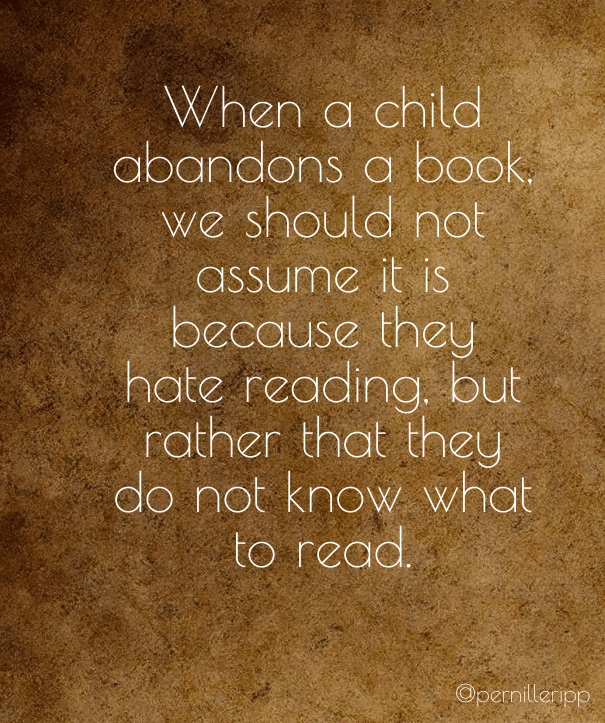
I used to think that when a child abandoned a book, they simple had not given it enough of a chance.  That the act of abandonment was a badge of honor; look at how I am not reading!  That they abandoned books because it was a way to not read, after all, you cannot read when you do not have a book.

So I helped them by creating rules…  You cannot abandon a book until you are 50 pages in.  You can only abandon one book, then the next one you have to read.  You must tell me when you abandon a book so we can discuss why.  The rules were meant to discourage it, to make abandoning a book a hassle, to inspire students to give the book a proper chance.  And they kind of followed them, or I thought they did, until I noticed that the students were no longer abandoning books, instead they were fake reading, getting the timing just right of their meticulous page turns, yet their eyes were not on the page.  My helpful rules had thus created a bigger problem; children who would rather sit and do nothing but turn a page rather than read a boring book.

Yet, I now know that book abandonment is a sign of a larger problem.  That it is not something most students pride themselves on but instead becomes yet another sign that reading is seemingly not for them.  That book abandonment becomes proof of their failures as readers.  And the students seem to not know what to do about it.  So if teaching 7th graders (and 5th graders, and 4th graders) has taught me anything it is that we have to face it head on.  So I had to find a new approach, we had to bring book abandonment into the limelight and embrace it for the reading beast it is.  Therefore, in our classroom, we…

Share our own abondenments.  I celebrate my book abandoning because it tells the students that I am reader who knows herself.  That I am tuned in to my own reading needs to find a book that works for me at that moment.  And that those needs change depending on what is going on in my life.  Students need an abandonment role model so that the stigma can be removed and the conversations can begin.  Because that is what we need; more discussion.  More reflection.  I never tear a book apart, I instead explain why it is not a great fit for me right now, and then offer it up to others.  Most of the time someone grabs it and proves me wrong.

Log it.  No, not a reading log,  I don’t need to know minutes or pages read, but instead a list of books they have finished and books they have abandoned.  They have a readers notebook in our classroom that has a section for this so they can easily do it in class.  Students need to have a way to examine their own actions, and so the simple sheet with the title on it helps them do just, which leads to the next thing.

Ask why.  Assume that all students abandon books, not just the “bad” readers and then ask them why they abandoned that book specifically.  Have them examine their own habits so that they can figure out who they are as a reader.  My students reflect on their reading habits several times a quarter so that they can see patterns.  They look at their list of books they loved and books they didn’t so they can get clues to what they like to read, and then start to pay attention to it.  They need to study themselves, and be given the time to do so, so they can learn from this rather than just view it as an inevitable part  of their reading habits.

Ask “Now what?”  Too often our students expect us to come up with the answer, to hand them the next book.  I have learned that while we should support their book browsing, we also need to pull back to let them become “Wild readers” as Donalyn Miller says.  Readers who know who they are and what they like.  So when a child abandons a book and ask me for another recommendation, I ask them to look at their To-Be-Read list, to think for a moment about what they need right now, what their life looks like, and how much energy they have.  They then have to find a stack of books to browse through so they can find their next read.  They usually let me know at the end what they pick, not because they have to, but because they want to share their find.

Practice total honesty.  I ask my students to be completely honest in their reading habits, whether when we speak or when they reflect, because if they are not I cannot help them.  They have to trust me to not punish them or somehow degrade their answers.  And I don’t.  Total honesty is paramount to how we work in our classroom.  And that starts with me; I do not sugarcoat my own habits.  If I did not read the night before they know.  If I am dragging in a book, they know.  And they also know my reading goals because I set them right alongside them.

Ask probing questions.  I will ask a child the harder questions, I will ask them if they are just giving up because they are in a pattern of giving up.  I will ask them if they think they should try a few more pages or if they have given it careful thought.  That does not mean there are rules for when you abandon, but I do want to make sure that the decision to abandon is one that they know should be carefully considered.  That yes, sometimes we know after 1 page that we do not want to read a book, and that is perfectly fine, as long as we know why we don’t want to read anymore.

Have an enticing library.  Many researchers have solidified the need for incredible classroom libraries, and yes, I know that means that we probably pay for the books out-of-pocket.  But it is worth it.  Having students be able to immediately try to find another book can be both a blessing and a curse, but in the end, I would rather have a child that is faced with many choices than one who has to wait for a pass or our scheduled time to go to the library to get one.

Creating classrooms where students are passionate about reading, requires many things; a great classroom library, time to read, choice, and also the courage to break some of the rules that surround traditional reading instruction.  That includes facing book abandonment head on.  What have you tried that has worked?

PS:  For ideas on how to get reluctant readers to read, read this.  

If you like what you read here, consider reading my book Passionate Learners – How to Engage and Empower Your Students.  The 2nd edition and actual book-book (not just e-book!) just came out!

advice, aha moment, Be the change, being a teacher, being me, student choice, student voice

Why Are They Disengaged? My Students Told Me Why

I used to think that when students were disengaged it was their own fault, and while sometimes that is still true, I have found in my years of teaching that a lot of the fault lies with me as the teacher.  Yet, realizing that I may be the cause of my students disengagement is hard to swallow.  It certainly has not done wonders to my self-esteem, and yet, there is something liberating about realizing that while I am a part of the problem, that also means that I can fix it.  Or at the very least fix the things I control.  Student disengagement is something I can do something about.

But why are students so disengaged?  What lies behind the restlessness, the misbehavior, the bored stares?  Every year I survey my students throughout the year, and particularly on those days where nothing seems to be working.  I ask them simply to explain what is going on and they share their truths with me.  So here are their truths on student disengagement.

Students become disengaged, because..

They feel no connection to you.  I often notice that students are much more off task in the beginning of the year when we don’t know each other, right after the honeymoon is over.  This is when we seem to be in limbo and so I spend a lot of time having a lot of conversations with my students, I share stories from my life, and I speak to them in the hallways.  Students will work for you if they like you, so I try to be likable.  It may seem simple but it is repeated so often by my students.

They feel no urgency.  I have 45 minutes per class so the urgency is always there.  It is not the threat of a deadline that makes my students work at a faster pace, it is the promise of the next adventure that lies ahead.  My students and I make a deal that if they work hard and stay focused then I do not give them homework.  They know that they are given as much time in class as I can give them so they know to use that time well.  The students that don’t; they have to do the work outside of school.

They feel there is no purpose.  I use to assume that students knew what the greater purpose of something was, but they don’t.  So now we spend time deconstructing our standards and we speak about the connections between things.  We speak of why we are learning something and how it fits into our lives, not just how it is preparing us for the next year or for college.  We speak about how the learning we do right now allows us to become better human beings.

They feel they have no power.  When students feel powerless in our rooms, most become disengaged.  Particularly those kids who have often had behavior issues in the past.  Those are the kids, in particular, that need to feel like they have more control over their day.  This is why I proselytize about student choice.  Give them choice, even if just in a minor way like telling them they can sit wherever they want.  Give them power over their day so that they feel like who they are matters.

When the teacher talks too much.  We do.  We need to stop.  We need to set a timer or whatever will stop us from going on and on.  Give them knowledge then let them work with it.  Give them a chance to speak as well, after all, they are the ones that should be doing the learning.

When the teacher does not personalize.  How often do we know whether a child already knows something?  How often do we plan to find out so that we can create new learning experiences for them?  If a child has already mastered something, then let them work on something else, something more challenging.  But to do that, you have to find out what your students know.  Ask them whether through a survey, an informal pre-test, or a conversation.  Not everyone comes to us as a blank canvas.

When they do mostly worksheets.  I have moved far away from worksheets over the past few years, but that does not mean all worksheets are bad.  If a worksheet gives foundational knowledge that will be used for further learning then it can be ok.  However, if using a worksheet is part of the routine every day, or is not used for anything more, then there seems to be no deeper learning purpose behind it.  Students have told me they feel like when most teachers give them a worksheet it is because we are too lazy to teach them.

When the learning becomes something to just get through.  I have done this, said that we just need to get through this to get to fun thing.  Yikes.  When we say this, students automatically disengage from the task, after all, if teachers see no value in it, why should they?  Yes, there are things that we don’t love to teach as much so then make it better.  If it is boring or a struggle for us, then think of how it feels for the students.  We are in charge of bringing the passion into our rooms.  Not just the students.

While there are still days in our classroom where I know that students were not as engaged as I hoped, there are more great days than bad.  There are more days where students stay on-task, where they get involved, and where meaningful learning occurs.  Every year, I start over with my students and how to best engage them.  Every year I learn a new way to keep them on-task.  Yet I have learned that the biggest thing for me is to keep the above list in mind at all times.  Even if I feel like I have planned the very best lesson.  Even if the day before went really well.  I do not take my students’ engagement for granted, instead it is something I work for.  Do you?

PS:  For ideas on how to evaluate why students are becoming disengaged tune in tomorrow.

If you like what you read here, consider reading my book Passionate Learners – How to Engage and Empower Your Students.  The 2nd edition and actual book-book (not just e-book!) comes out September 22nd from Routledge, but rumor has it that it is out on Kindle already!

being a teacher, being me, books, Literacy, Passion, student choice

On Hating Reading

recite-1ewom0k

I have loved reading as many years as I have lived.  Reading wove its threads throughout my life, from my mother reading aloud to me every night, to learning to read English books in the lap of my now-father, biking to our public library with a plastic bag empty waiting for the books that would fill it, and now passing my love on to my own children as they beg for just one more book, every single night.

I have brought my love of reading into the classroom, cementing that in this room we are all readers.  We all spend time finding those books that will transform us.  Finding those moments where we beg for just one more page, one more minute, and hope that the teacher will give it to us.

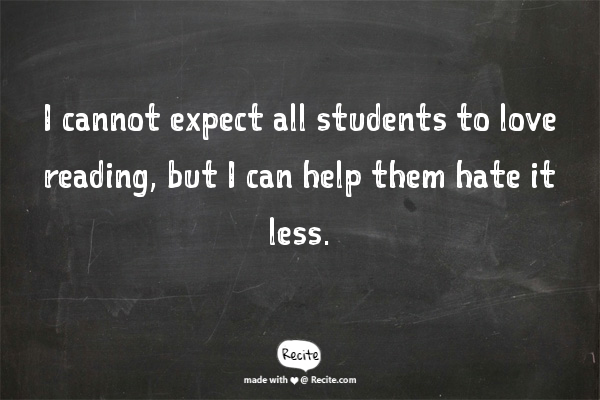
I love reading, but I do not ask all of my students to love reading.  I do not expect them to fall as madly in love with reading as I have, because if I did then I would ask them to accept the identity I have shaped for myself.  I would ask them to sometimes do something impossible.

Instead, I ask them to like it more.  To give it another chance, even if their hatred has been cemented in years of torturous reading experiences.  I make them promise me to give it a chance, a proper one, to keep their minds open as we grow throughout the year.  There are some students who will never love reading.  Who will never feel like reading is the one thing they must do every day to sustain their souls.  And yes, that makes me sad, but I also need to make sure that our classroom welcomes all students.  Even those that identify as reading haters.

So we should carry our torch for the love of reading wherever we go.  We should exude passion.  We should help each child believe that they are readers.  That books are for them.  That they too can immerse themselves in something so deeply that they almost forget to breathe.  Yet, I must remember, that if I tell a child that they must love reading, some children will rebel simply on principal.  Some children will find every reason to hate it more.  So I do not assume that all children will love reading.  I assume instead that within our short time together, I can make them hate it less.  I can change their minds, if even just a little bit.  After all, our classrooms are created by the true personalities of our students.  We must meet them where they are and help them grow on their journey.

I will never stop loving reading.  I will never stop telling my students that they are readers every single day.  Even those that don’t believe they are.  I will never stop sharing my own love of reading, but I will allow students to figure out where their emotions fall and then help them move from there.  I will see my students for who they are, even if they do not love reading. Even if I will never understand how you cannot.

If you like what you read here, consider reading my book Passionate Learners – How to Engage and Empower Your Students.  The 2nd edition and actual book-book (not just e-book!) comes out September 22nd from Routledge.

being me, student choice, student voice, voice

I Wrote This Post

recite-13iqtjc

I wrote this post three different ways, and none of them spoke my words well.  I wrote this post three different ways but none of them said what I really wanted to say.  I wrote this post three different ways all leading me to the same question; where are the students’ voices in our professional development?

Where are the voices of those we say we need to reach?

Because if they are not speaking to teachers as we prepare for yet another year.  If they are not on our committees.  If they are not at some of staff meetings.   If they are not there speaking to us throughout the year, then who are we really preparing for?

That’s it.

PS:  In my district today at our vision conference, we had a student-led panel for an hour and half talking about the good and bad in their education.  The whole afternoon was then spent reacting to what the students said.  I have learned more today about being a good teacher then I have at many conferences.  And that quote at the top came from one of our students today.

PPS:  To see all of the surveys I use with students and parents to get to know them better, go here.

If you like what you read here, consider reading my book Passionate Learners – How to Engage and Empower Your Students.  The 2nd edition and actual book-book (not just e-book!) comes out September 22nd from Routledge.  

being a teacher, Literacy, Passion, Reading, student choice, student voice

Stop Feeding the Beast – The Reading Myths We Pass on As Truth

“This is not a “girl” book even if the cover makes you think it is, boys can love it too…”And I stop myself.  And I cringe inwardly.  And I want to rewind time for just 10 seconds and tell myself to stop.  A “girl” book?  What in the world is that?  And since when did I label our classroom books by gender?

The stereotypes of reading seems to be a beast in itself.  We feed the beast whenever we pass on hearsay as fact.  We feed the beast whenever we fall victim to one of these stereotypical sayings without actually questioning it.  Through our casual conversation we teach our students that there are books for girls and books for boys.  We teach our students that a strong reader looks one way, while a struggling reader (God, I hate that term) is something else.  We say these things as if they are the truth and then are surprised when our students adopt the very identities we create.

So what are the biggest myths that I know I have fed in my classroom?

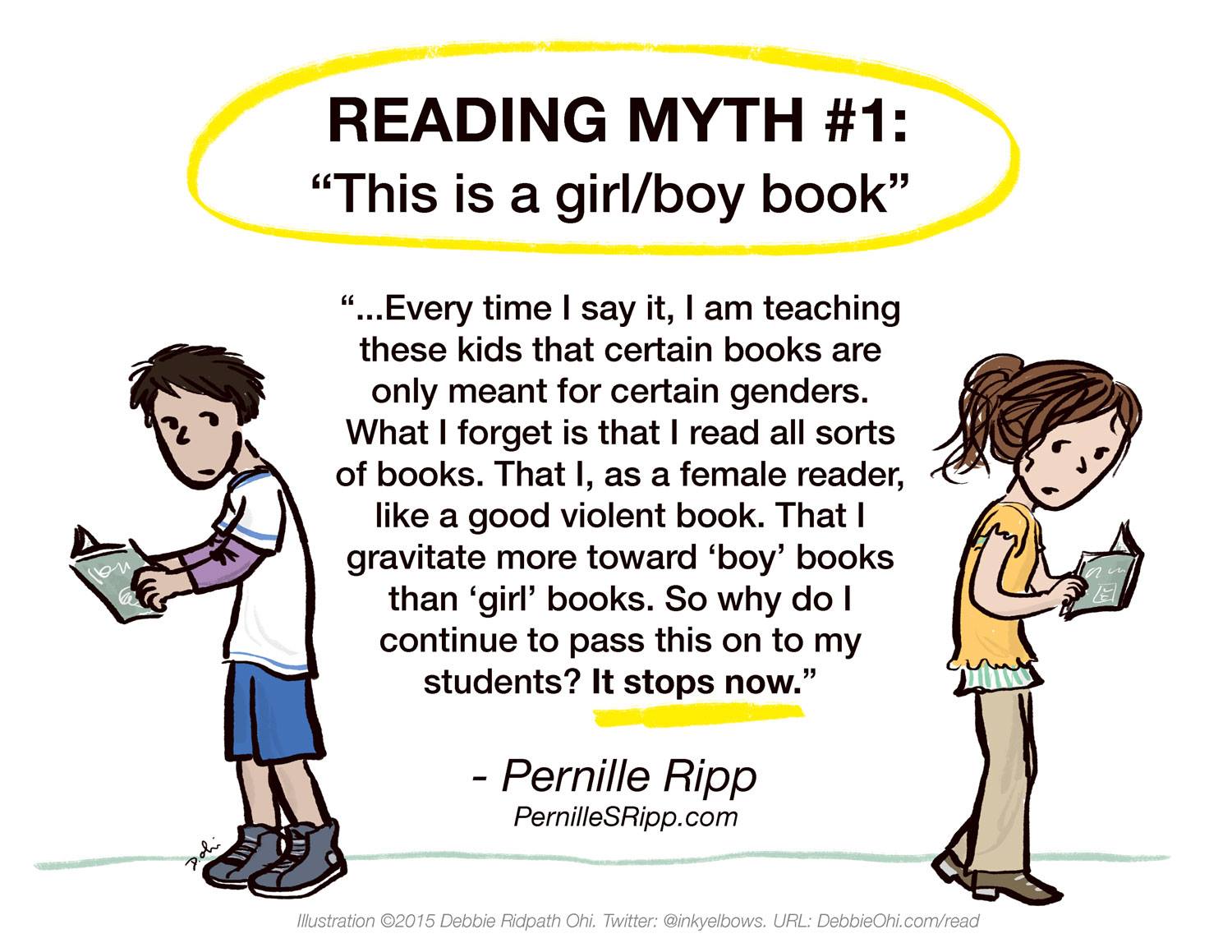
11232142_10153492591360196_439666777097332585_o
Thank you Debbie Ridpath Ohi for this image

“This is a girl/boy book.”  I have said this many times as I try to book talk a book.  I say it when I think the boys, in particular, will not give a book a fair chance because of its cover.  I say it when I think the girls will find a book to be too violent, to have too much action.  And every time I say it, I am teaching these kids that certain books are only meant for certain genders.  What I forget is that I read all sorts of books.  That I, as a female reader, like a good violent book.  That I gravitate more toward “boy” books than “girl” books.  So why do I continue to pass this on to my students?  It stops now.

“This is an easy read.”  Another common statement I have made while book talking.  What I mean by it is that for most students the text will not prove difficult to understand, yet I know now that ease of reading looks very different from student to student.  That what I may think is easy, even when I pretend to be a 7th grader, is not easy at all.  That even if a book is short does not make it easy.  Even if a book has a manageable story line does not make it easy.  That “easy” means different things to different readers and therefore does not provide a good explanation to anyone.  It stops now.

“He/she is a low or high reader.”  Our obsession with classifying students based on their data does not help our students, it only helps the adults when we are discussing them.  There is an urge in education to group kids according to data points so that rather than take the time to discuss each student, we can discuss them as a group.  Yet the terms “low” or “high” make no sense when discussing readers.  They make sense when we are discussing data points, but is that really all our students are?  How many of us have taught students who were amazing readers, yet scored low on a test?  What would we call them?  We need to discuss students using their names and their actual qualities, not these shortened quantifiable terms that only box them in further.  It stops now.

“Most boys don’t really like to read.”  I don’t know how many years of teaching boys I need to finally stop saying this.  Many boys like to read – period – but when we say that most don’t, we are telling them that what they love is not a masculine thing to do.  That boys loving reading is something strange and different.  If we want this to come true, we should just keep repeating this over and over.  Our male readers will soon enough get the message that reading is for girls.  It stops now.

“The older they get, the less they love books.”  I used to believe this, until I started teaching middle school.  Then I realized that it is not because students want to read less as they get older, they read less because we have less time for independent reading, and we dictate more of their reading life.  Homework builds up as do other responsibilities outside of school.  Compare a 5th grader who has 30 minutes of independent reading most days to my 7th graders that get a luxurious 10 minutes – who do you think reads more in a year?  Also, I wonder if anyone would want to keep reading if they did not get time for it in school or had choice over what they read for several years?  Sometimes I think it nearly a miracle that students’ love of reading can survive what we do to them in some educational settings.  It stops now.

“But they are not really reading…”  I used to be the hawk of independent reading, watching every kid and making sure that for the entire time their eyes were on the text.  If they stopped I was there quickly to redirect.  Independent reading time was for independent reading and by golly would I make sure that they used every single second of it.  Yet I don’t read like that myself.  When I love a book, I pause and wonder.  When I love a book, I often look up to take a break, to settle my thoughts.  When I love a book, my mind does not wander but I still fidget.  That doesn’t need a redirection, that doesn’t need a conversation, that simply needs to be allowed to happen so I can get back to reading.  Our students are not robots, we should not treat them as such.  Re-direct when a child really needs it, not the moment they come up for air.  It stops now.

“They are too old for read alouds…picture books…choral reading…Diary of Wimpy Kid…”  Or whatever other thing we think our students are too old for.  No child is too old for a read aloud.  No child is too old for picture books.  No child is too old for choral reading.  No child is too old for books like Diary Of A Wimpy Kid.  Perhaps if we spent more time showcasing how much fun reading really is, kids would actually believe us.  It stops now.

The myths we allow ourselves to believe about reading will continue to shape the reading lives of those we teach.  We have to stop ourselves from harming the reading experience.  We have to take control of what we say, what we do, and what we think because our students are the ones being affected.  We have a tremendous power to destroy the very reading identity we say we want to develop.  It stops now.  It stops with us.

If you like what you read here, consider reading my book Passionate Learners – How to Engage and Empower Your Students.  The 2nd edition and actual book-book (not just e-book!) comes out September 22nd from Routledge.