being a teacher, Literacy, Reading, Reading Identity, Student dreams

On “Easy” Books and Better Readers

It has been a summer of easy reading so far.  A few YA books, a graphic novel when the book I was reading hit a boring spot, picture books every day.  My professional development books beckon, but my brain is not ready.  I need to read to read.  To relax – summer has been crazy so far – to laugh, to discover new books that I can pass on to others.  To not think too much, I need easy books.; books that remind me why I love reading so much.

I was asked on Friday; what about the kids who read books that are much too easy, how will we challenge them?  The problem was implied; easy books don’t offer up real growth opportunities.  Easy books don’t develop their skills.  Easy books don’t push them forward in the ever-present journey toward becoming a better reader.

But it seems as if, in our well-meaning intentions, that we have forgotten what a better reader really is.  A better reader is not just someone who can just tackle complex texts, who can comprehend at a deep level, who can answer the questions on the test to back up what we already knew.  While those are aspects, they are not the only thing that makes a child a better reader.

A better reader is someone who sees reading as valuable.  Who recognizes the need to read because they will feel less than if they don’t.  Who sees reading as a necessity to learning, for themselves and not just for others.  Who sees reading as a journey to be on, something worth investing in.  And so I wonder; when we tell children not to read easy books, how much of that individual reading identity journey do we dismiss?

Easy books, whether they be graphic novels, books below their actual comprehension skills, free verse, audio books, or even picture books, can get such a bad reputation in our schools.  As if those books are only allowed in the brief moment of time when they fit your exact level, whatever level means.  As if those books are only meant to be discovered when you have nothing else to read, when you actually are allowed to read for fun, rather than for skill.  Yet these are the books that keep us loving reading.  That keeps us coming back.  Those books that we devour in one sitting because we must find out what happens next, aren’t those “easy” books for all of us?

Do we tell our students to embrace easy reading whenever they want to keep them loving reading?  Or do we push them so hard to develop their skills that their connection to reading breaks and then we wonder why reading becomes something just to do for school and tasks?

And yes, I teach that child that reads Diary of a Wimpy Kid every day, who is not sure of what else he can read that will make him love reading as much.  My job is not to tell him, “No, you cannot read that,” but instead to show him other options.  Not to take away, but to recommend, while also protecting the fierce commitment that exists between a child and a favorite book.  To explore why that child loves this book so much and then help discover others like it.  To acknowledge the reading relationship that already exists and to build on that rather than breaking it apart at all costs because I know better.

I am not dismissing the need to challenge kids to read more, to read longer, to read more complex text, but we must be careful with what we then say when it comes to what else they should read.  We must make reading for enjoyment, whatever that means for a child, a central part of our teaching so that children can understand that reading for enjoyment is just as, if not more, important than reading for a skill.  And the research agrees.  Kamil (2003) points out, “Motivation and engagement are critical for adolescent readers. If students are not motivated to read, research shows that they will simply not benefit from reading instruction.”  So are we making room to embrace those books that happen to make our children, and adults, love reading?  Or do we only focus on those texts that will continue to challenge them, to move their skills, unfocused on the other damage it may do?

While our job, as educators, is to develop children who can read, our job is also to develop children who want to read.  The two are not always taught together, so it is up to us, to make sure that when we plan for our reading experiences that “easy” books and anything else that may keep a child’s love of reading intact is not only welcomed but encouraged in our classrooms.  We must ensure that when we plan for reading instruction, that we plan for the protection of the love of reading.

If you like what you read here, consider reading my newest book, Passionate Readers – The Art of Reaching and Engaging Every Child, out August 2017.  This book focuses on the five keys we can implement into any reading community to strengthen student reading experiences, even within the 45 minute English block.  If you are looking for solutions and ideas for how to re-engage all of your students consider reading my very first book  Passionate Learners – How to Engage and Empower Your Students.      Also, if you are wondering where I will be in the coming year or would like to have me speak, please see this page.


being a teacher, Student dreams, student voice, survey

My End of Year Student Survey 2017

I owe my greatest growth as a teacher to the truths that my students have shared with me.  The courage that they have had to speak up for the type of education they would like to be a part of.  It is therefore only natural for me to ask all of my students for their honest feedback as we finish the year.  Every year, their surveys have shaped the coming year, whether it meant getting rid of a project or completely revamping something I knew was almost working.  My students’ answers have shaped much of my writing as well, both books and blog posts come from the answers they give me.

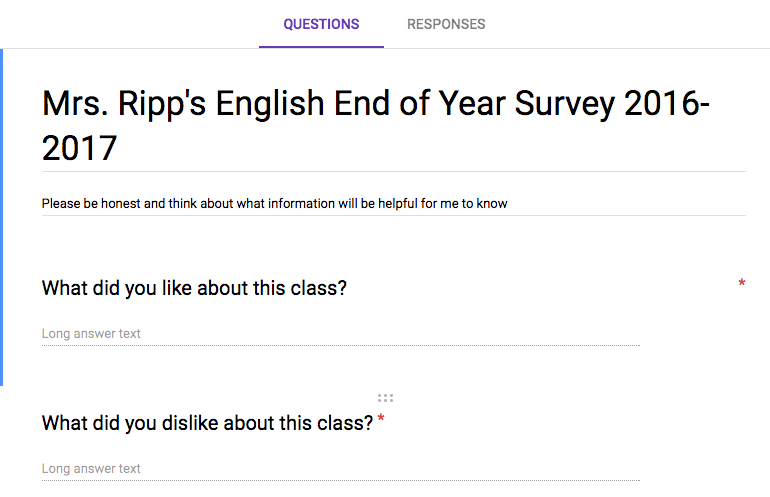
And what do I ask?  What I need to know; was this a good class for them, did I give enough help, what did they like or dislike?  Was I fair, did I get to know them enough?  How do they feel about reading, what do I need to change?  Anything I can think of that will help me grow, and not just the easy questions either, if a child did not like this class or felt disrespected then I need to know so I can change.

Mrs. Ripp's English End of Year Survey 2016-2017 - Google Forms.clipular.png

So I hope you take the time to ask your students as well as the year ends and then use those truths to change the way you teach.  Once again, we have the best professional development sitting right in our own classrooms, so don’t miss out on this opportunity to learn about what worked, what was ok, and what definitely needs to change.  I have given it both as a paper survey and an electronic one, this year I decided for a Google form.  To see what I asked, go here.

If you like what you read here, consider reading any of my books; the newest called Reimagining Literacy Through Global Collaboration, a how-to guide for those who would like to infuse global collaboration into their curriculum, was just released.  I am currently working on a new literacy book, called Passionate Readers and it will be published in the summer of 2017 by Routledge.If you are looking for solutions and ideas for how to re-engage all of your students consider reading my very first book  Passionate Learners – How to Engage and Empower Your Students.      Also, if you are wondering where I will be in the coming year or would like to have me speak, please see this page.

being a teacher, being me, Student, Student dreams, student voice

They Taught Me

I have taught children from the ages of nine to fourteen for the last nine and a half years.  I think I have taught them a few things, I hope I have, and if the comments I get from kids after they leave our classroom is any indication, then some of the things we dreamt up together did make a difference to them.

Yet, teaching was never about me.  This journey we are on every day, every year, was never about the adult in the room, but rather those kids that come every day.  Not always because they want to but because for some reason the universe has decided that we will be on this journey together.

So as another year winds down.  So as the calendar tells me only eight more days.  So as I finish my third year as a 7th-grade teacher, I cannot help but think of all the things my students have taught me this year.  Those things I don’t ever want to forget.

They taught me that being human would always trump being a teacher.

That a single story never has to define who we are, even if others refuse to believe otherwise.

That hugs can go a long way, even when said hug is to a child that towers over you.

That sometimes truths are not easy to share, nor easy to hear, and yet they can change everything.

That having faith in every child, not just the easy ones, will always take you further, even if it so hard.

They have taught me that I never know the full story and can only be grateful for the pieces that I get to know.

That choice in some way, even if tiny, will always lead to more engagement.

That I need to love first, teach second, thank you, Jed, for reminding me.

That sometimes kids don’t know how big of an effect they have on us even if we swear they set out to push ever single button they could find.

That the best part of my day will always be them, getting to teach them, getting to learn from them.

That sometimes teaching simply is preserving hope, more than anything else.

They have taught me that even when you want to shut your door, you should leave it open as you don’t know what you might miss.

That if we want real connections then we have to be real to begin with.

That even if something has worked in the past, there is no guarantee in the future.

That sometimes we don’t make much of a difference, even if we tried with every piece of us, and all we can hope is that we did not do further damage and that they knew we tried.

They have taught me that we are not perfect, that we can plan, and dream, and scaffold, and support, and yet still come up short.  That we are humans in the truest sense of the word and we are therefore inherently flawed, and yet, that should never stop us from trying to become better.

But the biggest thing, I was taught this year?

That I choose the narrative of how the year will be for me.  That I choose the way the story is told in our classroom.  That I choose whether this was a good year or a bad.

And that lesson was the lesson I needed the most.  I will miss this group of kids.

If you like what you read here, consider reading any of my books; the newest called Reimagining Literacy Through Global Collaboration, a how-to guide for those who would like to infuse global collaboration into their curriculum, was just released.  I am currently working on a new literacy book, called Passionate Readers and it will be published in the summer of 2017 by Routledge.If you are looking for solutions and ideas for how to re-engage all of your students consider reading my very first book  Passionate Learners – How to Engage and Empower Your Students.      Also, if you are wondering where I will be in the coming year or would like to have me speak, please see this page.

being a teacher, end of year, Student, student choice, Student dreams, student driven, Student Engagement

8 Ideas to Make the End of the Year Race Better

Have your students told you yet how many days that are left?  While it has been awhile for me, I can still feel it creeping up, sneaking up, whether we are ready or not; for many of us in the Northern hemisphere, the end of the year is near.  And if your students are anything like ours, then there may be excitement in the air mixed with a special kind of exhaustion that is threatening to derail even the best-laid plans.  So what can you, along with your awesome students, do to make these last few days or weeks better?  Here are a few ideas.

Make it matter.  And by this I mean; make it meaningful, make it count.  Now is the time to dig deep, to go personal, to make it something they will remember for a long time.  we end with out This I believe project, a student and teacher favorite every year and we work all the way up until the very last day.  I love how we end with something that ties us even closer together as a community, rather than just have us fade out in small to-do’s.

Teach with urgency.  This is not the time to slow down, instead, make every minute worth your time.  We start with reading, as always, and then we teach until the bell.  I want the days to go by fast, not drag on for everyone involved.

Increase student movement and talk time.  I love seeing the various projects our students are engaged in throughout our building, with many of them involving more movement and also more student agency.  Now is a perfect time to have students take the lead on projects if you haven’t before and also to incorporate as much choice as possible.  I was lucky enough to watch a PE class where students had to sit and write about their summer fitness goals, the kicker?  Every time they did a section they had to run and do other physical activities.  I loved seeing how even in writing, movement was incorporated.

Make memories.  Even if the students are ready to leave make sure you take the time to reminisce a little.  How has this year been?  What will they remember?  I try to have students write letters to the incoming 7th grade to offer them tips and ideas, these letters not only give me a way to welcome the new students but also to see what made a difference to my current ones.

Take them outside.  I used to shun the outside for teaching, after all, it was just so distracting.  Now we look for the days where we can get outside.  So far it has only been with my homeroom class for a quick walk, but the outside is calling all of my classes and I am thinking of a way to teach out there.

Survey them.  This is ripe reflection time for us as we start to look forward to next year so make sure you ask all of the questions you have.  While I have not finalized my end of year survey yet, last year’s told me a lot about which projects they loved, the ones they hated, and also how I could become a better teacher.  These kids know us so make sure you ask for their advice, after all, we have the best professional development sitting right in our classrooms.

Make plans for the summer.  I don’t think we should pretend that summer is not right around the corner, instead, we need to have some frank conversations about what their plans are and more specifically, what their reading plans are.  Many of my students told me today that they did not plan on reading at all, this is the reality many of us face, and yet I still have four weeks to showcase the most incredible books I can find.  Book talk with urgency and help them create long can’t-wait-to-read lists.  Partner with the next year’s teachers, partner with your school librarian, partner with those at home and help them remember to read.

Reflect on their growth.  I don’t think all of my students know how much they have grown, how much they can do, how much more they are now than when they began.  I think the is common for most kids, after all, growing smarter is a gradual affair.  So build in time for them to actual realize their growth, their successes, and also to goal set for next year.

Stay in the present.  Ah so that makes nine, but this one is so important.  It is so easy to get caught up in thinking about next year and even planning for next year, and yet; these are the kids we still have.  We are still in the current school year, so if we don’t stay in the present, neither will our students.  Love them, keep getting to know them, praise them, laugh with them, believe in them, and keep pushing them to strive for more.  After all, next year, you will miss them, we always do.  And just perhaps, if we are lucky enough, they will pop their heads in on that first day of school, just to say hi.

If you like what you read here, consider reading any of my books; the newest called Reimagining Literacy Through Global Collaboration, a how-to guide for those who would like to infuse global collaboration into their curriculum, was just released.  I am currently working on a new literacy book, called Passionate Readers and it will be published in the summer of 2017 by Routledge.If you are looking for solutions and ideas for how to re-engage all of your students consider reading my very first book  Passionate Learners – How to Engage and Empower Your Students.      Also, if you are wondering where I will be in the coming year or would like to have me speak, please see this page.

being a teacher, books, Literacy, Reading, student choice, Student dreams

On Assigned Summer Reading

Summer is coming closer here in the Northern hemisphere.  My own children add to our list of things to do every day;  we will play outside, we will swim, we will go to the library. Can we bake cookies?  Can we sleep in?  Can we watch movies?  Will our plants grow?  How will it be to fly on an airplane?  How many friends can I play with?  We will build a fort in our living room and read books together, we will listen to audio books as we take family trips in the car.  We will lead rich reading lives because we choose to, a privilege indeed.

Yet, as summer draws closer, now is also the time that schools start to think of their summer reading plans, or more specifically the required summer reading of the students.  The lists are being made, the books are being dusted off, and in our well-meaning intention we are thinking of all the reading this will inspire.  But will it really?

Somehow, somewhere, we seem to have forgotten that summer vacation, actually means just that; vacation.  Away from teachers, away from our rules, and yes, even away from the homework we sometimes feel like we have the right to assign.    That school is out for most.  That the children have worked all year, following our guidelines, investing in our work, and have therefore now earned the time off.  Even if we know that that time means they may not read, which, yes, I know how damaging that is.

Because the truth is; we have no right to tell children what to do on their time off.  We stretch it when we assign countless hours of homework during the school year but completely step out-of-bounds when it is over the summer.  I know it comes down to us meaning well; we want kids to read over the summer, we want them to come in knowing a shared text.  We want to prevent the summer slide.  We want to get to know them as readers, as writers, as thinkers and so we figure; what is one little book and this assignment really in the grand scheme of summer when the benefits far outweigh the potential negative consequences?  And yet, we forget that not all children have time to read over the summer?  That not all children will be able to read the book assigned?  That not all children have access to a safe place where they can work on homework during their time away from us.

So it is time to re-think this practice.  To really think of the potential damage the assigned summer reading list can do.  Sure, you will have those kids that love it, that read their books diligently and come to class prepared, eager to share and discuss further.  Those are not the kids we worry about when it comes to hating reading.  But the kids that wait until the very last-minute, the kids who fake it, who show up not having read.  Dictated summer reading means that they have just started a brand new year, one that was supposed to be a clean slate, already behind.  They have just started with yet another negative experience that only further cements how pointless reading is, how it is just something you do because the teacher tells you so.  And that matters, because those are the kids we need to somehow show that reading does matter, that being a reader matters. Those are the kids we need to get to trust us so that when we build can’t-wait-to-read lists together, there is actually a fighting chance that they may read a book.


So what can we do instead?  How can we potentially inspire summer reading, especially for the kids that already are so behind their reading development?

Just don’t assign it.  I know that seems blunt, and it is.  Really question the practice itself and see if the positives outweigh the negatives.  Find a different way to start the year, such as by doing a short read aloud together.  Give all kids a chance at starting in the same spot, rather than automatically setting some kids up for failure.  Ask the students themselves; would they like to?  If not, what would they like instead?  It may seem simple, but this minor thing is so often overlooked when we plan things for students to do.  For the kids it works for; assign it, for those it doesn’t, don’t.  Why waste our time assigning something we know won’t get done no matter the threats attached to it?

Start the year before.  In room 235D we have already started discussing our summer reading plans.  Not the ones I could make for the kids, but the ones that kids are making.  What will they read?  Where will they read?  How will they find books?  While some kids look at me like I am crazy, the constant repetition makes some of them see the importance of the need to read.  And for those who truly cannot wait to not read over the summer, well, we try other things.

Summer book check out.  The last few years, I have done a lot of book talks before the end of the year.  Rather than shut down our classroom library, I have left it open, encouraging kids to borrow books over the summer.  Our library is familiar, our library is a known entity, and so the books that are being introduced often seem less intimidating than the prospect of going to another library over the summer.  I merely keep a list of books borrowed and then check in with students once school starts again.  The same things goes for the school library; have it open a few days in the summer so that kids can come and book shop.

Summer book clubs.  If you are set on having students read over the summer, how about offering it up as a book club option?  Make your meetings special, read the book together and discuss.  Reach out to those you think will not read, ask the previous year’s teachers for a recommendation and then go out of your own way to show that this matters, because otherwise, why should it matter to students?

Have different accessibility.  Again, if you must assign a book, make sure you have different ways of reading it.  Can kids listen to it?  Can they partner read?  Can they meet and have it read aloud?  Yes, this means work, but it is only fair that if we ask students to work over the summer, then we should too.

Create choice lists.  Why one book?  Why the need for certain classics?  Why not create themed sets such as pairing classics with contemporary books?  Some kids may read the classic, others may read the newer book – think of the discussion that can ensue from NOT having read the very same book.

In the end, our assigned summer reading is really more for the teacher’s sake than the students.  It offers us a place to start, we are already ahead, well into the curriculum on that first day of school, and yet, it offers little in return to the student.  Why not focus our energy on creating amazing reading experiences while we have the students?  Why not tell them that in our classroom they are expected to work hard, to use their time well, to be invested, so that when they leave they can use their time whichever they want.  Why not create reading experiences that actually entices further reading, rather than further dictation of what kids are expected to read?  Perhaps now would be a good time to examine our summer reading practices before the damage is potentially done.

If you like what you read here, consider reading any of my books; the newest called Reimagining Literacy Through Global Collaboration, a how-to guide for those who would like to infuse global collaboration into their curriculum, was just released.  I am currently working on a new literacy book, called Passionate Readers and it will be published in the summer of 2017 by Routledge.If you are looking for solutions and ideas for how to re-engage all of your students consider reading my very first book  Passionate Learners – How to Engage and Empower Your Students.      Also, if you are wondering where I will be in the coming year or would like to have me speak, please see this page.

Be the change, being a teacher, Student dreams

To the Very Last Day

She was nine, tall for her age, with shoulder length brown hair and parents who deeply cared about her, but not each other.  She looked to me as if I had all of the answers, as if, in our classroom, everything that was happening outside would be forgotten, would not hurt as much as it did.

He was nine as well, dark brown hair, the oldest in his family and already labeled the broken one.  The one that could not be trusted.  The one that did not care.  The one that heard his parents fight about his intellect even when they said they believed in him to his face.

He was ten.  Tiny for his age but solid muscle, hands clenched in fists most of the day waiting for the next threat, for the next person that would see him as an easy target, waiting to prove them wrong.  He hugged my pregnant belly whenever he could and whispered his words of advice to the baby.  “Be strong baby, be kind baby, come soon baby.”  I cried the day he left.

He was eleven and had already experienced the biggest loss he could.  As he placed the picture of his mother into my hands and told me it was the most precious item he owned, I sat in silence.  How could a child who had lost so much still trust me with so much?  How could he show up and want to discuss books with me when it seemed so irrelevant in the face of it all?

How could any child, who has faced trauma, possibly find relevance in what we do all day?  In writing, in reading, in speaking well?

And yet he did, and yet they did.  They came to class, on the first day and on the last, hoping that in this classroom, that within our school they would be seen.  They would be heard.  They would be loved, not just on the days where everything went well, but also on the days where it didn’t.  On the days where they pushed as hard as they could just to see if we still stood there when they were done.

And I think of my own kids.  How different they all are.  How none of them learn in the same way.  How all of them have their own loud personalities.  How all of them make me hold my breath as they enter new phases in their lives and I hope that wherever they go, they are met with open arms, because underneath all of the crazy, underneath all of the yelling, underneath all of the sometimes struggle, there are these kids that will love their teachers like only they can.  Underneath all of the things that perhaps do not fit into what a typical learner looks like, there is this kid that just wants to be liked and taught in a way that makes sense for them.  That will tell me to buy their teacher flowers, and please get the pink ones, because pink is her favorite color.  That will ask me how they can possibly go on to the next grade level because that means leaving this teacher behind.  That worry that perhaps next year they will not like school as much, and I hold my breath and hope they will.

Those kids with their stories.  Those kids with their broken hearts.  Those kids with their stoic facades.  Those kids with seemingly perfect lives that still come to us with such a chip on their polished shoulders.  Those kids that dare us to prove them wrong, that tell us they hate school, that they hate us.  Those kids who tell us they don’t need us and for a brief moment we believe them because after all, we are only human, and there is only one of use and so many of us, and perhaps, we are not the teacher that will make a difference.   And perhaps I am a terrible teacher.  And perhaps I have no idea what I am doing.

Those kids that tell us so many times that everything is stupid that we actually believe them and we are left with nothing but the fragments of what we thought made a great teacher.  Those are the kids that will push us to the very last day.  Who may fight us until the very last minute.  Who will continue to push, to yell, to tell us how little they care, just to see how we will react.  And so for them, we stand tall.  For them, we keep trying.  For them, we believe.  Because sometimes being a teacher simply means having more faith in the child than the child has in themselves.  And so that is my plan as the days count down.  To believe.  To try.  To love.  And to always remind myself that while I may not be enough right now, I am the teacher they have and so for that very reason alone, I have to keep believing I might be.

If you like what you read here, consider reading any of my books; the newest called Reimagining Literacy Through Global Collaboration, a how-to guide for those who would like to infuse global collaboration into their curriculum, was just released.  I am currently working on a new literacy book, called Passionate Readers and it will be published in the summer of 2017 by Routledge.If you are looking for solutions and ideas for how to re-engage all of your students consider reading my very first book  Passionate Learners – How to Engage and Empower Your Students.      Also, if you are wondering where I will be in the coming year or would like to have me speak, please see this page.