books, Literacy, Passion, Reading, student voice

On Reading Identity – An Essential Question to Ask Our Students

http---www.pixteller.com-pdata-t-l-190454

I have been watching my students carefully the last few weeks, waiting, holding my tongue, and just seeing what happens.  We have started every day with 10 minutes of independent reading, which yes, sometimes is so hard to give because I feel the pressure of what I have to cover bear down on me.  And yet, I know that giving my students independent reading time, particularly in the middle school, will make the biggest difference between whether they are readers or not.

So I have watched, and I have noticed the child that has already read 5 books on his device.  Absorbed, enthralled, and recommending books to me.  The child that is still re-reading the same old books that he has re-read the last few years, afraid to take a chance on something new.  There is the child that has asked me if she could please listen to the next book and will that count as reading?  (The answer is yes, of course).  And then there is the girl that has been sharing her truth with me in small casual comments; she hates reading, always has.  Reading was fun in kindergarten when she had to listen but that was it.  She says it likes it’s no big deal.  Like it is fact.  Reading is not for her and never will be.  So I tell her I will try to make reading better and she answers “That’s what they all say, Mrs Ripp.”

That’s what they all say.

Every teacher who has had her has told her the same thing; I will help, I will make it better, I will try.  And yet, she stands before me now confessing that reading makes no sense to her.  That even when she has pictures it makes no sense.  And it doesn’t matter how many strategies she tries, it’s too hard and she will just read whatever,just so she can get through it.  Because getting through reading is the only thing she knows how to do.  Even though she has support.  Even though she has teachers who care.  And So I ask more questions, trying to discover just who she is, and what her reading identity means to her.

So often, we feel the pressure to teach.  We feel that every time we speak to a student we must offer them up a kernel of truth, some inspiration, and a thing to try.  We do it so that reading can become better for them, so they can comprehend deeper, understand it more, and develop their skills.  Yet, in slowing down these past few weeks, I have learned yet another lesson when it comes to our readers;  We cannot teach them well if we do not know their reading identities.  And sure, that comes through speaking with them, but it also comes through quiet observation and casual conversations.

The students know what we want to hear.  They will not tell us their truths until they trust us. So I withhold my judgment, reel back my eagerness to fix, and I pay attention, and I listen.  Our students speak so loudly, yet we often forget to hear it.

So as they read or not read, depending on their choice, I sit next to them and ask quietly; “Are you a reader?”  They are often surprised at the question, yet how they answer it tell me so much.  I thank them and I move on.  I take notes on my reader profile sheet and I ponder what the next step should be.  How this year will help them and not hurt them.

We are not yet ready to talk strategies.  We are not yet ready to talk goals, other than finding great books.  We are not ready to analyze text, break it apart, or even compare.  Not as a class any way.  But we are ready to share our truths.  They are ready to declare whether reading is for them or not.  And I am ready to listen.  Are you?

If you like what you read here, consider reading my book Passionate Learners – How to Engage and Empower Your Students.  The 2nd edition and actual book-book (not just e-book!) just came out!

advice, aha moment, Be the change, being a teacher, being me, student choice, student voice

Why Are They Disengaged? My Students Told Me Why

I used to think that when students were disengaged it was their own fault, and while sometimes that is still true, I have found in my years of teaching that a lot of the fault lies with me as the teacher.  Yet, realizing that I may be the cause of my students disengagement is hard to swallow.  It certainly has not done wonders to my self-esteem, and yet, there is something liberating about realizing that while I am a part of the problem, that also means that I can fix it.  Or at the very least fix the things I control.  Student disengagement is something I can do something about.

But why are students so disengaged?  What lies behind the restlessness, the misbehavior, the bored stares?  Every year I survey my students throughout the year, and particularly on those days where nothing seems to be working.  I ask them simply to explain what is going on and they share their truths with me.  So here are their truths on student disengagement.

Students become disengaged, because..

They feel no connection to you.  I often notice that students are much more off task in the beginning of the year when we don’t know each other, right after the honeymoon is over.  This is when we seem to be in limbo and so I spend a lot of time having a lot of conversations with my students, I share stories from my life, and I speak to them in the hallways.  Students will work for you if they like you, so I try to be likable.  It may seem simple but it is repeated so often by my students.

They feel no urgency.  I have 45 minutes per class so the urgency is always there.  It is not the threat of a deadline that makes my students work at a faster pace, it is the promise of the next adventure that lies ahead.  My students and I make a deal that if they work hard and stay focused then I do not give them homework.  They know that they are given as much time in class as I can give them so they know to use that time well.  The students that don’t; they have to do the work outside of school.

They feel there is no purpose.  I use to assume that students knew what the greater purpose of something was, but they don’t.  So now we spend time deconstructing our standards and we speak about the connections between things.  We speak of why we are learning something and how it fits into our lives, not just how it is preparing us for the next year or for college.  We speak about how the learning we do right now allows us to become better human beings.

They feel they have no power.  When students feel powerless in our rooms, most become disengaged.  Particularly those kids who have often had behavior issues in the past.  Those are the kids, in particular, that need to feel like they have more control over their day.  This is why I proselytize about student choice.  Give them choice, even if just in a minor way like telling them they can sit wherever they want.  Give them power over their day so that they feel like who they are matters.

When the teacher talks too much.  We do.  We need to stop.  We need to set a timer or whatever will stop us from going on and on.  Give them knowledge then let them work with it.  Give them a chance to speak as well, after all, they are the ones that should be doing the learning.

When the teacher does not personalize.  How often do we know whether a child already knows something?  How often do we plan to find out so that we can create new learning experiences for them?  If a child has already mastered something, then let them work on something else, something more challenging.  But to do that, you have to find out what your students know.  Ask them whether through a survey, an informal pre-test, or a conversation.  Not everyone comes to us as a blank canvas.

When they do mostly worksheets.  I have moved far away from worksheets over the past few years, but that does not mean all worksheets are bad.  If a worksheet gives foundational knowledge that will be used for further learning then it can be ok.  However, if using a worksheet is part of the routine every day, or is not used for anything more, then there seems to be no deeper learning purpose behind it.  Students have told me they feel like when most teachers give them a worksheet it is because we are too lazy to teach them.

When the learning becomes something to just get through.  I have done this, said that we just need to get through this to get to fun thing.  Yikes.  When we say this, students automatically disengage from the task, after all, if teachers see no value in it, why should they?  Yes, there are things that we don’t love to teach as much so then make it better.  If it is boring or a struggle for us, then think of how it feels for the students.  We are in charge of bringing the passion into our rooms.  Not just the students.

While there are still days in our classroom where I know that students were not as engaged as I hoped, there are more great days than bad.  There are more days where students stay on-task, where they get involved, and where meaningful learning occurs.  Every year, I start over with my students and how to best engage them.  Every year I learn a new way to keep them on-task.  Yet I have learned that the biggest thing for me is to keep the above list in mind at all times.  Even if I feel like I have planned the very best lesson.  Even if the day before went really well.  I do not take my students’ engagement for granted, instead it is something I work for.  Do you?

PS:  For ideas on how to evaluate why students are becoming disengaged tune in tomorrow.

If you like what you read here, consider reading my book Passionate Learners – How to Engage and Empower Your Students.  The 2nd edition and actual book-book (not just e-book!) comes out September 22nd from Routledge, but rumor has it that it is out on Kindle already!

being me, Literacy, Passion, Reading, student voice

At Any Given Moment We Have the Power to Stop the Hatred of Reading

recite-io73x2

It used to astound me that my 4th graders would come to me and profess a hatred of reading.  It used to shock me to the core.  After all, these were the same kids that would ask for just one more page of our read aloud.  Who would ask me to read a picture book aloud the minute it came to our room.  Who had no problem confessing the love for the book we were sharing, but had none for the one they were reading alone.  I always thought that the next year’s teacher would surely get them on the right path even if I couldn’t.

Now I am the next year’s teacher, and their dismay of books has only grown further.  The group of children telling me that they never read outside of school has only grown.  And this is not a boy-reader problem, this is an any gender problem.  This is not something just caused by poverty, nor disengaged parents, nor reading difficulties.  I see the hatred of reading defended the most from my students who have had every opportunity to fall in love with reading.  I know I am not alone in this.  And I know I cannot wait for someone else to fix it.

So I started to dig a little deeper.  I get that they “hate” reading, but why?  What parts was it that caused so much emotion, or sometimes so little, that students would have a physical reaction to whenever we had independent reading time.  And their truths were not pretty, because the finger they pointed, pointed right at me.  Or us, as educators.

We may think that it is too easy to blame teachers for the systematic destruction of reading love in our schools, and it is, because there are forces beyond our control that have a huge part in this as well.  But part of the blame does lie with us, and that means we can do something about it.  Especially in the upper grades where reading is no longer treated as something magical, but instead merely something useful.

At any given moment, we have the power to stop ourselves from telling students what to read.  In our eagerness to shape well-rounded readers we are instead creating non-readers.  In our eagerness to make sure students are exposed to all types of books, we are limiting them from discovering their own reading identity.  Would we rather have a child that reads every single fantasy book they can come across, or a child that begrudgingly only reads a few books a year from other genres?

At any given moment, we have the power to make reading fun again.  Fun is a not a swear word in our schools.  There is nothing wrong with discovering a book that makes us laugh, or makes us wonder, or makes us think.  Reading does not always have to have a purpose.  It can be just to share a wonderful experience.

At any given moment, we have the power to stop interrupting children while we read.  To not point out every single detail.  To not have them do post-its for every thought they have.  To not have them turn-and-talk every few minutes.  Let them reach the reading zone as Nancie Atwell calls it.  And not just once in a while but most of the time.

At any given moment, we have the power to reclaim what reading should feel like in our classrooms.  To stop always using whole-class novels.  To stop furthering our own vision for what makes a reader a reader.  To stop hanging our own reading identities around the shoulders of students and wonder why it does not fit?

At any given moment, we have the power to create classrooms where reading is magical.  Where reading is celebrated.  Where reading is taught, but taught in a way that does not extinguish the love of the very thing we are trying to promote.  But we have to look at our own practices first, we have to stand up and change.  We have to ask our students what we are doing so that we can be better.  So that their love of reading does not have to survive our classrooms.  So that their hatred for reading does not have room to grow.  But it starts with us, not them.

If you like what you read here, consider reading my book Passionate Learners – How to Engage and Empower Your Students.  The 2nd edition and actual book-book (not just e-book!) comes out September 22nd from Routledge.

being me, student choice, student voice, voice

I Wrote This Post

recite-13iqtjc

I wrote this post three different ways, and none of them spoke my words well.  I wrote this post three different ways but none of them said what I really wanted to say.  I wrote this post three different ways all leading me to the same question; where are the students’ voices in our professional development?

Where are the voices of those we say we need to reach?

Because if they are not speaking to teachers as we prepare for yet another year.  If they are not on our committees.  If they are not at some of staff meetings.   If they are not there speaking to us throughout the year, then who are we really preparing for?

That’s it.

PS:  In my district today at our vision conference, we had a student-led panel for an hour and half talking about the good and bad in their education.  The whole afternoon was then spent reacting to what the students said.  I have learned more today about being a good teacher then I have at many conferences.  And that quote at the top came from one of our students today.

PPS:  To see all of the surveys I use with students and parents to get to know them better, go here.

If you like what you read here, consider reading my book Passionate Learners – How to Engage and Empower Your Students.  The 2nd edition and actual book-book (not just e-book!) comes out September 22nd from Routledge.  

being a teacher, Literacy, Passion, Reading, student choice, student voice

Stop Feeding the Beast – The Reading Myths We Pass on As Truth

“This is not a “girl” book even if the cover makes you think it is, boys can love it too…”And I stop myself.  And I cringe inwardly.  And I want to rewind time for just 10 seconds and tell myself to stop.  A “girl” book?  What in the world is that?  And since when did I label our classroom books by gender?

The stereotypes of reading seems to be a beast in itself.  We feed the beast whenever we pass on hearsay as fact.  We feed the beast whenever we fall victim to one of these stereotypical sayings without actually questioning it.  Through our casual conversation we teach our students that there are books for girls and books for boys.  We teach our students that a strong reader looks one way, while a struggling reader (God, I hate that term) is something else.  We say these things as if they are the truth and then are surprised when our students adopt the very identities we create.

So what are the biggest myths that I know I have fed in my classroom?

11232142_10153492591360196_439666777097332585_o
Thank you Debbie Ridpath Ohi for this image

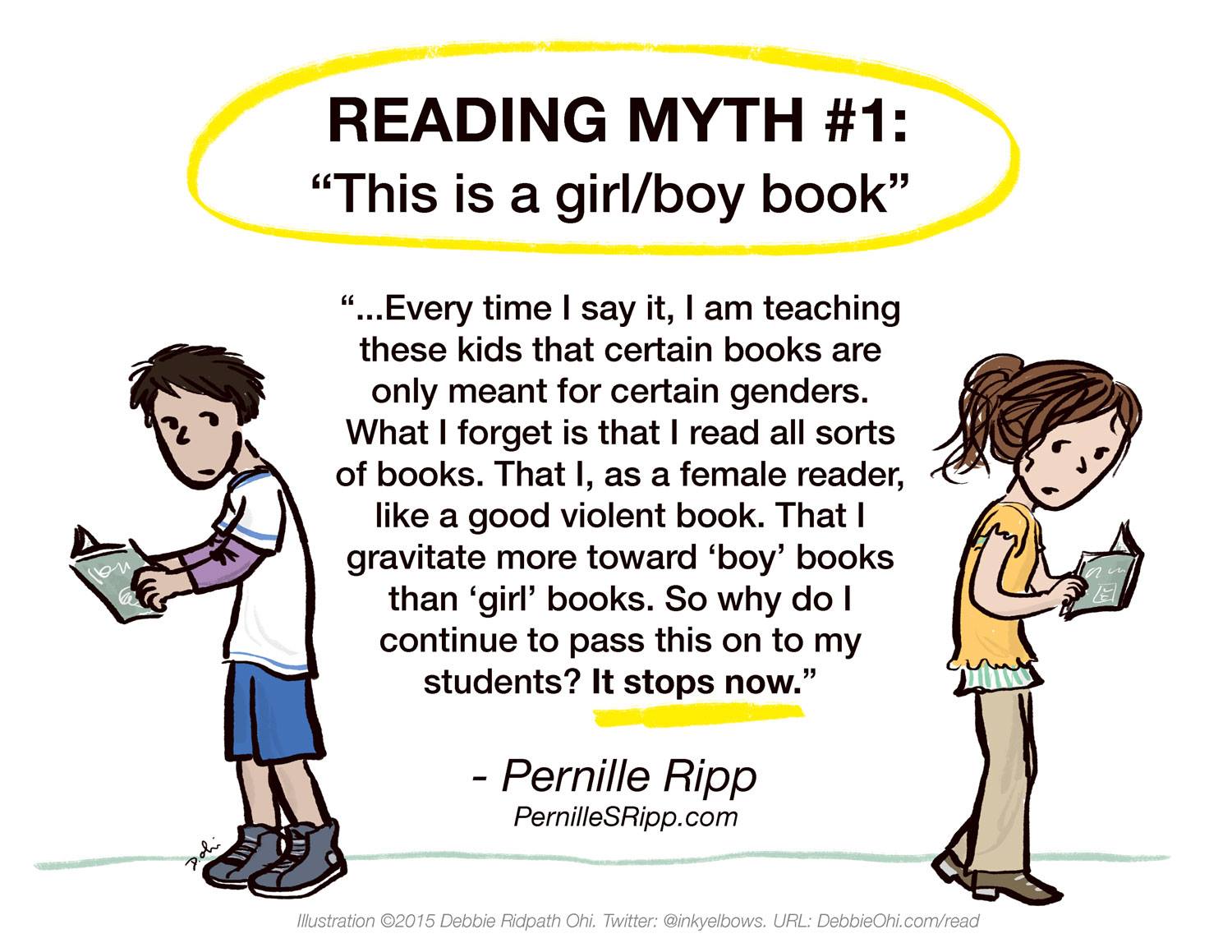
“This is a girl/boy book.”  I have said this many times as I try to book talk a book.  I say it when I think the boys, in particular, will not give a book a fair chance because of its cover.  I say it when I think the girls will find a book to be too violent, to have too much action.  And every time I say it, I am teaching these kids that certain books are only meant for certain genders.  What I forget is that I read all sorts of books.  That I, as a female reader, like a good violent book.  That I gravitate more toward “boy” books than “girl” books.  So why do I continue to pass this on to my students?  It stops now.

“This is an easy read.”  Another common statement I have made while book talking.  What I mean by it is that for most students the text will not prove difficult to understand, yet I know now that ease of reading looks very different from student to student.  That what I may think is easy, even when I pretend to be a 7th grader, is not easy at all.  That even if a book is short does not make it easy.  Even if a book has a manageable story line does not make it easy.  That “easy” means different things to different readers and therefore does not provide a good explanation to anyone.  It stops now.

“He/she is a low or high reader.”  Our obsession with classifying students based on their data does not help our students, it only helps the adults when we are discussing them.  There is an urge in education to group kids according to data points so that rather than take the time to discuss each student, we can discuss them as a group.  Yet the terms “low” or “high” make no sense when discussing readers.  They make sense when we are discussing data points, but is that really all our students are?  How many of us have taught students who were amazing readers, yet scored low on a test?  What would we call them?  We need to discuss students using their names and their actual qualities, not these shortened quantifiable terms that only box them in further.  It stops now.

“Most boys don’t really like to read.”  I don’t know how many years of teaching boys I need to finally stop saying this.  Many boys like to read – period – but when we say that most don’t, we are telling them that what they love is not a masculine thing to do.  That boys loving reading is something strange and different.  If we want this to come true, we should just keep repeating this over and over.  Our male readers will soon enough get the message that reading is for girls.  It stops now.

“The older they get, the less they love books.”  I used to believe this, until I started teaching middle school.  Then I realized that it is not because students want to read less as they get older, they read less because we have less time for independent reading, and we dictate more of their reading life.  Homework builds up as do other responsibilities outside of school.  Compare a 5th grader who has 30 minutes of independent reading most days to my 7th graders that get a luxurious 10 minutes – who do you think reads more in a year?  Also, I wonder if anyone would want to keep reading if they did not get time for it in school or had choice over what they read for several years?  Sometimes I think it nearly a miracle that students’ love of reading can survive what we do to them in some educational settings.  It stops now.

“But they are not really reading…”  I used to be the hawk of independent reading, watching every kid and making sure that for the entire time their eyes were on the text.  If they stopped I was there quickly to redirect.  Independent reading time was for independent reading and by golly would I make sure that they used every single second of it.  Yet I don’t read like that myself.  When I love a book, I pause and wonder.  When I love a book, I often look up to take a break, to settle my thoughts.  When I love a book, my mind does not wander but I still fidget.  That doesn’t need a redirection, that doesn’t need a conversation, that simply needs to be allowed to happen so I can get back to reading.  Our students are not robots, we should not treat them as such.  Re-direct when a child really needs it, not the moment they come up for air.  It stops now.

“They are too old for read alouds…picture books…choral reading…Diary of Wimpy Kid…”  Or whatever other thing we think our students are too old for.  No child is too old for a read aloud.  No child is too old for picture books.  No child is too old for choral reading.  No child is too old for books like Diary Of A Wimpy Kid.  Perhaps if we spent more time showcasing how much fun reading really is, kids would actually believe us.  It stops now.

The myths we allow ourselves to believe about reading will continue to shape the reading lives of those we teach.  We have to stop ourselves from harming the reading experience.  We have to take control of what we say, what we do, and what we think because our students are the ones being affected.  We have a tremendous power to destroy the very reading identity we say we want to develop.  It stops now.  It stops with us.

If you like what you read here, consider reading my book Passionate Learners – How to Engage and Empower Your Students.  The 2nd edition and actual book-book (not just e-book!) comes out September 22nd from Routledge.  

being a teacher, books, Literacy, Reading, student voice

Books Are A Chance To See the World They Do Not Live In

recite-j7nids

My classroom library is a large mix of reads.  Several thousands of books greet my 7th graders when they enter and are free to leave the room in their hands.  Over the last year I have tried to expand it as much as I can afford to make sure that it represents the world we live in, that it represents their experiences, that they can find themselves within our library and use that knowledge to boost their own lives.  My students need to see themselves in our books.

Yet, after a conversation with a great friend, I realized that it is not so much the need to find themselves within our library that I should be focused on because let’s face it, most of the world surrounding them is filled with images that look just like them, sound just like them, and share many of their same experiences.  They are used to turning on the TV and seeing kids that are like them.  They are used to picking up books and seeing like them in the pages.  To  many of my students seeing something other than white is uncommon.  For my mostly white, rural population of readers it is important that they find the rest of the world in the pages.  That through our library they can experience the world that they do not live in.  That their emotions can be stretched to encompass events that they will most likely never have to encounter.  That the library provides them with a window to things that they most likely will never have to live through such as racism, extreme poverty, no access to education, civil war, religious intolerance and a myriad of other issues that exists in only small ways in most of their lives.

So when we rally the cry for diverse books, it is not just so that our kids can find themselves within our pages and find books that mirror their experience.  It is so they can see the world they do not live in.  It is so they can see a world that may not make sense to them and start to make sense of it.  It is so they can start to develop empathy, interest, and community with other parts of the world, other societies, other experiences that do not mirror their own.

Most of my students have plenty of books that they can find themselves in.  My job is to provide them with ones they can’t.

I am a passionate teacher in Oregon, Wisconsin, USA but originally from Denmark,  who has taught 4th, 5th, and 7th grade.  Proud techy geek, and mass consumer of incredible books. Creator of the Global Read Aloud Project, Co-founder of EdCamp MadWI, and believer in all children.  The second edition of my first book Passionate Learners – How to Engage and Empower Your Students” is available for pre-order now.   Second book“Empowered Schools, Empowered Students – Creating Connected and Invested Learners” is out now from Corwin Press.  Join our Passionate Learners community on Facebook and follow me on Twitter @PernilleRipp.