Next week, in my 3rd grade Danish class, we’re starting something new — or maybe something old, just done differently.
We’re bringing the Thinking Classroom to our literacy work. I have seen the excitement from it in math, which made me wonder; how can we model the same concept but within ELA (or DLA in my case 😊).
So in true Pernille fashion, I asked if anyone was interested in seeing the slides with prompts I had made in either Danish or English, and it turned out that, yes! Many were interested, thus this blog post. I’ve made about 40 slides filled with open-ended prompts — things that make kids talk, think, argue a little, and notice patterns together. They’ll work in groups of three at whiteboards with pens in hand, no right answers in sight.
Some prompts are silly. Some are uncomfortable. Some might just stay half-finished on the board — and that’s fine. The goal isn’t to finish, it’s to think.
We’ll spend 15–20 minutes at a time exploring ideas like the rules of horror, what truth really means, or how emotions might have colors. The work will shift with them — from laughter to silence to something that feels almost like discovery.
I can’t wait to see what happens next week when we start.
If you want the Danish slides, join my Facebook group: Læselyst i Danmark.
In my Patreon community, a fellow educator recently reached out with a growing concern: their district has mandated the exclusive use of Lexile-leveled texts in English classes. That’s right—only texts that align with students’ grade-level Lexile scores are now considered acceptable. The frustration in their message was tangible. Texts that students love, that have sparked rich discussions, and that they’ve built curriculum around are now off-limits because they don’t “fit” the approved band.
I’ve long raised concerns about the over-reliance on Lexile scores. Like many of you, I’ve seen firsthand how these measures, while perhaps well-intentioned, can be wielded in ways that do real harm to reading joy, choice, and depth. So, if you’re facing increasing pressure to center Lexile in your classroom—if you’re trying to navigate a system that keeps narrowing what “counts” as appropriate reading—I hope these thoughts and ideas help.
Limitations of Lexile
Limited Understanding of Text Complexity
Lexile scores are essentially math. They rely on sentence length and word frequency—quantifiable features that can be measured by an algorithm. But we all know that complexity is never just about numbers. A book like Night comes in at a relatively low Lexile level, and yet its themes of loss, isolation, and moral ambiguity leave readers shaken. A text might be “simple” on paper but profound in practice.
Instead, try:
Use a text complexity triangle (quantitative, qualitative, reader & task) when planning. Bring students into that process—ask, What makes this book challenging? What makes it powerful?
Encourage student reflection journals or book clubs where kids identify their own “hard” books—not based on Lexile, but on how the text made them think, feel, or struggle.
Create classroom charts that define complexity through student terms: “Books that made me cry,” “Books I needed to reread,” “Books I’ll never forget.”
Considerations:
How does Lexile account for the cultural and historical significance of a text?
What qualities of a book matter most to your students?
How can we expand students’ definition of what makes something “challenging”?
Exclusion of Inclusive Texts
One of the most heartbreaking outcomes, and oft-overlooked aspects, of Lexile-only policies is the quiet erasure of culturally rich and relevant literature. Books written in vernacular, verse, or translanguaged text often get pegged with a low Lexile, despite their emotional and intellectual heft. That means fewer books by authors of color, fewer windows and mirrors for our students, and fewer moments of deep connection.
Instead, try:
Curate parallel text sets: pair a high-Lexile nonfiction article with a lower-Lexile but deeply resonant novel or memoir. Let students draw connections between form, voice, and truth.
Push back by documenting engagement: show how students are thriving with texts “below level” by collecting writing, discussion notes, and self-reflections.
Use picture books and graphic novels with older readers—these often get dismissed due to low Lexile, yet offer rich analysis opportunities and accessibility.
Considerations:
What culturally relevant texts are missing from your curriculum because of Lexile?
How can student voices help you advocate for broader criteria?
How do we make the case that what students read matters more than how difficult it is to decode?
Narrowing Students’ Reading Choices
If we want kids to love reading, we have to let them choose what they read. That means trusting them with books that fall outside their “band.” Lexile-driven mandates send the opposite message: we don’t trust your choices, your interests, or your readiness. But reading joy isn’t built through constraint. It’s built through access, autonomy, and meaningful support.
Instead, try:
Build “just-right-for-me” libraries where students classify books based on interest, not level. Include sticky notes with peer reviews and genre tags.
Hold 1:1 conferences where students reflect on how books make them feel, not just how hard they are to read.
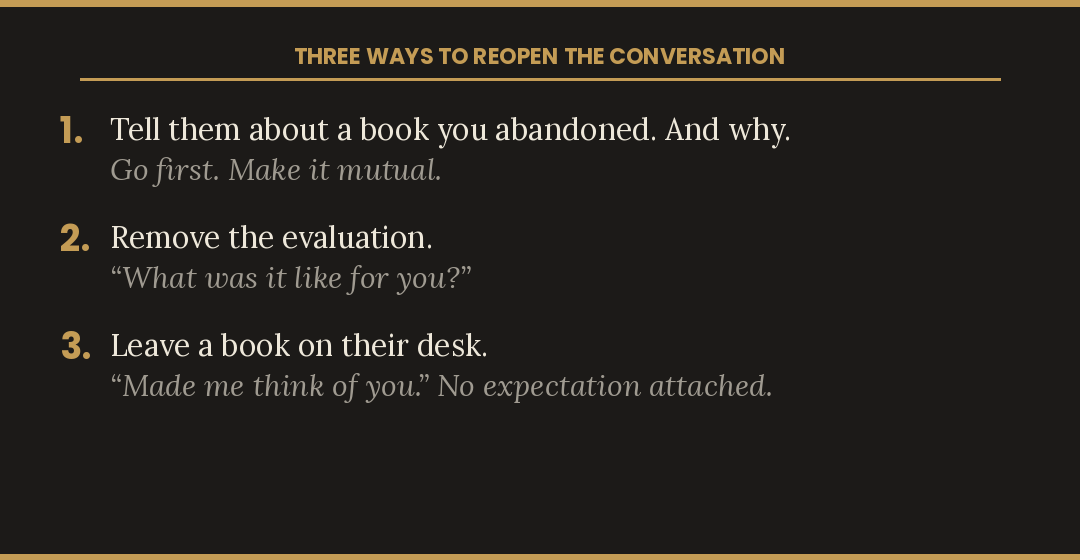
Share stories of your own reading life: books you loved that were “easy,” books you gave up on, books that changed you. Model complexity in decision-making, not just content.
Considerations:
What happens when we let students build their own definitions of “good reading”?
What are the long-term consequences of only offering scaffolds instead of skills?
How do we teach students to be readers without us?
Ignoring Individual Student Needs
Teaching is about relationships. About knowing the kid who hides behind her hair and always picks dog books. About the one who just discovered he loves horror. About the quiet student who will read 600 pages if you don’t make him write a log. Lexile scores can’t know them—but we can.
Instead, try:
Use Lexile as one data point—alongside student interviews, running records, self-assessments, and your own observations.
Let students set reading goals that reflect their identities: “I want to finish my first series,” “I want to read a book by someone like me,” “I want to try nonfiction.”
Co-create book stacks that mix comfort reads, stretch texts, and “wild cards” just for fun.
Considerations:
How can we restore the nuance of teaching in a data-driven system?
What tools do you use to get to know your readers deeply and personally?
How can you document growth in ways that go beyond numbers?
I’m not anti-data, far from it. But I am against any system that flattens our readers and limits our reach. We deserve better tools. Our students deserve broader definitions. Reading instruction should be built on relationships, curiosity, and choice—not compliance.
So when Lexile threatens to become a gatekeeper, let’s push back. Let’s expand what counts. Let’s keep joy at the center. And let’s keep sharing what works—not just because it sounds good, but because we’ve seen it in action.
I’d love to hear how you are navigating this. What has worked in your district? How are you reframing conversations about levels, choice, and rigor? Let’s keep this conversation going.
In June 2020, I wrote a post saying that perhaps 2020 would be the last year. for the GRA That after 11 years, perhaps it was time to say goodbye, end on a high note, move on to other things. Mired by the pressures of the world, bogged down by the usual emails and comments disparaging the choices of books, overwhelmed by the world, that decision felt like the right decision at that time. In June, 2020, I could not have imagined how I would feel now in February 2021, in a world that still feels extraordinarily heavy. That is still moving at a very slow pace as we look for small glimpses of hope in the form of a vaccine, in the form of brief moments of togetherness that has eluded us for so long.
And so as I sat across from my husband last night, celebrating our 16th wedding anniversary at home pretending to be at our favorite restaurant, he brought up research that is being done right now on the power of hope and having things to look forward to. That for the first time in a long time researchers are noticing that people are not planning for things in the long-term because COVID has bogged us down for so long. That we are not planning trips, we are not making plans in the future and that they wonder what not having things to look forward to will do to us as human beings. And it made me think once again about the power of the GRA. About the many emails, comments, and reach outs I received after announcing that 2020 might be the last year. How some of you told me that it was the one constant in your year, that it was one of the biggest things that you looked forward to, that there had to be some way to keep it going. And you kept telling me, periodically an email would show up asking if I had made a decision, would I reconsider? And I had been thinking of it, after all, due to COVID teaching I didn’t even get to do it with my own students this year, it felt unfinished in some ways.
And so last night I made the decision that I have been pulled toward for a long time. The Global Read Aloud will be back, albeit a bit more streamlined, but it will happen in 2021. I feel a bit like a flake, like I played with a lot of people’s emotions, but in June it didn’t feel possible, now it does. And I hope you can forgive me for that.
So a few changes you may notice for this year are:
There will be no sign up, just join the Facebook community or stay tuned to this website for updates. That way I don’t have to send out emails all of the time to all of the new sign ups.
There will be no voting. Having contenders meant a lot of people got mad when they didn’t feel the right book was selected, so this way it should feel more streamlined; if you don’t like the choice, simple, don’t do the GRA this year.
What is information you may want right now?
Kick off will be October 4th and the project will run for six weeks as usual, ending on November 12th.
The official hashtag for the year is #GRA21, other hashtags will be announced once the books are.
Books will be announced end of March, beginning of April.
I will continue to try to find books that speak to a broader world experience, whether set somewhere outside of the US or with a broader global appeal, I am still looking for suggestions, so please consider nominating books here
I hope you consider joining me again as we continue to connect around the world, as we continue to create larger conversations centered in understanding, in acceptance, in empathy. I am excited for another year of reading together, I hope you are as well. If you have other ideas or questions please leave them in the comments.
It’s summer and all Thea wants to do is play in the pool or read books. As a person who loves to play in the pool and read books, I happily oblige thus we read and read and read. And then she saves special books for her daddy to read when he gets home. She has a pile of books every night that she “reads” (she is not at the stage of reading the words yet) every night before bedtime She asks me what a page says so she can retell the story to Ida and Oskar. She met her first author yesterday and couldn’t be happier. I cannot help but love that she loves books as much as I do.
In my classroom this was the year of the books. I finally infused my classroom with my passion for reading and lo and behold; my students did the same. I don’t know why I had never done that before. So we became a reading classroom; a room that discussed books whenever we had a chance, a room that rushed book recommendations to each other, a room where boys shared what they were reading as much as the girls. We invited in authors, poets, and other readers. We wrote our own books and performed them for our 1st grade buddies. We skyped about books, we debated whether the first book or the second book was best, and we watched our books being shipped to us hoping that the tracking email was incorrect and that they would get here sooner. We tweeted about books, we breathed books. Books were just as important as math facts and for those who know me, that means a lot.
And it hasn’t ended; one student texts me about the books he is currently reading and continues to offer me recommendations. Another sends me emails and has even started a reading blog of his own. Some use KidBlog and others are ready to tell me what they are reading when I see them out and about. They are still readers and we are still a reading class even if the walls have disappeared.
As I read a book a day this summer and my pile grows rather than shrinks, I am eager to start with my new incredible group of students. I have spotted them reading in the hallways. I have asked them what they have been reading. I have even given a few book recommendations already. I will create a book display of what I read over the summer so that my passion is visible that very first day. I hope to get what I am this year as well. I hope they love books as fiercely as I do. I hope they are willing to share that love with me and the world. I hope they are readers.
My mother never told me what to read. Neither did my teachers. Sure, I was an insatiable reader, a child that loved riding her bike to the public library only to return with the biggest bag of books my handlebars could handle. Sure, I would sometimes stay up past midnight just to see what would happen next. Sure, I used to be able to read in the car without getting carsick. And yet, it wasn’t because I read just right books. It wasn’t because I logged how many minutes I read at home and at school so that I could see the pattern. It wasn’t even because my teacher told me I would love this book and I had to read it next. It was simply because I loved the freedom of reading.
The freedom of reading….
How often do we discuss that in our classrooms? How often do we just let our students read whatever they choose and then let them discuss however they want why they just loved reading whatever they chose? How often do we let them sing the praises of a certain book even if it is not just right for a majority of the class? How often do we let them try that book even if we think it may just be a tad too hard, too long, or too boring?
The freedom to read….
We seem obsessed with the particularity of reading. Of breaking it down into nothing but strategies so that students understand what great readers do. Of logging every minute and every page. Of finding “just right” books through levels and forcing them upon children because we know best. Yet the problem with breaking something down is after a while all of those pieces become just that; pieces, and we lose sight of why we did it at all. When reading becomes a strategy to master, we forget about the love that should be a part of it as well. When we take away students freedom to read, we take away a part of their passion, a step of the path to becoming kids who just love to read. And when we continue to tell them what to read, we take away part of what it means to become a great reader: knowing thyself.
So when we discuss “Just right” books don’t forget that that may just mean just right for that kid. Just right for their interest. Just right for their passion. Just right for their curiosity. Just right for their need. And that may have nothing to do with their reading level. When we discuss strategies don’t forget the big picture and what the goal is. When we discuss logs and minutes and genres, well, just don’t discuss reading logs, please. In fact, do your students a favor and get rid of them. If you want to see why, read this post by Kathleen Sokolowski titld “How Do You Know They Are Reading?” and then think about it.
Give students the freedom to read so that they may want to read. How powerfully simple is that.