I had my first back-to-school nightmare yesterday.
Woke up feeling unprepared, heart in my throat, and all sorts of nervous. It was nothing special, the standard one where everything starts off smooth, and then all of a sudden everything falls apart. I am unprepared, lost, and being evaluated. I woke up in high alert, what do I need to do right now in order to not get there.
School starts August 11th in Denmark, and on that day I get to take on the role of homeroom teacher for two 3rd grades. I get to continue with the class that has made me a teacher in Denmark, and then I get to add their neighbor class to be mine as well. And the nervousness is real.
After all, how do you split yourself between two classes like that? How do you make sure that both classes know that they matter? How do you invent, create, reflect, and ponder without overworking yourself? How do you make each kid feel seen when you are split evenly between two communities that both need you in unique ways? How do you show up in the way that you know matters, when these new kids are wondering how much you will be their teacher and whether *you will be with us a lot, Pernille?*
It almost feels like I am welcoming my second child, hoping that my heart will stretch enough to love widely, knowing that it will.
But tell that to my nightmares.
In the past, I would have thrown my into prep wok, spending countless hours planning, conceiving, creating. I would have gone in for hours, trying to get it just so, trying to work my way through my nerves. Making copies until I could feel my anxiety ebb.
But not now. Not anymore. Instead, I garden. I bake. I go to cross fit. I read. And sure, I dream a little. I reflect on how I want that first day to be framed. I consider how I want to get to know them, and how we want to continue to build their community.
So I plan. But differently now, a plan where I don’t drown, and summer just feels like the checklist item to be done before another school year. I plan for presence. For slowness. For the moment when a child looks at me and wonders, Are you really here with us? and I can say yes—not just with my words, but with the way I show up. And to do that I need to not work. I need to not stay in that space where teaching takes up most of me. Because that doesn’t fill me in the ways I need to be filled, in order to go all in.
So I give myself permission to pull back. To trust that stepping away is also a kind of preparation—that rest is not a pause in the work, but part of it. Because when I give myself space to breathe, I make space for them too.
I think about how I want that first day to feel. Not just for them, but for me too. I want it to feel calm. Possible. Like a beginning, not a performance. I want them to know I see them, both classes, both groups of humans who deserve a teacher that isn’t running on empty.
And so, instead of drowning in to-do lists, I remind myself of what I already know: that the magic isn’t in the deeply detailed plans or the laminated name tags – although those will come. It’s in the way we build trust, one small moment at a time. It’s in the way I let my heart stretch and make room—just like it always has.
If you’re waking up from your own back-to-school nightmare, you’re not alone. This time of year is heavy with what-ifs and should-dos. But maybe the work isn’t to prepare more. Maybe it’s to believe more—in who you already are, and the teacher you’re still becoming.
We’ll be ready. Not because we’ve done it all, but because we’ll be there. And that matters more than anything else. We’ll be ready, because that’s what we do.
I wrote this blog post last year, what follows is an updated version of it in case you are interested in loose parts or storytelling kits with older students. Scroll down to see the update.
A few years ago I traveled to do a day of learning with passionate educators in Maple Ridge/Pitt Meadows in British Columbia. After flight cancellations and changes in airports, Denise Upton, one of the district’s helping teachers, graciously agreed to pick me up and take care of me during the stay. While together, she told me excitedly about Story Workshop, oral storytelling grounded within playful literacy, that they were doing with children as part of their literacy approach. She shared all of the work that they did with students in order to give them natural materials to manipulate and create stories with before they ever sat down to write. She spoke of Indigenous oral storytelling traditions and how they were working on bringing the rich traditions of the peoples’ whose land their school buildings sat on and whose tribal members were within their school population back into the classrooms as a way to honor, teach, and preserve a broader envisioning of writing I was inspired and intrigued. Particularly, after she told me how they were using these material kits with their upper grade levels as well and that the response they had was incredibly positive. After a whirlwind visit, the idea sat in the back of my mind for a while, hoping to someday become something I wanted to do with my own 7th graders.
Well, after a year of teaching unlike any other, after too much screen and not enough togetherness. After once again teaching kids who repeatedly told me how much they hated writing, how writing was so hard, whose sentences were forced across the pages, I decided that someday was now. With a commitment to reconsider every unit and every idea we build our classroom learning on, taking our writing in a much more tactile and playful direction was exactly what I need right now to get excited about next school year. Hopefully, my incoming students will think so as well.
So with a loose idea of what it was Denise had shared with me, the seeds started to grow; what if I build some oral storytelling kits for kids to use in partnerships, trios, or by themselves before we begin to write? What if I collect natural materials for them to manipulate and play with as they share stories from their own lives and also from their imaginations? Surely someone had done this before?
The answer is yes, many have! None of my ideas shared here are really original but I got so many questions on social media when I shared the kits I was building that I figured a blog post would be nice. If you are learning about Indigenous storytelling, there are so many wonderful resources shared, such as this one. If you google “Loose Parts”, you can see a lot of information. If you follow the work of Angela Stockman, she has been sharing so many ideas for years and is truly inspirational. If you are trained within Montessori, you know this work. If you know Reggio Emilia principles, then you know these ideas. If you have worked with younger grades, you probably do this already. There are so many resources out there, so dig in and learn.
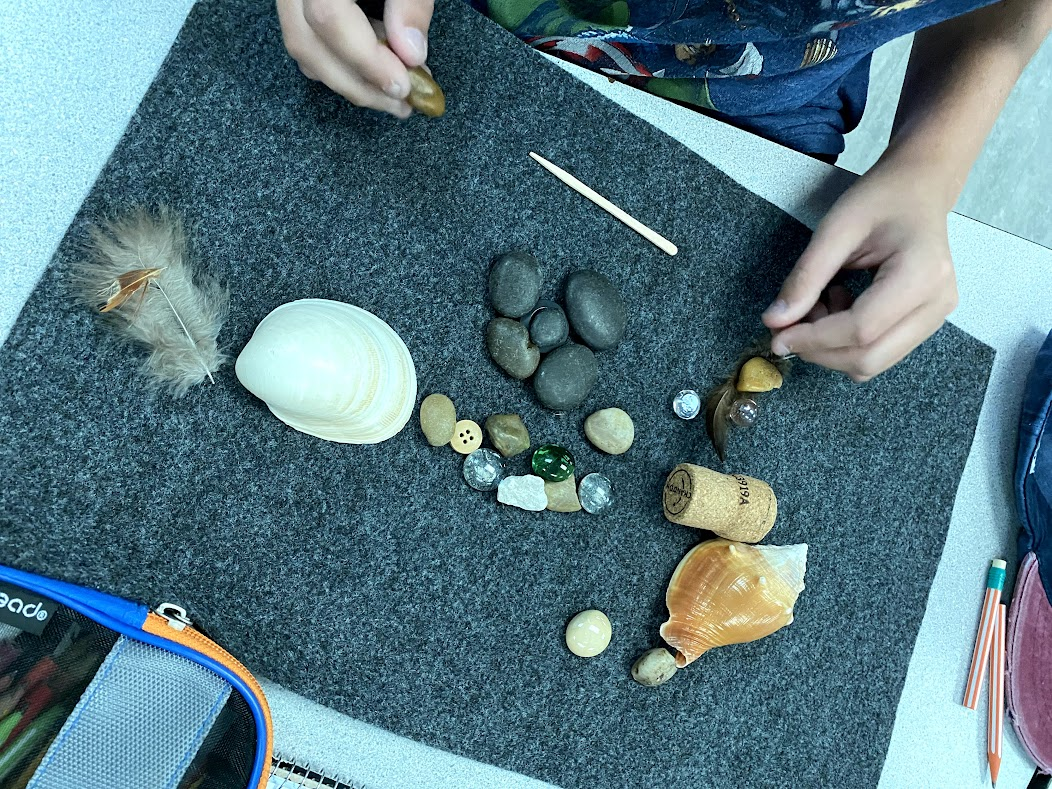
My purpose for these kits is to get kids talking more before they write out stories, whether they be stories from their own lives or stories they invent. I want them to build scenes or entire stories together or individually depending on the exploration we are doing. I want them to play with their imagination and ot be forced into written production as quickly as we have done in the past, I want them to build community through story, I want them use their hands more. I want English to have more joy and I want it to authentically fit into the identity-centered work we already do in our literacy explorations.
Building the Kits
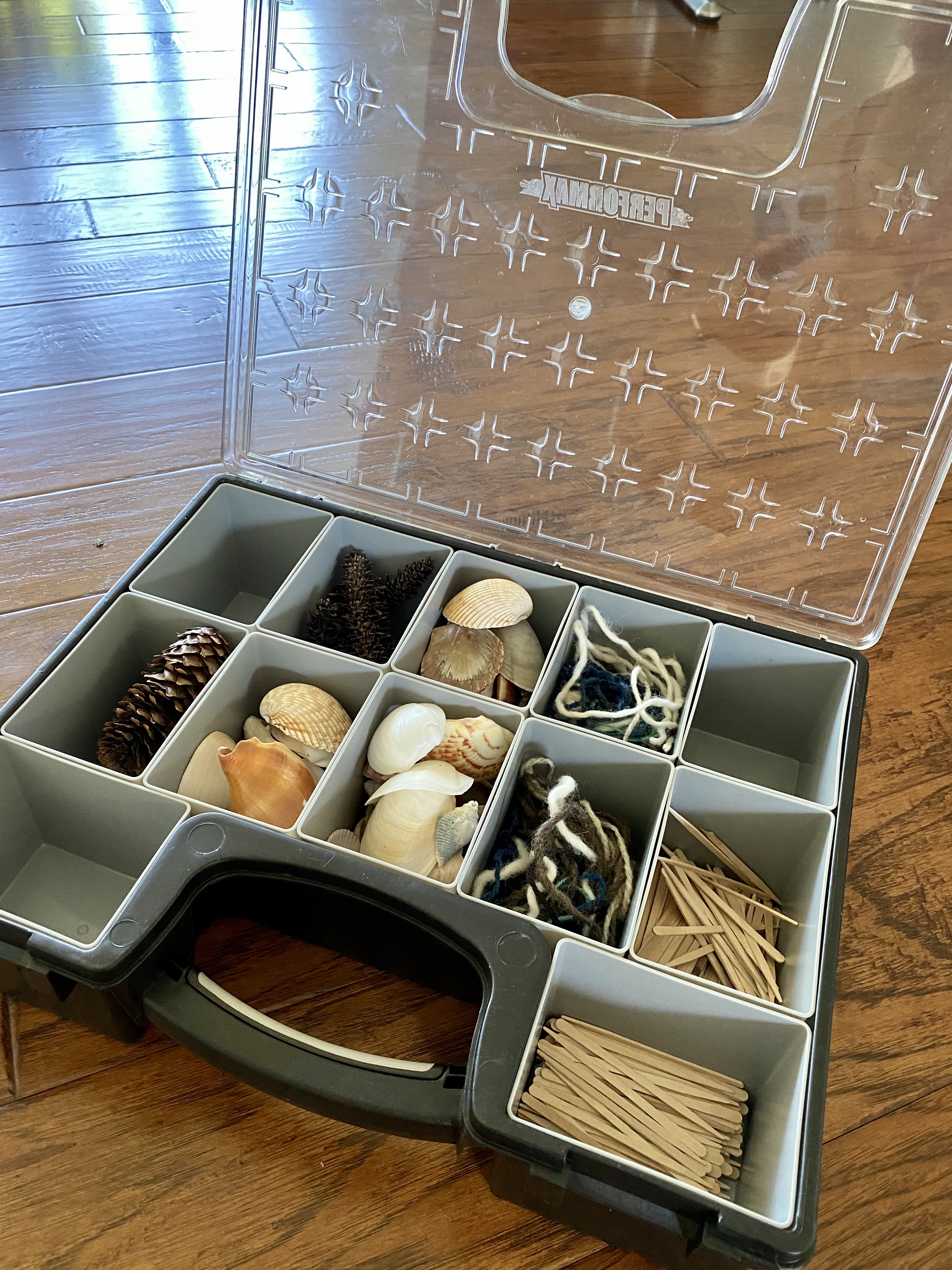
I had a million ideas right away and needed a way to ground them so I started by focusing on ideas for what to put in them and also building the kits to give me a more tangible sense of what it would look like. I hate so much that educators are almost always forced to purchase things out of their own pocket, so I spent school budget money to purchase the toolboxes. I bought two different kinds, five altogether, so that I can share them between tables – I typically teach 28 students at a time, so I wanted to make sure that I had enough kits to share materials between 10 different groups if need be. I also needed the kits to not take up too much space in our classroom, be easy to store and move, as well as have different size compartments. The first kind I bought was this one and the second kind was this one.
All the boxes are removable in both kits so we can spread them out on the different tables as needed.
Once I had the boxes, then I got more serious with my materials. I had a few guidelines I wanted to follow:
Natural materials whenever possible
Different sizes of things to use
Material that doesn’t necessarily look like “one” thing in order for them to be used for many things
Low cost and easy to replace
Then I wrote a list, there are so many lists floating on the internet but I posted mine to Instagram and got even more ideas as well as a huge “Duh!” moment. Notice on my original list, I have nuts on it. That is not going to work at all for some of my students due to their allergies. After a helpful educator made me see the light, I updated my original list.
I knew that if I felt like spending a ton of money, I easily could just order all of these things but I don’t want to. So, instead I turned to my local Buy Nothing Facebook group and asked if anyone had any materials they could donate. So what you are looking at in the kits above, almost everything is donated from kind strangers or friends who happened to have materials lying around. Amazing!
So right now in the kits I have:
Seashells, all sorts, all sizes.
Pine cones – I need to gather more.
Small popsicle sticks – they are pointy and I don’t know if I love that.
Wine corks that do not have wine labels on them.
Small cork buttons.
Wood buttons – I bought a giant bag off the internet.
Wool yarn in different colors – I have cut lengths of string in a variety of lengths.
White rocks.
Feathers – I think I may add more of these.
Glass beads.
Slices of wood.
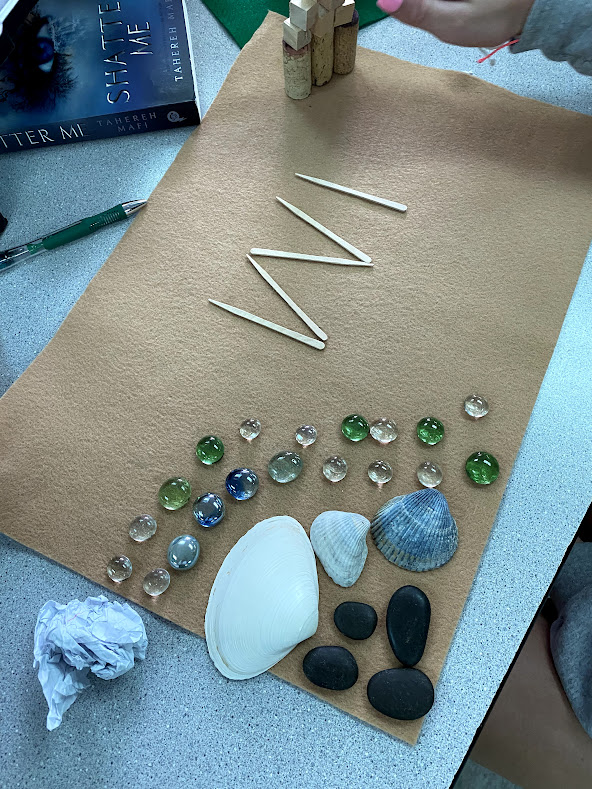
I also purchased felt mats in green, gray, and brown for the kids to use as a background. They can use more than one if we have enough left over, again I went with natural tones as a way to center us in nature even if the story takes place in a different setting.
Things I would still like to add:
Beach pebbles for more color
More cork
Cinnamon sticks
Acorns
Large popsicle sticks
Ideas for use
So while the kits themselves are a lovely work in progress and bring me happiness right now as I plan, what matters more than the stuff in them is making space for them to be used with our students. So as I planned for the first two weeks of instruction (I do this in order to be able to walk away for a while, not because I want to work all summer), I planned with the kits in mind.
My two-week plan can be viewed here, but please know that it is so much a work in progress, that some of the ideas in it are my own, and others are based on the incredible work others have kindly shared, and that I have given credit to those whose work I am borrowing from or copying. Please feel free to also borrow or use my ideas, just give credit. The kits will be utilized, hopefully, on the third day of school in an activity where students continue to think of the stories they carry and start to build scenes from their own lives that they then, in turn, share with their peers at their tables. After their initial appearance, they will continue to be integrated into our work as we start our first longer writing exploration; personal narrative. Students can use events from their own lives or springboard events from their own lives into a fictional story.
I also want us to think of how the kits may help us work within the emotions we have tied up with our writing, how we can use them to go deeper into story and how stories can weave us together even when we don’t see eye to eye. I am hoping that as we explore our own identities and how that makes us view and react to others, these tangible items will ground us and make us feel safer within our burgeoning community. I am hoping that having these tactile explorations will bring more playfulness into our classroom, as well as more joy. We will also create expectations of how to use the kits with each other. My main focus for that is to be respectful of the material and of what is shared within their stories, but I will ask the students to also think of how to use the materials, how to clean up in order to preserve the kits, and how to work together. It really all ties into the community work we do throughout the year.
My own children helped me eagerly build the kits and have since then also used them. It has been amazing to see them build scenes, stories, and whole worlds using just these materials and then walking me through their stories that they now see so clearly. Even my son who has repeatedly that he hates writing has been using the kits and telling me his stories. I hope I will see the same willingness to try in my 7th graders.
Update
I rolled these kits out with students a few times and the results were mixed. Some LOVED them and jumped right in building scenes, drafting stories, and using them to get their imagination flowing. Others not so much, they played with the materials after a while and built embankments and such (yes, even in 7th grade). But you know what, that actually makes sense to me; some kids will love storytelling this way, others will not. Much like we explore different ways to draft, this then became another choice for it.
And for some kids they allowed a freedom they hadn’t felt in a while as they sat in front of screens, so as I think of rolling them out next year; they will be a choice, not a force as so many other things are in our classroom. Not meant to be yet another way to force kids into a specific mold of what a writer is, but instead offering them ways to discover how they write best. How they would like to play with words and story. I will also dive a little further into how we care for the materials, most were kind to the things, a few had to be reminded. That all comes down to the make up of our classes and the energy the students bring into our space.
Ideas for use
A few ways you can use kits like these:
Draft your story, scene, or storyline
Poetry creation
Introduce yourself
Partner story creating
Summarizing a read-aloud, article, or other media
Create scenes to then act out
One child creates a scene, the other writes the story without knowing what is but just based off of the components shown
Even with mixed success, they are still exciting to me. They offer us more hands-on opportunities, more ways to use oral storytelling before jumping into typing or handwriting, and also offer us a way to create build community; stories bind us together and trusting each other with our stories is powerful.
A year ago, I shared a digital reading notebook that I would be using with my 7th graders as I prepared for a year of pandemic teaching. The work we normally did by hand would need to find a home digitally as I had no idea just how long I would be teaching virtually, and so I created a collection of tools for students to use in order to continue our work furthering and centering their identity as readers, even as we were far apart.
Now a year later, I was asked whether I would be using the tool with my students again or whether it had been changed, and this post is the answer.
I did update the tool in September of last year as students started using it to streamline it a bit. Here is the updated version. It streamlined some of the pages and cut down the size a bit which helped a lot. I still love the tool, just wish there was a way to use it without it clogging down their computers.
So as of right now, because let’s face it things change all of the time, I will not be using the digital tool in this iteration again, for a few reasons, but the main one being that I am (right now anyway) scheduled to be in person fully with my 7th graders. This means that instead of having a digital tool like this, we can create sections in our notebooks for this work that they can can be shared when needed. This has in the past been easier for students rather than needing to log onto their chromebooks, then wait for the tool to load, then get to the right page etc. Another reason for stepping back to paper is because scrolling through the tool on chromebooks was unwieldy and slowed down our work. Many students wanted to do the work but their computers froze trying to open it up.
However, the work within the pages will still be going on in 7th grade. Everything within this notebook is important to the work we do as we dive into our reading identities and how the emotions and experiences we carry surrounding that shapes the decisions we make with our reading lives. I will just go back to stand alone forms, gathered in their notebooks or in my binder depending on the purpose of it, to do the work.
So where can you find some of these forms as a stand alone form? Their to-be-read list is just the first few pages in their notebook, they write down author, title, and genre so that they can find the book later. I usually have them set aside 4 pages for this. Others can be found via the links below.
The work surrounding “Who Am I as a reader” can be found here. (Google Slides or paper copy)
While these first few surveys and goal exercises are just the beginning, they provide me with an invitation into a conversation even if they don’t write much because if a child writes “IDK” for most answers, that tells me something about them as a reader, if a child doesn’t want to share anything that tells me something about them as a reader.
As I dream about the school year to come, I am excited to continue our work surrounding reading identity and hopefully help students protect or cement a positive relationship to reading. I have seen the difference this work does, I have seen it impact kids in thoughtful ways as they start to understand and work with the experiences they have had as a readers and chart new courses. Not just because of these forms or the survey questions I ask, but because of the conversations and subsequent actions that they lead to.
This summer has been one of worry. Of anxiousness. Of too much time spent thinking about possibilities that seemed to shift every day. Of waiting for answers. Of too many times trying to not think about the fall. But the countdown to go back to school has started for many of us, the future, while still uncertain, has at least been hinted at, and I still have so many questions.
A few weeks ago we were told we would be fully virtual for the first quarter and with that information I knew that I could stay overwhelmed and anxious or I could move into solution mode. To take it day by day, rather than try to figure out my whole quarter; focus on the first week, and then have an idea for what might come after. It has helped calm me as I think of all of the unknowns. (Not that I am feeling calm by any means).
And so, as I move ideas into action, it is time to invite you into the thoughts and discussion in my final masterclass of the summer: Masterclass – How Do We Learn Best – Embedding Authentic Choice and Voice. While some of the underlying research and ideas will not have changed from May when I offered it last, I have updated it with ideas of how I plan on establishing conditions to build community, to determine how we can feel safe with one another, how I will embed choice and space for students to speak up and change our time together as we start fully online. This class dives into why it is vital that we center the voices and identities of students as we plan on our instruction and interrogate the systems we have in place. It is meant to inspire, spark discussions, and also offer practical ideas. The accompanying office hours will allow you to ask follow up questions, to share your ideas, and also to have a collective of experts help you with your problems of practice.
Also, if your district or conference are interested in bringing me in virtually throughout the school year, please see information here. I have been supporting teachers remotely and in-person as they plan for meaningful literacy instruction in an in-person, virtual or hybrid model throughout the years and would love to help others as well.
Just the front cover, to see the whole notebook, press this link
While my district gathers information as we try to determine what the fall can look like my wheels have been spinning. While I may not know whether I will be in a hybrid setting or completely virtual, I know that it will not be school as usual and so a huge question I am wrestling with is how do I translate what we do as a community face-to-face into this new mode of teaching? How do I continue to center our classroom on reading and writing identity when we won’t have the same opportunity for daily discussion and community exploration? When I won’t be right there to kid-watch and adjust my instruction and care of them accordingly?
Every year our readers’ notebooks become a trusted place for many of our students to reflect on who they are as readers, how reading impacts them, and how reading fits into their lives. It is all-year work that ties in with the overall focus on identity, how they see the world, how the world sees them, and how our lens of the world impacts our action. It is at the heart of what we do and yet, this year, I don’t know when I will be with them to do this work. How do we still do meaningful work in our notebooks without kids having to upload every image into our learning hub, how do we center our work in our identity and see how we grow throughout the year?
Enter digital notebooks which really are just fancy templates to make slide shows look like notebooks as my husband pointed out. And yet within the fancy template also comes a familiarity. These templates look like the notebooks we would use with kids, they can be organized in ways that will hopefully make it easier for kids to navigate the work and will ground our work for the year whether we are face-to-face or online.
And so last night, I created a digital notebook for our reading identity work based on a template created by Laura Cahill and while it is a work in progress I wanted to share it here as I know a lot of people are trying to wrap their heads around this work as well. As I write this, my former students are assessing it to give me feedback, I have also asked for feedback from other educators. I know it could be better, I know that collaboration will always improve my teaching.
In this work, I also know that I need to be careful with my students’ reading lives. That year after year they tell me how much they hate to write about their reading, how when we attach to-do’s to their reading it becomes a chore rather than a journey. That when we are constantly asking kids to prove that they are reading they start to not read. This is not anything new, I have written and shared the words of my students for years and it grounds me in every decision I make as the teacher who starts our journey and guides it throughout our year.
With this in mind, I had components in my instruction that I wanted to address as I created this tool.
How will I support kids through this tool? Each component is a separate lesson that we place the foundation for in the beginning of our year together and then return to throughout the year. I have written about all of them on this blog throughout the years as well as gathered all of my thoughts in my book Passionate Readers. So when I ask students to use their to-be-read list or reflect on who they are as a reader, they are not going into this unsupported, instead we weave lessons throughout these conversations such as about our reading journey, which emotions tied in with reading we carry, and many other things. It is also so much bigger than this notebook, this is work embedded in the conversations we have, the media we surround ourselves with, the quiet reflections, the surveys, the connections, the trust, the community, and everything else that we do with the realizations and questions we have. Please do not think that this notebook is all we do or encapsulates all of the work that happens throughout our year, it can’t be and it won’t be.
How will I know whether they are actually reading? I won’t. That comes down to trust, where they are on their journey, as well as which role reading plays in their life. There is no single tool that is worth me implementing for all kids that may not cause more long-term damage to their reading identity. When we are face-to-face, I usually have kids sign in for attendance with their page number that day, this allows me to get a quick glance at their reading that then is deepened in our reading conferences, that is not a fully viable option this year. So instead, the “Accountability” tab offers them an option to choose a way to show me when they have finished a book, and the “Reading data” tab gives them a way to keep track of what they are reading. I will be stressing to kids that their reading data is not meant to capture every minute or page read like a traditional reading log would, but instead to let them give a broad statement about their reading life the previous week. It is the two sections in particular I am still not loving, that will probably change as the year gets going and that I will be keeping a deep eye on as far as potential harm to reading habits. I also know that some kids will not want to use this reading notebook at all, that they would rather refuse than engage, so then that will simply be where we start our conversation. I will be utilizing reading check-in conferences as well, I am just not sure what they will look like yet since I don’t know my school year will look like. I will share my ideas for that when I have them.
How can we get ideas for what to read? Book shopping and surrounding kids with books is a cornerstone of what we do and kids need more than audio and digital books to really continue their reading journey. I have already written about ideas of how to help kids get books in their hands if in a hybrid or virtual learning environment and I will be sharing more ideas as I plan with our incredible librarian and other colleagues for when we know more. I know I will be doing live book talks whenever possible, but also dedicating time in our instruction for kids to book browse virtually, as well as continue to suggest books whenever I can to individual kids. Another idea that I am loving is that when students pick up or drop off books, we add extra books to the bag that they may also like, so that instead of just one or two books, kids get a bag of five or so.
How can students set reading goals that matter to them? For too long, I set the reading goals for my students. Luckily, I saw the light several years ago and I haven’t looked back since. Having students set meaningful reading goals, though, takes time. Many kids, even kids who have fantastic relationships to reading, want to hurry through the goal part and set it just so their teacher will check it off on their to-do-list. This is why setting a 6-week goal at a time and following it up with conversation will be so important in our year together. This is why our goal is not just focused on quantity but habits. Yes, they should read more than they have in the past if they can, but “more” encompasses many different things not just quantity. Kids can use the same goal for more than one round of 6-weeks as needed, some of my students work on the same goal all year. I just want to ensure that we have built in reflection time for the goals and will add dates when I know what my school year calendar looks like.
How will they develop their thinking about who they are as a reader? “Who are you as a reader?” is a question we have used for a few years now in our work with students. At first, many of my students have no idea what to answer, they don’t know necessarily what the question means or are not sure what I am looking for in their answer. That is why this is a year-long reflection question and one that we unpack together, especially because reading identity really just equals identity and so when I ask who are you as a reader what I am really asking is who are you? Since trust is something we build, I see a significant change in students’ responses throughout our year together.
While this is not a finished tool, it won’t be finished until we start using it because my new students will surely impact the work we do and how we do it. For now, this is my best draft and so I share it with the world in the sense of collaboration. That also means that you can certainly make a copy of it and use it, but please do not sell it or forget attribution. This is the work that I along with others have developed over several years. I am grateful that Laura Cahill shared the template for free, so this work is shared, as always, in the same spirit. Feel free to leave questions or comments for me.
Also, if your district or conference are interested in bringing me in virtually throughout the school year, please see information here. I have been supporting teachers remotely as they plan for meaningful literacy instruction in a virtual and hybrid model throughout the summer and would love to help others as well.
As summer continues here in the Northern Hemisphere, I am excited to move into my next free Masterclass focusing on developing and supporting an individual student reading identity. This is the work I have been invested in with my students for the past six years in particular and I am so excited to offer others a deep dive into all of the components that we integrate into the curriculum as we try to create and maintain experiences that center on the individual student’s journey in reading. These sessions will be live as well as recorded for later access if the times do not work for you.
This masterclass is in 4 parts:
July 8th at 11 AM PST – Passionate Readers: The Art of Reaching and Engaging Every Child.
This first 1-hour session is focused on the birdseye view of the entire year, the research behind why student identity needs to be at the core of our work as well as practical ways to start or continue the focus on reading identity. This will also focus on how to do an all-district or school reading audit and how we can align practices better so that students are not victims of an educational lottery where some get access to meaningful reading experiences that center on personal reading, and others do not.
July 15th 1:30 PM PST – But They Still Hate Reading: Establishing and Cultivating a Personal Reading Identity- Part 1.
July 22nd 11 AM PST – But They Still Hate Reading: Establishing and Cultivating a Personal Reading Identity- Part 2
July 29th 11 AM PST – But They Still Hate Reading: Establishing and Cultivating a Personal Reading Identity- Part 3.
These three parts will focus on all of the components that make up our year together: Creating and maintaining an inclusive book collection, supporting independent and joyful reading, reflection and goal setting throughout, scaffolds and supports we can use to help kids whose reading experiences have been negative, using book clubs as a meaningful way to discuss the world, individual reading challenges, and of course, how to help students find space for reading in their life outside of school. The three sessions will take place on the following dates. This is an invitation into the work I do behind the scenes, the work my students take on, as well as planning for a virtual or hybrid school start.
While the sessions will take on the form of presentations, there will be office hours to go along with them. These office hours are meant for questions, discussion, resource sharing, as well as anything else related to the sessions. These are also free, but not recorded.
The final masterclass after this one will be embedding authentic choice and voice as we start the year together with students. It will be focused on all of the things I am trying to wrap my head around as we prepare for our new year together. The information for those can also be seen on the website and sign up will be open soon.
Also, if your district or conference are interested in bringing me in virtually throughout the school year, please see information here. I have been supporting teachers remotely as they plan for meaningful literacy instruction in a virtual and hybrid model throughout the summer and would love to help others as well.





 Pernille Ripp