A month off with big plans of all the things I was going to do, and so many things I didn’t. I didn’t plan really. I didn’t read PD books, or watch webinars, or delve into education shorts. I have not stressed, mostly. Instead I have read, I have cooked, I have gardened, I have explored, I have napped – so many glorious naps. And I have been present with people I care about as much as possible. It has been glorious, and oh too short.
But now a new year beckons, and with that I will teach 2 different third grades in Danish. I cannot wait to experience what being a split classroom teacher will be like.
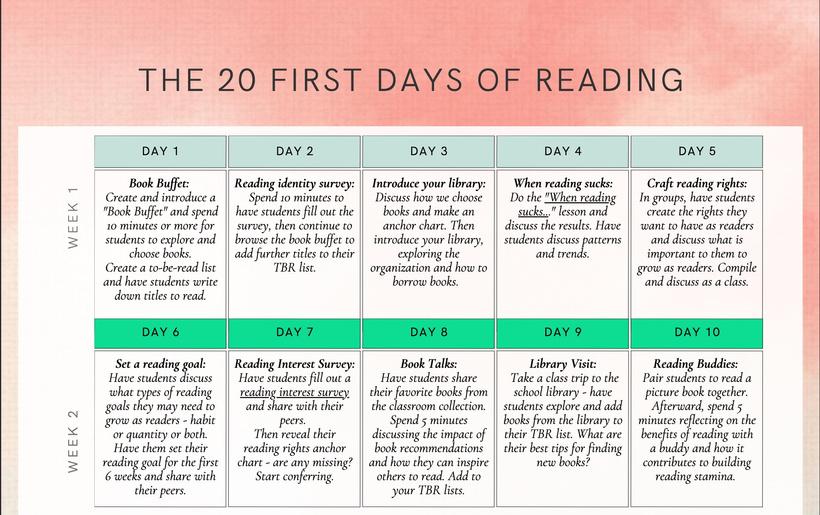
I know many of you are also gearing up to head back. Some of you still have weeks left, others only days. Perhaps like me you are looking for some inspiration of where to start? Two years ago, I created this resource for my Patreon community, and so I thought it might be helpful to share it here- it’s called the “First 20 Days of Reading” calendar, and here is a sneak peek of what is behind the link.
As many of us embark on a new school year, I believe that fostering a love for reading is one of the most precious gifts we can give to our students. This calendar is designed to build independent reading stamina and cultivate a reading community within our classrooms.
📖 Why the First 20 Days? 📖
Research has shown that dedicating just 20 minutes of daily reading time can have a significant impact on children’s word acquisition, vocabulary, and writing skills. Moreover, creating a positive and engaging reading environment can help instill a lifelong love for reading in our students.
💡 What’s in the Calendar? 💡
The “First 20 Days of Reading” calendar is a curated collection of 20 fun and manageable reading activities, each meant to take little time and be added on to our independent reading time. These activities are designed to introduce reading choices, nurture reading enthusiasm, build reading stamina, and foster reading independence. And of course start the focus on reading identity development.
You can pick and choose between using some of these activities or all of them. You do not need to follow the order precisely either, as always, you know what you need. But I wanted to pull out a timeline approach for all of the components we can introduce when fostering reading culture and give you a placer to hang your ideas. The sky is the limit and I would love to hear what else I could add in.
👉 Access the Calendar 👈
To access the calendar and get started on this reading adventure, simply go here! Feel free to customize the calendar based on your students’ needs and interests. I included links to all the surveys and questions plus more.
So as I pack up my family to head home from a summerhouse, say goodbye to my family visiting from the US – wow is that ever hard – I hope this little post will give you some ideas, maybe save you some time, or maybe be that missing thing that you didn’t know you needed.
I will be sharing throughout the year as I embark on this new school year. Perhaps you will too?
In my Patreon community, a fellow educator recently reached out with a growing concern: their district has mandated the exclusive use of Lexile-leveled texts in English classes. That’s right—only texts that align with students’ grade-level Lexile scores are now considered acceptable. The frustration in their message was tangible. Texts that students love, that have sparked rich discussions, and that they’ve built curriculum around are now off-limits because they don’t “fit” the approved band.
I’ve long raised concerns about the over-reliance on Lexile scores. Like many of you, I’ve seen firsthand how these measures, while perhaps well-intentioned, can be wielded in ways that do real harm to reading joy, choice, and depth. So, if you’re facing increasing pressure to center Lexile in your classroom—if you’re trying to navigate a system that keeps narrowing what “counts” as appropriate reading—I hope these thoughts and ideas help.
Limitations of Lexile
Limited Understanding of Text Complexity
Lexile scores are essentially math. They rely on sentence length and word frequency—quantifiable features that can be measured by an algorithm. But we all know that complexity is never just about numbers. A book like Night comes in at a relatively low Lexile level, and yet its themes of loss, isolation, and moral ambiguity leave readers shaken. A text might be “simple” on paper but profound in practice.
Instead, try:
Use a text complexity triangle (quantitative, qualitative, reader & task) when planning. Bring students into that process—ask, What makes this book challenging? What makes it powerful?
Encourage student reflection journals or book clubs where kids identify their own “hard” books—not based on Lexile, but on how the text made them think, feel, or struggle.
Create classroom charts that define complexity through student terms: “Books that made me cry,” “Books I needed to reread,” “Books I’ll never forget.”
Considerations:
How does Lexile account for the cultural and historical significance of a text?
What qualities of a book matter most to your students?
How can we expand students’ definition of what makes something “challenging”?
Exclusion of Inclusive Texts
One of the most heartbreaking outcomes, and oft-overlooked aspects, of Lexile-only policies is the quiet erasure of culturally rich and relevant literature. Books written in vernacular, verse, or translanguaged text often get pegged with a low Lexile, despite their emotional and intellectual heft. That means fewer books by authors of color, fewer windows and mirrors for our students, and fewer moments of deep connection.
Instead, try:
Curate parallel text sets: pair a high-Lexile nonfiction article with a lower-Lexile but deeply resonant novel or memoir. Let students draw connections between form, voice, and truth.
Push back by documenting engagement: show how students are thriving with texts “below level” by collecting writing, discussion notes, and self-reflections.
Use picture books and graphic novels with older readers—these often get dismissed due to low Lexile, yet offer rich analysis opportunities and accessibility.
Considerations:
What culturally relevant texts are missing from your curriculum because of Lexile?
How can student voices help you advocate for broader criteria?
How do we make the case that what students read matters more than how difficult it is to decode?
Narrowing Students’ Reading Choices
If we want kids to love reading, we have to let them choose what they read. That means trusting them with books that fall outside their “band.” Lexile-driven mandates send the opposite message: we don’t trust your choices, your interests, or your readiness. But reading joy isn’t built through constraint. It’s built through access, autonomy, and meaningful support.
Instead, try:
Build “just-right-for-me” libraries where students classify books based on interest, not level. Include sticky notes with peer reviews and genre tags.
Hold 1:1 conferences where students reflect on how books make them feel, not just how hard they are to read.
Share stories of your own reading life: books you loved that were “easy,” books you gave up on, books that changed you. Model complexity in decision-making, not just content.
Considerations:
What happens when we let students build their own definitions of “good reading”?
What are the long-term consequences of only offering scaffolds instead of skills?
How do we teach students to be readers without us?
Ignoring Individual Student Needs
Teaching is about relationships. About knowing the kid who hides behind her hair and always picks dog books. About the one who just discovered he loves horror. About the quiet student who will read 600 pages if you don’t make him write a log. Lexile scores can’t know them—but we can.
Instead, try:
Use Lexile as one data point—alongside student interviews, running records, self-assessments, and your own observations.
Let students set reading goals that reflect their identities: “I want to finish my first series,” “I want to read a book by someone like me,” “I want to try nonfiction.”
Co-create book stacks that mix comfort reads, stretch texts, and “wild cards” just for fun.
Considerations:
How can we restore the nuance of teaching in a data-driven system?
What tools do you use to get to know your readers deeply and personally?
How can you document growth in ways that go beyond numbers?
I’m not anti-data, far from it. But I am against any system that flattens our readers and limits our reach. We deserve better tools. Our students deserve broader definitions. Reading instruction should be built on relationships, curiosity, and choice—not compliance.
So when Lexile threatens to become a gatekeeper, let’s push back. Let’s expand what counts. Let’s keep joy at the center. And let’s keep sharing what works—not just because it sounds good, but because we’ve seen it in action.
I’d love to hear how you are navigating this. What has worked in your district? How are you reframing conversations about levels, choice, and rigor? Let’s keep this conversation going.
Moving to America at the age of 18, gave me a whole new education. An education in privilege, in control, in power, and how to know your place. To pursue your dreams but only if others see you as worthy of that dream.
Becoming a teacher in the American public school system has been one of my greatest joys but also one of my biggest frustrations, my biggest moments of failure, of regret. The power handed those of us with teaching degrees is immeasurable; I can continue the systemic inequities of the structures we work within, or I can learn, listen, question, dismantle, disturb, and create an education that is truly for all kids. I didn’t know that when I started as an educator, my own privilege awarded me blinders and ear muffs. But 10 years ago I started to wake up, a little at a time, although not fast enough, and I recognized that how I used control as a way to ascertain my power in the classroom meant that not all kids could thrive, that not all kids were cared for. That my classroom might have said “Welcome” but those were shallow words. And it was echoed in the curriculum we did and how I helped students grow, how I used choice, how I used rewards and punishment.
And so I started to change the way I taught, the way I thought of education, of my own power within the classroom. I immersed myself in the expertise and wisdom of others who have been on this journey so much longer than I have, I started to ask my students questions I should have been asking from the start and I started writing this blog; sharing my thoughts out loud, inviting others on the journey as I stumbled through and tried to create an education that might work for all kids. A shared experience that would center on the identity of each child rather than the curriculum. It is the work I continue to do and will for a long time. I continue to stumble through on this journey, I continue to share on here, I continue to learn and grow from others while offering my own journey up and now I have been invited by CUE and Microsoft to share through their channels as well as a way to invite you into the journey.
And so I invite you into a conversation surrounding the writing we do in our classrooms with students and how we can use storytelling not just as a way to teach standards but to help students examine and find power within their own identity and story. To come along with me as I share the questions we discuss in our community, the writing we do, and also the resources I have learned from so perhaps you can learn from them as well. So if you have space in your life or a desire to go on this journey with me, please go here to register
The Masterclass will be three parts much like the other masterclass I have done this summer, you can join live or access the recording when it is posted here. I will also be finishing up Embedding Authentic Choice and Voice. part 3 this week, on Thursday at 11 AM PST.
Posting this today, I also know that not everyone is in a place for PD or perhaps that this is not the type of PD you want to immerse yourself in, this is okay. The world is rightfully continuing to need our attention and perhaps you are putting in your energy elsewhere or fully taking a break. I know I have been taking many breaks the last few weeks as I plan for actions in the fall and right now, but for those of you who want to learn with and from me, please know that there will be several offerings all the way through summer.
Live office hours will start up next week – my first drop in one is on the 22nd at 8 AM PST. This is a great opportunity for you to bring problems of practice and we can brainstorm together for an hour or so. If you participate in the Global Read Aloud, you can also use the office hours to brainstorm with me or just ask questions.
All of these sessions are free and the sessions are recorded (office hours are not) so even if you can’t or don’t want to be there live, you can access them later.
The schedule for the rest of the summer’s free PD from me looks like so:
Sessions:
6/17 7 AM PST – Masterclass: Passionate Writers Pt1
6/18 10:30 AM PST – Choice and Voice Pt 3
6/24 7 AM PST – Masterclass: Passionate Writers Pt 2
8/13 7 PM PST – Repeat Masterclass: Embedding Authentic Choice and Voice as we get ready for a new year Pt 1
8/20 7 PM PST – Repeat Masterclass: Embedding Authentic Choice and Voice as we get ready for a new year Pt 2
8/27 7 PM PST – Repeat Masterclass: Embedding Authentic Choice and Voice as we get ready for a new year Pt 3
Office hours:
6/22 – 8 AM PST
6/28 – 8 AM PST
7/2 – 7 PM PST
7/5 – 8 AM PST
7/12 – 8 AM PST
7/19 – 8 AM PST
7/26 – 8 AM PST
7/29 – 7 PM PST
8/7 – 8 AM PST
8/15 – 8 AM PST
8/16 – 8 AM PST
8/23 – 8 AM PST
I hope I can be of service through these sessions. I hope to see some of you there.
If you are wondering where I will be in the coming year or would like to have me speak, please see this page. I offer up workshops and presentations both live and virtually that are based on the work I do with my own students as we pursue engaging, personalized, and independent learning opportunities.I also write more about the design of my classroom and how to give control of their learning back to students in my first book, Passionate Learners.
I am at our public library right now and it is deserted. Wisconsin was ordered to close their schools this coming week as more and more cases of Covid-19 pile up. The world is upside down.
As we prepare to switch to online learning, I have been thinking of the power of the read aloud. How having the social connection through shared books can bring us together. How doing a read aloud in this stressful time can calm us. And so as we plan for what we will do, I immediately thought of reading picture books aloud to my students and having them respond to them in a short paragraph through Google Classroom. However, there is one glaring problem; copyright violations, I don’t want to break copyright by reading aloud a book and then sharing it with students. So instead, I compiled as many lists as I could find here featuring the creators reading aloud. Perhaps the list will be helpful to you?
Kate Messner has a post that details which publishers have given limited permission to read their books aloud following their guidelines, see the post here.
Indianapolis Public Library has a compiled list here with more than 100 titles
I will keep adding resources here as I find them and as they are shared with me. If you know of any more, please share.
Take care, stay safe, and take care of others. We will get through this.
And by the way, if you can’t feed your family in the coming weeks or months, please reach out to me. I will try to send you a giftcard for groceries if I can.
If you are wondering where I will be in the coming year or would like to have me speak, please see this page.
In 2010, I created a project called The Global Read Aloud, for the past 11 years I have been the driving force behind this global literacy initiative. For 11 years, I have asked educators to recommend books for us to read aloud on a global scale. To suggest books they feel would make for an incredible connection around the world. That will inspire students to learn more about others. That will inspire students to learn more about themselves. That will generate connections that maybe were not possible before.
You could say that for the past 11 years, I have seemingly had a front row seat to the most recommended read aloud books in America. And I am here to tell you something; they are almost all by White authors featuring White kids.
Probably not a shock to many, but still something to sit with for all.
I used to not notice. That’s what happens when White privileges blinds you to seemingly obvious things. I would gladly go with the suggestions not thinking about skin color or ethnic heritage as the read alouds were selected. Not thinking past the book and into the life off the author, after all, a read aloud is separate from the person who creates it, right? And these books were great. These books would generate conversations. These books had merit. These books had endured and would guarantee a beautiful read aloud experience for all of us. And they did.
And yet, a few years in, someone kindly asked; when will the “Global” part of the name come true? When will you pick a book that isn’t set in America, that isn’t written by a White author? I felt so dumb when the comment came my way. How could I have not noticed? How could I have forgotten to think deeper about what the project recommended?
Now looking back at the years of recommendations, patterns emerge quickly. Despite asking for #OwnVoices authors and stories set outside of the White dominant culture, these books continue to be the most often recommended. The same authors keep popping up. The same titles even. Even when they have been chosen in previous years, I am told that they would make for a great read aloud again because surely nothing can beat the experience we already had. Even if the books have been deemed problematic, they are still recommended.
This is not a trend limited to the Global Read Aloud. I see it play out on social media all of the time. Someone asks for a recommendation for a read aloud and in that list are the same White books. The same books that we, White educators, have loved for years and years and continue to read aloud because to us they mean something more. The same authors but with new titles. The same situations. The similar story of yet another White child overcoming obstacles. And of course, we need these stories too, however, we do not need them as much as we are using them right now. With a teaching profession in America that is dominated by 80% White people, it shouldn’t be a surprise, and yet, it should be something that we, as a profession, recognize and see the harm in.
Dr. Rudine Sims Bishop, of course, reminded and continues to remind us of the power of seeing yourself in books. We Need Diverse Books started from yet another moment of exclusion in a White dominated conference field. The CCBC continues to remind us how White children’s books are. Lee and Low reminds of how White the publishing industry is. But that doesn’t mean our read alouds need to be. In fact, quite the opposite. This is the once again urgent reminder to all of us, White educators, and those who choose the books that we hold up and venerate enough to make a part of our curriculum, of our experience, that we need to audit our read alouds.
That we need to look past the books we have loved for a long time and see what else is out there.
That we need to start recommending #OwnVoices books. Books written by people who are marginalized within our society.
That we need to expand our loyalties. Our lists should contain numerous names of BIPOC authors who are writing incredible stories.
That we need to start reading more widely ourselves in order to discover the new authors who are creating stories that we so desperately need in the hands of our children.
That we need to stay current.
That we need to audit across grade-levels so that we can see what the read alouds are from one year to the next and disrupt the pattern of White dominance that inevitably occurs within most schools because an audit is not done.
That we look around and ask ourselves; what is the story told of kids of color? What is the story told of White kids? And how often is the story told? How does my read aloud cement or disrupt the dominant culture and how we view others?
Whose story is highlighted? Whose story becomes a part of the community we weave together? Whose stories hold power for all of us?
We need to think of the patterns we continue to perpetuate when we fail to see how much power a read aloud holds. Especially if we teach in White majority schools or in schools with White majority teaching staff. Our kids deserve stories about kids whose lives may not mirror their own, but who are still living incredible lives.
Because that’s what a great read aloud does; it creates connections, it leads to revelations, it it binds us together in deeper sense because we have lived through the story of another.
So we need to keep asking; whose stories are we living through? And how does that impact the students we teach? Because it is, and it does, and it is up to us to do something about it.
Last week, we kicked off our second and final round of book clubs for the year. As I shared the titles for this round of book clubs, I was asked a lot of implementation questions. What do they look like? What do kids do? How do you make them successful? And while I have been referring people back to this post that discusses the changes that we have implemented through the years, I thought it might be nice for a comprehensive post that shares the how and why of what we do.
Timeline and Time Spent
Where do book clubs fit in for us? This graph may help with our layoot for the year. While I love doing book clubs, I will not do more than two of them in a year, our students ask us for moderation in everything we do and so two is enough in order for them to have other experiences with books as well. Of course, students may choose to run their own book clubs at any point, but they are not required to discuss their books like this except for these two times.
Having a gap in the book clubs allows us to continue our all-year focus on joyful independent reading, as well as see their growth. Since we start out the year by focusing on their independent reading and then slip into a read aloud for the Global Read Aloud we have done a lot of work with establishing our overall reading community. This helps a lot when I need students to work independently either reading or discussion while I am coaching other students in our team area.
In our 90 minutes our breakdown looks something like this (note this is the only time during the year that we do not start our class with independent reading:
Five minute word study (a root word exploration required by our district).
Then 20 to 30 minutes is reading time for the groups. They can also choose to discuss in their group, I require they discuss in front of a teacher once a week.
After our bell break, we usually finish with book clubs and switch to our writing work for 45 minutes. We will be kicking off our This I Believe writing unit next week that fits in nicely with our book club theme.
Overall Purpose
The number one purpose of book clubs for us is for students to engage in meaningful discussions, that are rooted in their chosen books but not confined by them. We really want students to feel like they are honing their voices, continuing to carve out their ideas and thoughts on the world, and also find others to share their thoughts with. This community piece is huge for us, which is why there is very limited written work associated with their time in book clubs.
We have a few guidelines in room 235D:
The book club experience needs to protect their reading identity.
The book club experience needs to be worth their time.
The book club experience needs to give them opportunities for authentic, non-teacher directed conversations.
The book club experience needs to help them grow as readers, thinkers, and human beings.
The book club experience needs to be accessible to all types of readers. It is not just meant for the chosen few.
We want to make sure at all times that these guidelines are honored in order to protect the reading community we have painstakingly built together. This means that we check in with these guidelines before we implement anything.
This also means that the skills they are assessed on are directly tied into their discussions and not to any written work, unless they choose this. The rubric for their discussions can be viewed here. If a student does not do well in discussion or would rather be assessed through writing, we give them the option to do this one-pager created by my fantastic colleague Liz. We also have a few kids where they are doing the one-pager and discussing with an adult instead of with a group because of extenuating circumstances. However, we try our very best to give ALL kids the same experience, even if we provide more support for some of them in order to be successful. Often, kids who are labeled as below grade level readers will not be exposed to the same reading experiences and opportunities as their peers, because we worry that they will not be able to do it, however, when we remove even the opportunity for them to try then we may end up limiting their future growth. How can you ever be successful in discussions if you have never been expected to do one?
Book Choices
Central to the experience is, of course, the choice of books. While our first book club of the year is centered around Dystopian Science Fiction (which the students loved), this second round is centered on the theme overcoming obstacles. Because this is a broad theme it has allowed us to bring in all types of formats of books, as well as honor many different reading accessibility points. We, therefore, have more than 40 books to choose from. These include many genres such as realistic fiction, fantasy, science fiction, historical fiction. It also includes different formats beyond the regular chapter books such as free verse novels, graphic novels, and audio books.
While all students are expected to read at least one book in the three or so week span that clubs last, we also have groups who choose to read an entire series. They then engage in across series comparison work. One trick then is to make sure that they slow down enough to think deeply across the books and not just skim through the pages.
To see our book club choices, please view the slide show. Note: this is updated and I keep updating it so if you want to remember these choices, I would encourage you to make a copy for yourself.
One thing, we are asked a lot is how do you have so many books? There are a few factors at play here. One, my district, Oregon School District, believes in the power of funding books. This is why we have a beautiful school library and classroom libraries. We have a well-curated book room that continues to grow and expand as we add more titles, we tend to add groups of 5 to 10 titles in order to have a lot of different books to offer rather than just a few. I also buy a lot of books, I wish it wasn’t that way, but I do. While I certainly buy many via traditional means, I also use Books4School and Scholastic to help supplement our collection.
Because our book clubs are central components every year, we have been adding to our collection year after year and I don’t think that will stop any time soon. We have a lot of different readers and need a lot of different books.
Making Groups and Choosing Books
Because choice and honoring who our students are as human beings is a central component, we knew we needed to offer students ways to be invested in who they are spending all of this time with, as well as the book(s) that they end up reading. This is why they have a central voice in who they are with.
This starts with the partner interviews. This is a way for all students to reflect on who they are as a reader and what they need others to be in their groups. While many students naturally gravitate toward interviewing their friends, they often find that their friends’ reading habits do not match their own. They use this sheet to interview each other and then hand it in. For this later round of book clubs, students were given the opportunity to totally group themselves. We did discuss that they needed to be welcoming to all students and to base this off their reading habits, not just who they were friends with. All classes did a really nice job setting up their groups. All groups are kept to 3 or 4 students, with a rare exception for a partnership or a group of 5. We like the 3 to 4 people groups because it means everyone has an active role.
We do not assign roles to members of the group because we see this as an artificial component of groups, that while it may be helpful when students first start out in book clubs in younger grades, really can end up changing the experience and not allowing them to fully express themselves they way we would like them to.
Once they have created a group, they then go through the slideshow to select their top 5 of the books. There are two rules, they have to follow:
No one in the group can have read the book or watched the movie.
Everyone has to agree to rank it.
For some of my voracious readers, there were not enough choices. We then enlist the help of our classroom library, school library, and our librarian in order to help them find something they want. This is also where I typically end up buying one or two other sets of books that then get added into our rotation.
Once their books have been selected, they turn their sheets into me and then wait a day while we puzzle out what they get. The very next day, they are then introduced to their book club choice. Students then create their own reading plan breakdown. This is once again to honor their busy lives and reading habits. They then sign up for one day a week to discuss in front of a teacher, who assesses their discussion skills. There are still a few choices here:
The group can choose to change their book before they even begin – we then show them what is left for them to choose from.
The group can choose to abandon the book together within the first 3 days of reading. This is in case they don’t love it as much as they should. We want this experience to be awesome, not awful so book choice is vital.
A student can choose to abandon their group within the first 3 days as well, if they really dislike the book or the dynamics are not working out for some reason. They then need to approach another group to ask if they can join them (with adult support) and then catch up to that group.
If a group needs access to the audio version of the book in order for all kids to be successful, we then add the book to our Audible account. We don’t ever want the decoding of the words to stand in the way for a child to truly participate since the decoding is not what is being assessed. This also allows our kiddos who need extra support to be a part of these clubs without barriers that may harm their reading identity. Many groups also end up using Audible as a way to read together, thus enhancing the reading experience.
And now they read and we start our mini-lessons. We always give them a few days to get into their book, during this time we do reminders of what we are looking for in powerful discussions, as well as have them do a main character baseline.
Other “tools” we introduce to help our students find success are…
Creating an anchor chart following our mini-lessons of what they can pay attention to when they are reading.
Handing them a bookmark that also gives them things to discuss. They tape their reading plan to the back of it. I also pull small groups that need extra support with their discussions in order to help them find success.
I stop discussions if they are not going well. If it is clear that a group is not prepared to discuss, I would rather pause them than keep them going. This means they get a chance to come back the following day once they have prepared. If it happens again, then they do their discussion ad we discuss what needs to happen the following week.
Lots of post-its or note cards. This is the only time during the year where we require students take notes as they read. I do mini-lessons on what you can annotate for so that there is a deeper meaning to their notes and not just “…the teacher said I had to do it…” some students need more help than others. They cannot discuss if they do not have evidence pulled to support their thoughts.
Discussion prep sheets. We have found that if we have students pick things they want to pay attention to and discuss the following week, their discussions are so much better. This graphic organizer changes as we see fit. Before they then discuss in front of us, we ask them what they are focused on this week and then hold them accountable for that.
Partner feedback groups. I have written more about these in this blog post.
After the first week, I pull them to discuss in front of me and then continue to do so every week. The first discussion is a formative discussion and then the following two are summative. I will write another post about what I am listening for if there is any interest in that.
PS: In case, you missed the announcement, I am running a book study of my first book Passionate Learners this summer in the Passionate Readers Facebook group. You should join us!
If you like what you read here, consider reading my newest book, Passionate Readers – The Art of Reaching and Engaging Every Child. This book focuses on the five keys we can implement into any reading community to strengthen student reading experiences, even within the 45 minute English block. If you are looking for solutions and ideas for how to re-engage all of your students consider reading my very first book Passionate Learners – How to Engage and Empower Your Students. Also, if you are wondering where I will be in the coming year or would like to have me speak, please see this page.