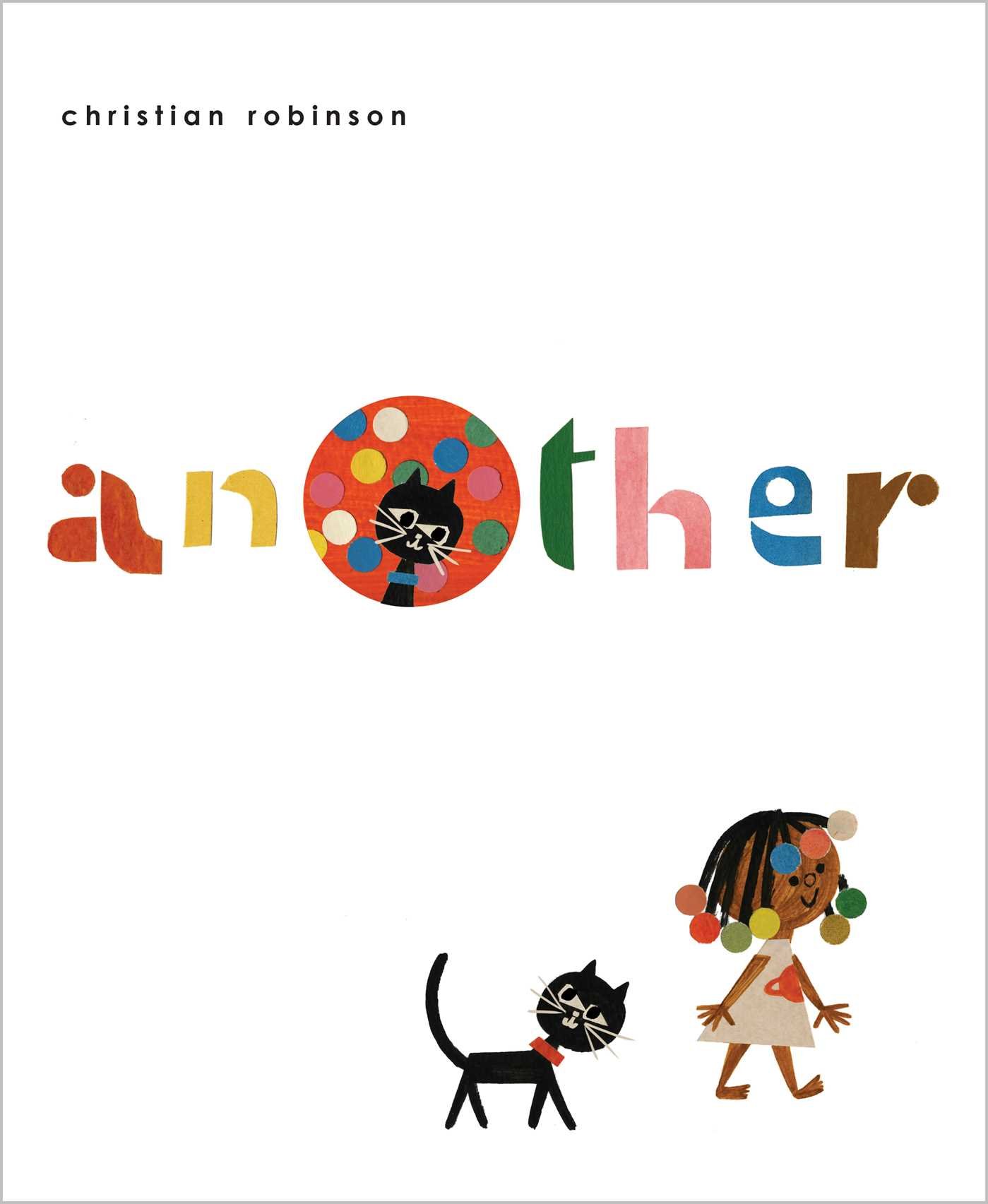
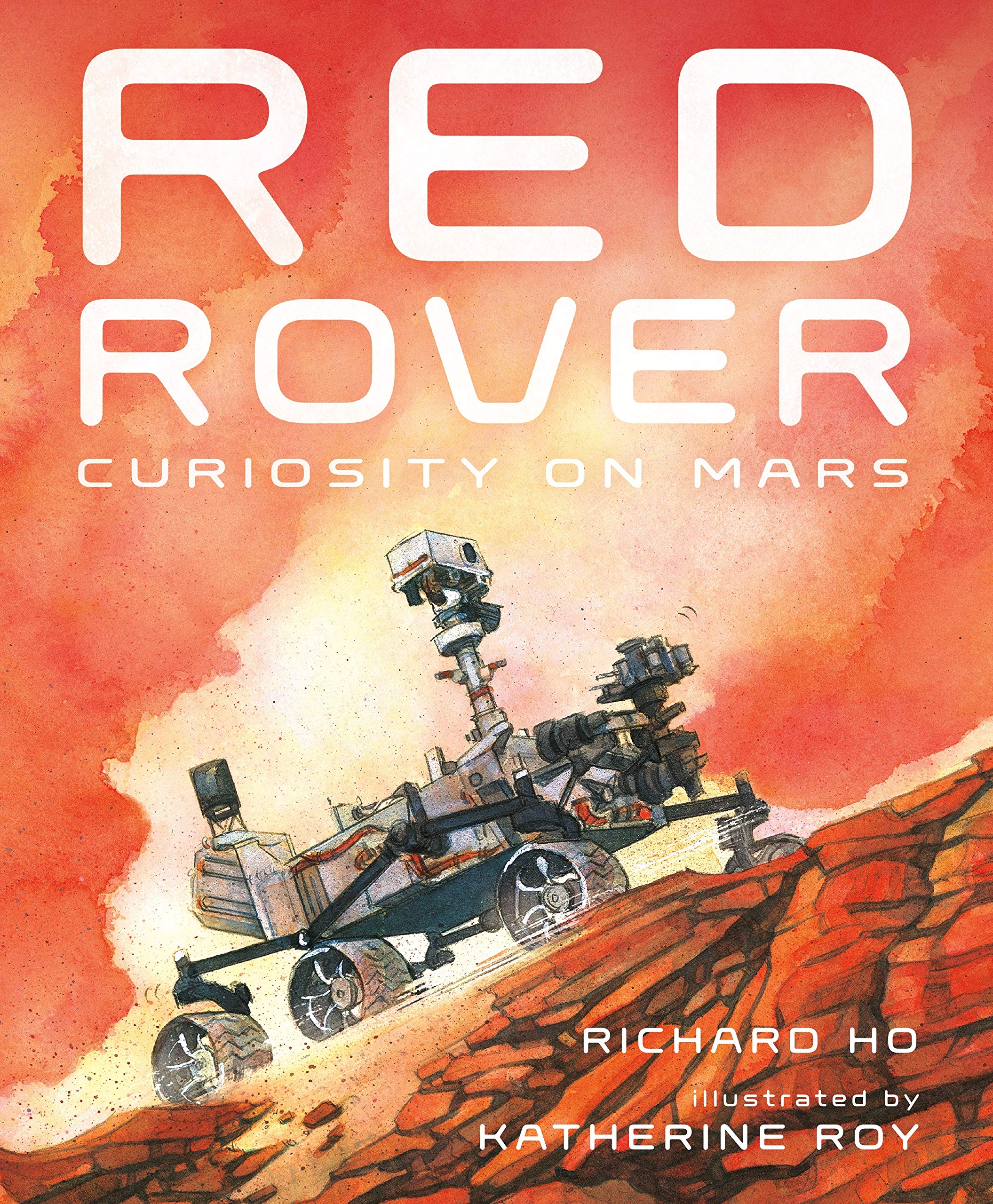
For the past 5 years, I have done a Mock Caldecott unit with students as we come back to school in January. And while January is far away, the year is quietly winding down which means the reflection begins on which illustrations took my breath away. And there were many. Last year, I ballooned my choices but it turned out to be too hard to get through for my students. So this year there are a few changes.
One, I am reading all of these books aloud in the weeks leading up to our unit. While the students will still read them in their group, they will have experienced the full text with us all first.
Two, I am limiting our choices to 12. That way we can leasurely work through the unit, savor the illustrations, and give it the time it needs rather than skim through pages in order to come up with a winner.
Three, each group will pick their winner. Every year we have had a vote for class pick, but this year, I will let our groups select and root for their individual winners. We will, however, vote for an overall winner in all of my English classes combined.
The lessons will not change much; I use previous winners to discuss the different components of the award and then students grab the books they will discuss that day and rank. Each group gets a packet with the titles and a voting sheet. The slides I use are here and are pretty straight forward. The voting packet I use is here each group gets one and it helps them keep track of their scores.
So which books have I chosen for the year? (Not that I matters because we almost never pick the winner, ha)
If you are wondering where I will be in the coming year or would like to have me speak, please see this page.. If you like what you read here, consider reading my latest book, Passionate Readers – The Art of Reaching and Engaging Every Child. This book focuses on the five keys we can implement into any reading community to strengthen student reading experiences, even within the 45 minute English block. If you are looking for solutions and ideas for how to re-engage all of your students consider reading my very first book Passionate Learners – How to Engage and Empower Your Students.
She told me that her goal was to find more time to read. That life had been busy and so reading had gotten lost. That while she liked it, sometimes, there just wasn’t enough time in the day. That while she liked that book, sometimes, she didn’t bring it home because there wouldn’t be time. That while she knew she should read outside of class, sometimes she just didn’t have the time, after all, there was so much else to do. And she wondered how I read so many books, how I found the time, despite it all. And I only had one answer to give…
I don’t find the time. I make the time. I make the time to read the books so I can speak books with the people in my care. I make the time to read outside of my known, outside of the known of my students so I can bring the stories in that we maybe didn’t even know we needed. I make the time because I see the value, I live the value so that perhaps through our shared dedication, through our conviction, our students who have not (yet) found the value will.
We make the time to find the stories that will light up a new understanding. That will entrance. That will captivate. That will spark, even if only for a moment. That have just entered the world and now need to enter ours.
We make the time because if we don’t then we can tell students to read until we are blue in the face and they will know that we don’t really mean it. After all, how can we say we value it if we don’t give the gift to ourselves?
We make the time so we can speak books, develop a shared language wrapped up in our shared experiences, colored by the rollercoaster tracks of the stories we surround ourselves with.
And we question the books we love to make sure that our love is warranted. And we question the books we dislike to question whether our dislike is misplaced. And we keep an open mind so that all stories, because our kids are our stories, feel safe and valued and accepted no matter the differences we all bring into our community. No matter the sameness we bring into our community.
Because as we all know, or at least we should, the days we have lived will never come back. The moments we have spent will never trigger more. No person in human history has ever found more time. We all live by the same 24 hours, the same 86,400 seconds. We all live by the busy, the to-do and the get-done’s. By the push and pull of a life we say we control and yet at times feel such little control over.
But the time we make.
The time we take.
That’s what matters when we share this community with our students. When we wind ourselves up in stories. When we hand a child a book we loved too. When we hand a child a book we cannot wait to read. When we hold up a new story that has somehow become a part of who we are. When we admit that last night, even though I wanted to, I just didn’t read, because last night I chose to give my time to something else, but tonight! Tonight I will read because I want to. Because I choose to.
So we make the time and we urge our students to do the same. Our colleagues to do the same. Our own kids to do the same. So that this life, one that is already rich with story, becomes a life where quiet moments of great imagination are not the exception but instead the reality we choose to live on our own.
So we read so we can grow so we can share so we can learn.
And we tell all of our children, even the ones that do not belong to us, that stories are the threads of humanity and so we must take the time to read them. We must take the time to live broader in the ways that only stories can provide us, because that is the reward we can give ourselves day after day. That is the reward we can give others.
If you are wondering where I will be in the coming year or would like to have me speak, please see this page.. If you like what you read here, consider reading my latest book, Passionate Readers – The Art of Reaching and Engaging Every Child. This book focuses on the five keys we can implement into any reading community to strengthen student reading experiences, even within the 45 minute English block. If you are looking for solutions and ideas for how to re-engage all of your students consider reading my very first book Passionate Learners – How to Engage and Empower Your Students.
You may have noticed that this blog is slowing down a bit, while life continue to churn, I am slowly starting to work on a new book potentially. This means that there may be less brand-new writing on here and instead a mix of from the archives and new. The wonderful thing with continuing to be a teacher is that our teaching, hopefully, evolves as does our understanding of the work we do. With that I present to you a reworking of an older postfrom 2015.
I met my first book abandoner my very first year of teaching. Yet, he was not your average run of the mill book abandoner. No, he was the “look you straight in the eye and ask you what you are going to do about it” kind of abandoner. So I did what I knew best; forced him to read the book and not allow him to abandon it. And he did what he knew best; fake read for a good amount of time, skimmed a few pages, and failed the book report as well as the presentation. Repeat with every book. I don’t think he ever read anything beside “Diary of A Wimpy Kid” that year, and that was to spite me more than anything as I forced him into my choice of book time and time again. because I figured that when he couldn’t pick a book it was up to me to do it. When he couldn’t pick a book it was up to me to create accountability.
Everyone has these types of readers. The ones that abandon book after book because they hate to read, always have, always will. The ones that abandon book after book because they cannot find a great book, or perhaps they found one once, or perhaps they never have. The ones that abandon book after book because they get bored easily and while a book may have started great, now it is just meh. Some years we have a lot, others not so many.
Often for every child that abandons a book, there is a conversation missing, one that we need to engage them in in order to break the cycle. One that centers on one of the true goals of reading which is that the children we teach should be able to leave us being able to find a book that they are wanting to try on their own, without relying on artificial supports such as their level, their Lexile, or their teacher because they inherently know themselves better as readers.
This conversation takes time, it takes patience, and it takes diving into all of the many components that centers around the giving up a book. While often it may be seen as a rash decision made from an overall disinterest in reading, one that we dismiss when we hand a child another book to try, it is important that we dive into the nuances surrounding book abandonment in order for a child to know themselves more every time they abandon one. Make the act of abandonment one of internal reflection so that it no longer becomes automatic but instead becomes a choice that they can use to further investigate who they are as a reader.
This, therefore, means that there are questions we should be asking of our programming as well as the children that choose to leave yet another failed read in their wake. These questions shape the future decisions they make as well as their overall journey into their own reading identity.
Do they have choice? Because if they don’t, then that is the very first place we start. And not limited choice based on levels, Lexiles, or AR scores, but real honest-to-goodness choice where they get to pick their reading materials out of all the reading materials we have. This includes choosing the format and how to access it. Even as they abandon book after book, that choice needs to be protected at all costs, because while we may think that limiting choice will help them in the short-term, that’s exactly the problem with this approach, it helps in the short-term but does not push them further in their own understanding of book selection that works. So even when it seems like the list of abandoned books is too long to bear, let them continue to choose as there are other perimeters to consider.
Do they have time to actually book shop? Often we ask kids to quickly select a book and then wonder why they seem to not be invested in the choice they make, yet, if we study our own adult reading habits we know that leisurely browsing through selections is a pillar of how we choose books. So what are the time constraint placed on students? Do they have time to look through books, try a few pages, sit with a book for a while before they fully commit? Do they have time to speak to their peers about potential titles? Book shopping should be a social endeavor not one done in solitude if they don’t want to, so what are the conversations that need to happen as they browse?
Do they have time to read? If little time is given to reading then we are expecting them to do something they may not like only outside of school. That is foolish and also malpractice when it comes to the use of our time. Every child, every day, should be engaged in supported independent reading. So when can they read in class and try on the book? When can they be under the guidance of a trained adult that can help them navigate difficult concepts or words?
Do they have access? We know that students need great books in their hands. We know students need great libraries coupled with a librarian, but they also need books in our classrooms. And not old, worn out books, but new, enticing, high-interest books that they can check out easily. So when are they surrounded by books to choose from, what are those choices? Can they check the books out and bring them home or do they have to be kept in class? Yes, I lose books every year, but it is worth it to me if it helps a child read.
Are they overwhelmed? One student I taught told me 6 months into the year that our classroom library was simply overwhelming to browse in. That he didn’t know where to start despite my labels and bins. It took that long for him to tell me because he didn’t trust me with the information, afraid that I would think it silly or stupid, and yet, I didn’t think anything like that. What a way to know oneself! Once he had told me, we were able to create a way for him to browse specific sections of the library that he liked and able to pull out books from large stacks that I would pull for him. As he gradually got more comfortable, I was able to pull back my support.
Do they see themselves in the books? We discuss students needing windows, mirrors, and sliding glass doors in their reading lives as crafted by Dr. Rudine Simms Bishop, but do we also evaluate the stories we have? Are we making sure that we are not just crafting a new cannon of sorts that continues to misrepresent marginalized populations or only share one aspect of someone’s journey? What reading choices are the students surrounded by? Is it culturally responsive such as how Dr. Gloria Ladson-Billings discusses? Will it further a perhaps damaging narrative that they already have about others, or will it break down misconceptions, stereotypes, and harmful thinking?
Do they have people? Is it cool to not be a reader in their friend group? Who do they have to talk books to? Do they have reading role models that extend beyond the teacher? Who are the people that have similar tastes as them, that they can speak books with? Many of my students tell me that they don’t have many others to get recommendations from despite being in book-rich environments for years and teachers working specifically on this. So how else can we increase the natural book conversations, students are having in order for them to make connections with the reading tastes of others? I often invite kids to book shop together so that they can find books together, we also use book talks for this as students discover others with similar tastes as them. Also, who are the adults that can speak books to them? It should never be just the classroom teacher, invite your librarian in, create a rich reading community so that students can see many readers int heir day, and many opportunities to speak books.
Do they have reason to read? And by that, I don’t mean because of a prize or a reward. Do they see any kind of gain from reading? Is anything positive connected to the art of reading? Will it actually make their lives better or is it just one more thing to do? Many of my students who abandon books repeatedly do it because they see no point and until we start to help them see a point of reading that goes beyond “the adults make me do it” then it is going to be hard to break any kind of habits. So how can we stress the importance of reading, what is it they want to accomplish in their lives where reading plays a central role? Is is that they want to understand others? Understand the world? Or is it much smaller than that?
Do they have different ways to read? Reading is not just done with our eyes but also with our ears, so if a child is constantly abandoning books get them hooked on an incredible audio book. This has changed the reading path of several of my students in a profound way. Sometimes getting them into text is what makes a difference, especially if they would like to read a book that may be difficult for them to decode independently, why not use audio books as a way to help them become invested in a text? Then we can work on the decoding separately.
Are they hiding gaps? I have taught several students that could ace their reading assessment, mostly because it had been given to them so many times, and yet had a large gap in their skills. So is their book abandonment masking a larger problem such as not actually understanding what they are reading or not having developed the stamina to stay with the story? Is reading seen as something emotionally draining because it is incredibly difficult? We cannot dismiss the emotions that are attached with reading for many kids, especially our vulnerable readers, and so we must work on developing their understanding of themselves as readers along with the skills of reading. This requires trust.
Are we making them do things that kill their love of reading? When students abandon books a lot, it is a sure sign that we need to reflect on our own practices. And not just skim over that reflection and pretend that everything must be ok. Are reading logs killing their love of reading? Are programs liked Accelerated Reader or LLI? Are we constantly asking them to do things with their reading rather than “just” read? What else is attached to our reading that may make a child abandon rather than finish a book?
Have we asked them? This is the biggest component needed because too often we try to figure out why a child is abandoning books and we never ask them why. Not beyond the “What didn’t you like about it?” So instead we must give the students a chance to discuss or reflect and really start to study their own habits. What patterns do they see? What types of books might they like to read? What can they do to change their habits? Students need to feel empowered in their self-reflection because otherwise, their pattern won’t change. They also need to set goals and then be able to honestly assess their own progress. This is part of the much larger work that must be centered in who they are as readers and how they want to take control of their reading identity.
Do they trust you? Trust is often something that is taken for granted in our classrooms, as if by simply being together, we build trust, and yet that is not true. Often we have to work hard to earn the trust of students, particularly those whose school experiences have not been safe or those whose lives are different than the ones we lead. Trust takes many things; choosing to be vulnerable, creating a calm and safe space, acknowledging our own limitations as a teacher and adult, recognizing our own limited experience of the world, and also being genuinely invested in the success of every child no matter where they are in their journey. We earn trust, plain and simple, and we do it by showing up, asking questions, actively listening, and passing no judgment. By investing into the lives of each child, by partnering with those at home, and by removing shame as a tool in our learning environments. By expanding our tools as a teacher, and more importantly our knowledge so that we can do better. Often students tell me much later in the year why they really hate reading or why they abandon book after book but it takes time for them to feel that I deserve the truth. Sometimes they are not sure why until much later. Until they do, I engage them in conversation both planned in our reading conferences and casual, I congratulate them on the accomplishments they do have, and I continue to provide them with the tools I can think of to help them be successful. It takes time, it takes patience, and it takes trusting your students even if they don’t trust you.
Abandoning books is often seen as an irritating habit that we must break quickly at all costs when it comes to students, but what if it instead is viewed as a starting point for a deep and nuanced exploration into the reading journey that a child is on? Think of the conversations we can have.
If you are wondering where I will be in the coming year or would like to have me speak, please see this page.. If you like what you read here, consider reading my latest book, Passionate Readers – The Art of Reaching and Engaging Every Child. This book focuses on the five keys we can implement into any reading community to strengthen student reading experiences, even within the 45 minute English block. If you are looking for solutions and ideas for how to re-engage all of your students consider reading my very first book Passionate Learners – How to Engage and Empower Your Students.
A conversation I find myself having often with other educators is just what to do next for curriculum. How do we get everyone on the same page? How do we ensure that what we do is actually happening in different classrooms with different teachers? How do we ensure that the very kids we are entrusted with have somewhat similar experiences within our classrooms all while protecting the art of teaching?
You may think that textbooks with daily lessons are the answer, and for many it appears to be, but it doesn’t have to be that way. As Dr. Allington reminds us, “…no research existed then, or exists now, to suggest that maintaining fidelity to a core reading program will provide effective reading lessons.” (What Really Matters When Working With STruggling Readers, 2013) . Yet, fidelity has become a major selling point as we see many programs being touted to schools who are unsure what to do next. Fidelity has become a point of judgment; how closely aligned are we? Do we use the same texts? The same worksheets? The same words in order to ensure the same experience for all? I was once told by a well-meaning but ill-advised administrator that “I better be on the very same page of the textbook as my colleague next door” as he passed from classroom to classroom.
And yet if there is one thing I know about teaching, it is that our kids are not the same. From class to class, from year to year, the kids have needed different things. Have needed educators that are adept at adapting, that are unafraid to try something new, that know their research, but also know to seek out others for more ideas. Who know their own areas of growth so that they can provide better and better experiences year after year. Sure, use a program to start you off, but don’t forget about the very art of teaching that asks to be responsive to the very kids we teach, that require us to be disruptors of inequitable practices that have shaped the educational experience of so many.
I teach in a district that puts an incredible amount of trust in their teachers and fellow staff who support our students. Whose very core of teaching is autonomy, responsibility, and professional development. Who believes in developing teacher craft so that students can be vested in classroom experiences that speak to them personally and not just whatever the pacing or curriculum guide has told them to care about. Who believes in disrupting inequitable education experiences and providing the room to do so, supporting each teacher on their journey. But how do you then ensure that students aren’t unknowing members of an educational lottery where their growth is based on the experience and know-how of a single teacher? How can you create room for your teachers to personalize while still ensuring that certain experiences are in place?
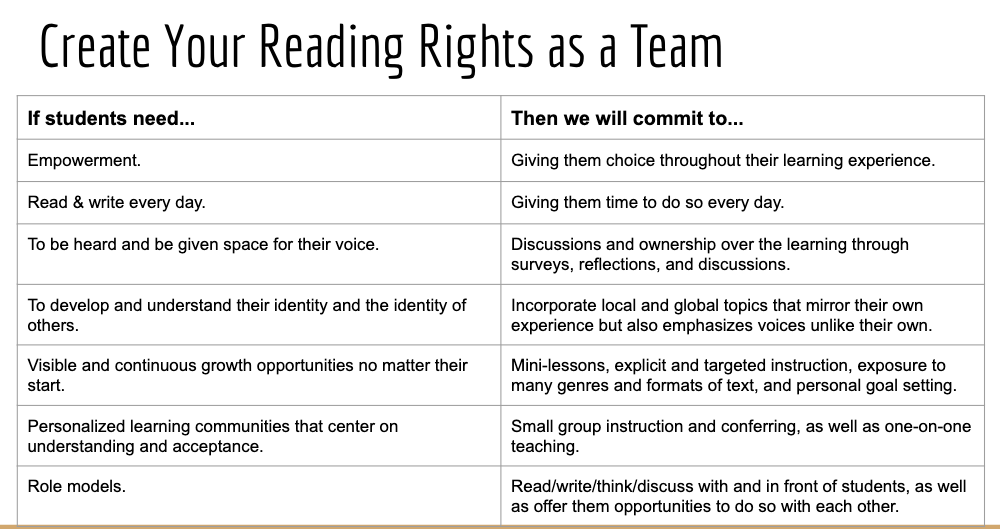
The foundational idea is deceptively simple; create student rights together. A living breathing document that shows which experiences every child should have in every room, no matter the teacher. Live by it. Work by it. Discuss and change as needed.
But in practicality, how do you get there?
The first step is to have time to discuss what the experiences of students should be. What do we, as the practitioners, believe every child should have as rights in their English (Or whichever curricular area) educational experience? Reading books they like, having a librarian and time in the library, abandoning books, picking writing topics, a teacher that will confer with them, discussing relevant topics. Brainstorm as many things as you can. Group them to see patterns. And then step back.
What is missing? This isn’t something that is done quickly, after all, this will be a guiding document. Do research on best practices within your curricular area. What do you not know about? What do people like Dr. Rudine Simms Bishop, Dr. Richard Allington, Dr. Gloria Ladson-Billings, Zaretta Hammond, or Dr. Louise Rosenblatt say about the experiences students deserve?
Then group all of the post-its or thoughts together. What are the clusters? What clearly speaks to all of you as a team? Try to come up with words that can tie it all together. Which patterns do you see? The right to read, to speak to one another, to have texts and materials that reflect their experience and the experience of others? The rights to connect with others? To free write? To skillful instruction? Again, pay attention to your own gap areas, which parts of instruction are you not thinking about? Do these potential rights mirror an entire experience or only parts of one?
Then translate the goals into actual experiences, such as if your team believes in student choice in reading, what will that actually look like? When will there be guaranteed time for that? How often do they get to choose? How will you support their choice? Who else will support it?
Then it may look something like this…
If students need…Empowerment – then we will commit to giving them choice throughout their time with us.
How: Choice in their independent reading book, choice in their topic of writing when possible, choice in who they work with, choice in who they share with, choice in how they work through learning. Space to reflect on their experience, speak up about it, and shape the teaching that happens.
If students need to read and write every day, then we will commit to giving them dedicated independent reading time every day and writing time every day.
How: Start with 20 minutes of independent reading focused on developing their relationship to reading and reading identity. An emphasis on free writing when not otherwise steeped in their own writing. Planning reading and writing experiences every day.
It may end up looking something like this then.
Go through each foundational right as a team and then commit to it as a team. Bring it up throughout the year to see whether you are actually living it. What are the opportunities for the students throughout the year? What is missing and needs to be added?
Having a foundational understanding of what the experiences should be for every child provides us with a guide of which direction to go while also being able to see our own gap areas. Where do we need to grow as practitioners? What are we not yet providing for students and how is that impacting them? How do our choices in our learning tie in with these rights?
So often we look at curriculum and think that is where to start with any changes when really what we need to do is step back and look at the foundational beliefs and rights that support and determine the curricular choices we make. Because those beliefs are what shape every single experience kids have with us. Because those beliefs sometimes hurt the very endeavors we are trying to accomplish. While I know our documents and guiding beliefs are not perfect, nothing ever is, it gives us a place to start when we discuss what we are working on, what kids need, and the disruptions that need to continue happening for all of our students. Perhaps these guidelines can help others as well.
If you are wondering where I will be in the coming year or would like to have me speak, please see this page.I . f you like what you read here, consider reading my newest book, Passionate Readers – The Art of Reaching and Engaging Every Child. This book focuses on the five keys we can implement into any reading community to strengthen student reading experiences, even within the 45 minute English block. If you are looking for solutions and ideas for how to re-engage all of your students consider reading my very first book Passionate Learners – How to Engage and Empower Your Students.
The books have been flying off our shelves once again in room 203. So many titles that barely get to rest for a moment before another eager set of hands attached to an even more eager reader grabs the book, so happy they finally got it. This book they have been waiting for, this book that everyone seems to be clamoring for. And while many books are receiving love this year, a few stand out above the rest; an entire format of books, as it has for several years now.
Books that at a glance may seem easy, or not that challenging, after all, we all know to not call books easy by now, right? Books that entice kids with their colors, their visuals, as they deftly maneuver complex topics but do it in an accessible way for many. In a way that grabs even my most vulnerable readers and tells them to give them a shot. That they, too, are readers and that this is just the right book for them.
I often step back and simply marvel at the wonder of graphic novels and how they make so many kids reconnect with reading or connect with it for the very first time. I am not alone, if we look at sales numbers for graphic novels they are dominating, circulation increase around the nation, and those who for decades have been holding them up as great books are being heard more and more.
And yet, I see so many adults, so many of us teachers, lament the fact that kids continue to reach for graphic novels, for comics, for books that for whatever reason seem to be too easy, whatever that may mean. I have seen it most often discussed when a book has pictures of any form. I hear it when we tell kids that it is time for them to graduate into chapter books. That they should read chapter books rather than picture books. When we tell kids that is time to try something harder and we stare at the graphic novel in their hand. When we pull out comics for fun but not for real reading. When we tell kids that we will take graphic novels away from them if we see them reading them (true story). When we tell them that, sure, they can read graphic novels, but just a few, because then they need to read something a bit more substantial. We say it with the best of intentions, after all, how will these kids grow in to “real” readers? Grow as readers if they only read “those” books? And we share the worry so that those at home start to worry too and they rush in with their questions and their eagerness to make sure their child is becoming the reader they always envisioned, a child who reads serious books that show off their prowess and skill. We do all this so casually that we don’t even see what it is we are all really telling kids.
“These books won’t teach you…”
“These books will not challenge you…”
“These books will not help you grow the way I hoped…”
“You will never be a reader…”
“You will never know how…”
“This will never be enough…”
And so we hand them other books. Anything but books with images. We search for recommendations in order to steer them away, to guide them on a new path instead of embracing the medium. Instead of letting them choose and celebrate their choices. Instead of immersing ourselves as fully as we can as their partners. Instead of embracing this newfound obsession with a complex medium and helping them challenge themselves within the format.
And it hurts kids’ reading lives.
And it hurts kids, period.
Because what we forget is what the research tells us about these books. About books like 150 Years Retold by Kateri Akiwenzie-Damn, Sonny Assu and many others. About books like Last Pick by Jason Walz, Pie in the Sky by Remi Lai, and Stargazing by Jen Wang. About the books that bring kids into our libraries and keep them there. That these books are not easy. That these books do not stop kids from growing as readers. From reading difficult texts because theseare difficult texts. Sure, there may be less words but every word matters. Sure, there may be pictures but that every picture tells part of the story and if you skim them, you miss out on the depth of the story. That reading these formats of books will not stop them from growing, from challenging themselves, from gaining vocabulary, or understanding difficult concepts. But indeed, as Krashen and Ujiie remind us, ““…those who read more comic books did more pleasure reading, liked to read more, and tended to read more books. These results show that comic book reading certainly does not inhibit other kinds of reading, and is consistent with the hypothesis that comic book reading facilitates heavier reading.” (1996)
And so we must embrace it. We must celebrate it much like we do when a child goes for a deep dive into a specific genre or author. Invite them to build reading ladders as inspired by Dr. Teri Lesene and challenge themselves within their chosen format. We must hold them up as the successful reading choices they are and continue to surround students with amazing choices. When they pick up another graphic novel, encourage it by discussing it, not shun it and forbid it.
This doesn’t seem hard and yet for so many kids this is not their reality.
So the next time a child grabs yet another graphic novel, perhaps we should read it too. Perhaps we should help all of our students see the nuances within these masterful stories, help them read them correctly, to slow down and see all of the details. Honor this format by teaching them rather than thinking of them as frivolous, as desert books, as books we read when we need a little break. Help students create them.
We forget that the kids we teach are on a lifelong journey of reading; why do we feel the need to rush them into different books? Why rush them away from images? From pictures? From anything that embodies visual literacy despite it being the world we live in more and more? Why not embrace the books they read and help them find more books like it instead? Why not let the kids read and be there to hand them another book rather than tell them that it is time to read something different? Why not let kids choose their own books, graphic novels and all, because in the end what we seem to have forgotten the most is that they are books. End of story. Magical, mesmerizing, enticing, books.
It’s not that hard, is it?
If you like what you read here, consider reading my newest book, Passionate Readers – The Art of Reaching and Engaging Every Child. This book focuses on the five keys we can implement into any reading community to strengthen student reading experiences, even within the 45 minute English block. If you are looking for solutions and ideas for how to re-engage all of your students consider reading my very first book Passionate Learners – How to Engage and Empower Your Students. Also, if you are wondering where I will be in the coming year or would like to have me speak, please see this page.
We are two weeks into the year and slowly the routines are starting to shape up. We know each other just a little. Our community is growing. The incredible inquisitive and funny nature of our 7th graders is coming out more and more. And every day we start the same way; twenty minutes at least of independent reading. Twenty minutes to “Settle in, settle down, and get reading.” Twenty minutes where I get to book shop with kids, check in on their day, and also do initial reading conferences with the kids as we start to get to know each other more. After all, how am I supposed to help them grow as readers if I don’t know them as readers, as people?
Our first reading conferences are simple yet effective as we start this journey together. All it takes is a few things: our reader survey, their goal setting as it ties in with their 7th-grade reading challenge, my note taking sheet, my home information sheet and time. Hmm, maybe that sounds complicated, but it is not. What these different things do is allow me to slowly gather information on the students and open up conversation.
The reading survey helps me get insight into their reading habits and emotions tied in with reading. They do this within the first few days of school.
The home sheet was used during our ready-set-go conferences prior to school starting but I also use it throughout the year to fill in more information. (The pronoun question/answer is an optional question from a different survey).
And my note-taking sheet, a constant work in progress, gives me a place to keep all of my information, in order to have a place to remember our conversations by.
Every class has its own binder where the information is placed alphabetically, and that’s how I start; alphabetically and call up two or three students every day during their reading time.
A few easy questions start us off: When we meet would you prefer to come to me or me come to you? (Many prefer the relative privacy of coming to me). Which book are you reading, how did you choose that one, how would you rank it on a scale from 1 to 10?
Then we move into their reading goal. Questions I ask are: What is your goal, how come you set that, and tell me more about your reading life last year? I take relevant notes throughout our conversations and I make sure the kids can see what I am writing down, I don’t want them to have to worry about what I may be recording. There are often follow up questions but I also want to be cognizant of wait time and the delicate nature at times of reading and how kids feel about themselves as readers.
Then we discuss their progress, how is it going? How is the book working for them? How is reading outside of English going? We also discuss what is hard about reading, no surprise, even my most adapt readers have challenges. Finally, I ask them if there are things I can do to support them right now better as we get to know each other. Many don’t have ideas right now but I like the openended question in case they do.
As we wind down, I ask them a few more questions. What is their favorite color? What is their favorite treat? And what do they do well? This information is used throughout the year as I celebrate them. It also gives me a peak into where they see themselves right now, many kids tell me they don’t do many things well, and so I always try to help them see great things about themselves.
I thank them for their time at the end. Thank them for investing in our class and allowing me this time with them and that I look forward to helping them grow this year.
The next time I meet with them, there are less questions so the conference goes quicker. Then it starts with, ‘What are you working on as a reader?” as you can see from the note-taking sheet and then evolves from there.
A simple way to start but one that sets us up together to work on reading, to maybe better their experiences in reading, to make it matter beyond the work, the pages, the labor that it is for some. I am so grateful for these kids and the conversations we get to have.
If you like what you read here, consider reading my newest book, Passionate Readers – The Art of Reaching and Engaging Every Child. This book focuses on the five keys we can implement into any reading community to strengthen student reading experiences, even within the 45 minute English block. If you are looking for solutions and ideas for how to re-engage all of your students consider reading my very first book Passionate Learners – How to Engage and Empower Your Students. Also, if you are wondering where I will be in the coming year or would like to have me speak, please see this page.










 Pernille Ripp