aha moment, being a teacher, books, Literacy, Reading

Why Audio Books in the Classroom?

http---www.pixteller.com-pdata-t-l-273869

“What should I read next?” he says, eagerly awaiting my answer.

His question takes me by surprise, after all, there is no possible way he has finished the book I downloaded for him two days ago.  He has mastered the art of fake reading a few months ago.

“You’re done already?  What did you think?” I ask, trying to feel out if he actually read it.

“It was so sad…at the end, when his dad came.  I couldn’t believe it…” He keeps going, telling me parts of the story that makes me nod in recollection, and it dawns on me; he read it, I think.  He read it, he loved it.  He is proud.  He is ready for another book.

“When did you find the time to read it?” I ask, still surprised.

“Last night…It got interesting so I listened to it all night.  3 hours, I think.” He says, “So what do I read next?”

This child who had not read a chapter book all year.  Who has abandoned book upon book, casting aside any favorites that we could think of.  Who has stuck to the same graphic novel over and over because nothing else mattered.  This child, whose disengagement has made us worry late at night, whose ability to tell you exactly what you want to hear has befuddled us all. He now stands before me, beaming, waiting for the next book.  He has become a child that reads.

And he is not alone.  Several students this year are having incredible reading experiences, kids who have never liked reading, are begging for the next book, begging for time to listen.  Yes, listen, because these students are devouring one audio-book after another.   Comprehending the words without having to struggle through the decoding.  Accessing stories that they have heard their friends talk about.  No longer looking at the easier books while they long for something with more substance.  Those children are becoming readers with the help of audio-books.

Some may say that does not count as reading, I certainly used to balk at it counting toward any reading goal, this year I am discovering otherwise.  Sure, there are cognitive differences in the processes that happens when we read with our eyes versus our ears, however, the skills that we are able to utilize through the listening of an audio-book are monumental in building further reader success.  And research has shown that the cognitive processes are surprisingly similar.   So what has adding (and investing in audio-books) done for our students?

Provided equity in reading experience.  Students who read significantly below their grade level are able to access the same texts as their peers.  This matters when we create reading communities, because they no longer feel different when they book shop.  Now, when they browse the books they can select any book they are interested in and we can get it for them either through Overdrive or Audible.

Supported critical thinking skills.  Students can develop critical thinking skills without having to spend enormous brain power on decoding.  Decoding is still taught and supported through other texts, however, they now have a text that we can practice deeper thinking with that actually has deeper meaning.  Not  just right text that doesn’t provide us with the complex relationships that make for such powerful stories.

Re-ignited a passion for reading.  Often students who are developing readers start to hate reading.  And I get it; when you are constantly in struggle mode, it can be so tiring, so having access via an audio-book lets students finally enjoy a story.  They can be in the zone with the book because their brain is not occupied with the work of having to read, creating a deep immersion into the reading experience.

Provided new strategies for teaching reading.  I can now pull out segments of text to use with a student knowing that they have the proper background knowledge, which is a key component when we build understanding.  I do not have to reference the entire text, but instead can have them focus on the skill at hand.   This therefore allows me to support their comprehension growth more efficiently.

Given us a gateway into reading with their eyes.  Often times, my developing readers harbor enormous hesitancy when it comes to veering out of their known text.  They are quick to dismiss, abandon and feign disinterest, all in the interest of saving face and saving them from yet another reading disappointment.  However, students finding success within the audio-book world are building their courage, their stamina, and their desire to pick up print texts.

I could list more reasons; being exposed to amazing fluency, students feeling like they have relevant thoughts when it comes to discussion, building overall reading self-esteem, planting high interest books in the hands of students to see them become “the books to read,” even changing the reading dynamics within a classroom.  Denise Johnson lists even more here.

In the end, I wonder whether  it really matter whether having students listen to audio books is cognitively not exactly the same as when they read with their eyes?  If our true goal of teaching reading is to make students fall in love with books, then audio-books are a must for our classrooms.  And so is the notion that they count as real reading.  No longer should we denounce or diminish the very thing that can make the biggest difference to some of our students.

That boy, who asked for another book, started listening to All American Boys yesterday.  That boy who has faced discrimination, judgement, and who has tried to fit in by being an amazing kid every single day.  He is now reading a book that may make a huge impact in his life.  That may offer him tools if he ever were to face a similar situation.  And he wouldn’t have been able to before.  That book would have been so far out of his zone of proximal development that he would have been robbed of the experience for a long while yet.  But not anymore, he is a reader now.  And he is proudly telling everyone he meets about the books he has read.

PS:  I cannot take responsibility for this idea of using audio-books, that belongs to my amazing colleague Reidun, who makes me a better teacher every day.  I am thankful she had the idea and decided to share it.

I have been looking for research and articles to discuss audio books versus paper books.  Here are a few articles.

Why “Reading” Audio Books Isn’t a Shortcut 

Audio Books vs Book Books, Which Does the Brain Prefer?

Are Audiobooks Worse Than Real Books?  Let’s Ask Science

Is Listening to Audio Books Really the Same As Reading?

More research and ideas from Sound Learning

New Research Shows Audiobooks have Powerful Impact on Literacy Development

As Far As Your Brain is Concerned, Audiobooks Are Not Cheating

Audiobooks: Legitimate “Reading” for Adolescents?

Time Magazine discusses pros and cons

PPS:  If you are wondering which book he had listened to in one night, it was, of course, Orbiting Jupiter.

If you are looking for a great book club to join to re-energize you in January, consider the Passionate Learners book club on Facebook.  We kick off January 10th.  

being a teacher, books, Literacy, picture books, Reading, student choice

Our Top Picture Books of 2015

For the past 3 days, my 7th grade students have been furiously discussing the their favorite picture books as we get ready for the Caldecott awards.  While we have not voted for our top 3 yet, I thought it would be worthwhile to share our all of our favorite picture books from 2015.  What I love the most is the care that the students are putting into their conversations surrounding their selection, looking beyond the “What a great story!” and really searching for picture books that will leave a long lasting impression instead.  Note, some of these are sadly ineligible for the award since the illustrator does not reside in the US, nor are they a citizen.  So if you are looking to boost your picture book collection, start with some of these incredible books.

The Skunk – story by Mac Barnett, Art by Patrick McDonnell

Strictly No Elephants – Story by Lisa Manchev, Art by Taeeun Yoo

Strictly No Elephants Art and Story by Jessixa Bagley

Drum Dream Girl – Story by Margarita Engle, Art by Rafael Lopez

Frederick’s Journey: The Life of Frederick Douglas – Story Doreen Rappaport, Art by London Ladd

Sidewalk Flowers – Story by Jon Arno Lawson, Art by Sydney Smith

Sad, the Dog – Story by Sandy Fussell, Art by Tull Suwannakit

Marilyn’s Monster – story by Michelle Knudsen, Art by Matt Phelan

I Don’t Like Koala – Story by Sean Ferrell, Art by Charles Santoso

The Night World – Story and Art by Mordicai Gerstein

Lenny and Lucy – Story by Philip C. Stead, Art by Erin E. Stead

Waiting – Story and Art by Kevin Henkes

Little Bird’s Bad Word – Story and Art by Jacob Grant

I’m Trying to Love Spiders – Story and art by Bethany Barton

To the Sea – Story and Art by Cale Atkinson

Elwood Bigfoot: Wanted Birdie Friends – Story by Jill Esbaum, Art by Nate Wragg

Float – Story and Art by Daniel Miyares

The Bear Ate Your Sandwich – Story and Art by Julia Sarcone-Roach

Henry Hyena, Why Won’t You Laugh? – Story by Doug Jantzen, Art by Jean Claude

Beautiful Hands – Story by Kathryn Otoshi, Art by Bret Baumgarten

If You Plant A Seed – Story and Art by Kadir Nelson

Pom Pom Panda Gets the Grumps – Story and Art by Sophy Henn

Growing Up Pedro – Story and Art by Matt Tavares

Voice of Freedom: Fannie Lou Hamer: The Spirit of the Civil Rights Movement – Story by Carole Boston Weatherford, Art by Ekua Homes

Water is Water – Story by Miranda Paul, Art by Jason Chin

Last Stop on Market Street – Story by Matt De La Pena, Art by Christian Robinson

Toys Meet Snow – Story by Emily Jenkins, Art by Paul O. Zelinsky

Finding Winnie: The True Story of the World’s Most Famous Bear – Story by Lindsay Mattick, Art by Sophie Blackall

The Only Child – Story and Art by Guojing

I cannot wait to see which books are in the top!

To see other favorite books in our classroom, go here

Awards, being a teacher, being me, parents, rewards

If You Really Want to Reward a Child

http---www.pixteller.com-pdata-t-l-271128.jpg

A few days ago, I sorted my own children’s toys.  Cleaned out all the misfits, the broken pieces, and marveled at the bag of plastic dippity does I was able to throw away.  A bag worth of trinkets, of things that meant something to them the first 5 minutes they got them, only to lie forgotten in their toy chest since.  The sheer abundance startled me, after all, I consider myself a miser when it comes to toy purchases.   But the proof was in the toy-chest; plastic trinkets galore.  As I snuck the bag out to the trash, I couldn’t help but feel like a mean mother for getting rid of their broken “treasures.”

Turns out, I didn’t have to worry as Thea, our 7 year old, came home with a plastic yo-yo today from school.  She proudly showed it to me before it broke (cheap plastic things tend to do that quickly) and told me she had earned it for reading. For reading…Because she had read every night.  And I sighed, and inwardly I rolled my eyes, and then I realized that I had to get something of my chest, (imagine that)…

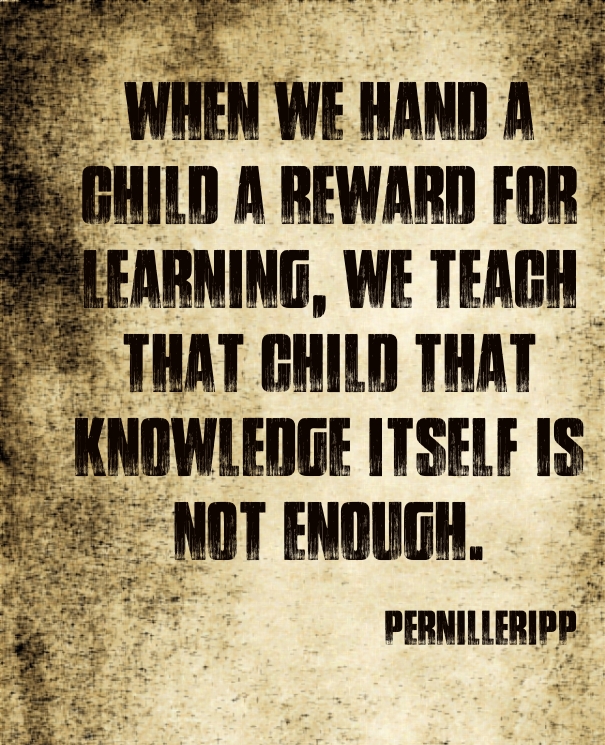
We need to stop cheapen the act of learning with plastic trinkets.

We need to stop teaching kids that when they learn, they earn something.  That when they learn they must be rewarded with a tangible thing to play with, rather than just the satisfaction of the knowledge they have gained.

Because in our well-meaning intention of trying to help students feel accomplished,  we are helping kill the love of learning itself.  We are teaching kids through our treasure chests, our prize boxes (guilty as charged), that learning is not enough.  That they have not gained anything until they hold a new toy in their hands.  That the knowledge they have gained is not enough.  That simply becoming more knowledgeable does not matter unless they have physical proof, and I shudder as I think of the long term effects that can have.

So if you really want to reward a child, hand them a pencil to write another story or solve another problem with.

If you really want to reward a child, hand them another book when they finish the first one.

If you really want to reward a child, give them more of your time as a class, give them a high five, a hug, or some sort of positive attention.

If you really want to reward a child, discuss their strengths with them, their effort, their growth, anythingt hat will make them see their own success if they do not already.

If you really want to reward a child, reach out to those at home; let them know what you see so that we can act accordingly.  Let us know what you see so that we can see it too.

But as a parent I plead, from one teacher to another; please stop handing out the trinkets, the stickers, the dippity doodads, the things we find at the dollar store.  Stop the paper awards and the made up rewards. Save us from the tangible, the things that break, the things that mean so little in the long run.   Celebrate, yes.  Acknowledge, please.  But save the toys for home.  The kids don’t need them, and neither do we.

If you are looking for a great book club to join to re-energize you in January, consider the Passionate Learners book club on Facebook.  We kick off January 10th.  


being a teacher, being me

To the Strangers that Become Friends

5 years ago I thought I was crazy.  That there was no way, I could do all of the things I knew I had to do to become a better teacher.  I knew that “testsandgrades” were killing my students’ curiosity.  I knew that when I held a child back from recess due to unfinished homework I was tearing down all of the community building I had worked on .  And yet, this is what good teachers did; they gave homework, they handed out grades, they punished and tried to make children behave with any means they could.  But I knew that if that is what it meant to be a great teacher, I didn’t want to teach.

But instead of quitting, I turned to Twitter.  To all of those people I admired that seemed to have it all figured out.  Because I felt so alone, so isolated, because no one else seemed to think that what I was doing was the right thing to do. I felt like a fraud, like someone was going to walk into my classroom and tell me how much I was damaging these kids with my crazy ideas.  But the thing about Twitter, or being connected, is that you realize that you are not alone.  That there are others out there who have had the same ideas as you, that have blazed a trail for you to follow.  That these random strangers can become the inspiration that you need to be better, can become a friend, even if you never met.  That in their fight, you can find strength.

Yesterday the education world lost a warrior.  A true trailblazer who in his sharing and speaking up gave me the courage and the guts to make my teaching better.  My friend, Joe Bower, passed away, leaving his two young children, his wife, and a global network of teachers stunned at his sudden passing.

And so I write this post in tribute to the strangers that become friends.  To all the teachers that dare speak up even when it has consequences for their own lives.  Who never back down when it comes to kids, even if they seemed too harsh at times.  Joe taught me to fight.  To speak up.  To give kids a voice and never make it about me, but always about the kids.  He taught me that there were always others to ask for advice from, that there was always a way to make something better even when it seemed like there wasn’t.    That even if you never met, you could still matter to others.

The world lost a fighter yesterday.  Many of us lost someone we admired, that we looked up to, that inspired us.  But we haven’t lost his voice.  His words will continue to push me and others to fight for change, to never forget what it is really about.

Joe wrote a chapter for a book called Reduced to Numbers and he starts with the line, “I am not the same teacher I used to be.”  Truer words cannot be found today as I mourn his passing.

Joe, I am not the same teacher I used to be, because you gave me courage.  For you and all those kids, I will keep fighting, we will keep fighting.  Thank you.


being a teacher, new year

Ideas for Working With the January Slump

http---www.pixteller.com-pdata-t-l-268942.jpg

We go back to school in 2 days.  Last night, I entered scores, sent a parent email and planned for the week ahead.  I realized that I was excited to go back, I always am, even though leaving my own children behind is bittersweet.  But I also realized that I was tired, nervous about the coming week because surely the students would be just as tired, perhaps a bit unmotivated, and maybe even unhappy to be back at school.  Knowing this I always treat January much as I treat September.  It is chance for us to get to know one another again, to recommit to the community we have built, to laugh, and to learn and to not just think that school is one more thing we just have to get through.

So how do we work through the January slump that sometimes happens?  A few ideas to help.

Bridge the past.  We will start with an honest discussion of the non-fiction picture book project they handed in before break, a reflection of some sort, and then they will get their assessments back.  We will take time to celebrate their accomplishments out loud but also set new goals.  Because many kids did just fine, but just fine will not change the world.

Make it special.  I should be doing a million things but choose to do a Mock Caldecott unit instead as we prepare for the ALA awards January 11th.  We love picture books in our classroom but have drifted away from reading them because of time constraints, so this week marks a recommitment to picture books but also to critical thinking as we try to predict who the winner and the honors books will be.  The other stuff will wait until after that.

Set the expectations.  On the first day of school, my students discussed their community expectations and we have since then lived by them.  Now is the time to refresh them because those kids I taught in September have changed a lot.  So once again, I will ask them to decide how our classroom should sound, feel and look like, give them time to discuss, and give them to time recommit.

Acknowledge the energy.  Too often we get upset when students are tired and yet, who can blame them?  Their bodies are in vacation mode as much as ours.  So instead of getting mildly upset, I will embrace it; more time for quiet, more time for reading, while also picking up the pace ever so slightly every day.  And yes, I will continue to be that annoyingly positive teacher who pretends not to be tired every day because the energy of the classroom starts with us.

Try something new.  January is the perfect time to start something new, whether it is just new to these students, or new to you.  You know each other, you have your routines somewhat down, and the classroom could use a boost.  So do something you haven’t done before this year; we will finally start blogging in the middle of January and I cannot wait, I have missed it a lot this year.

Bring others in.  January is also great for cross collaboration as it allows the students to think about your class in a different way.  So reach out to someone and see if they are up for doing a project together, whether it be in your school, or outside of your district.  Simply having the component of others involved is an automatic energy infuser.  We will be doing the 2030 Global Schools Project with the integrated literacy class at our school.  (And the rest of the world).

Clean up.  I took a day this break to clean our classroom.  Dust the bookshelves, declutter books, wipe off the tables and take down displays.  When the students arrive on Monday they will enter a fresh and inviting classroom with books eager to be read.  Our rooms get as worn down as our brains, so take the time to set up it again; note, that does not mean spending tons of time on new things or new displays.  Make it feel fresh again.

Protect what you hold dear.  Much like I took time to clean our classroom over break, it is time to clean up our to-dos.  Dust off those things you hold dear as a class and give them more time, declutter from stuff that is unneccessary and try to work it in a new way.  Look at your plans and your schedule and recommit your focus on those things that matter most to your kids.  A few months in is when we often get bogged down by all of the to-dos rather than the things that really matter.

Re-ignite your own passion.  A deflated January can often lead to the famous February and March slump so now is your chance to surround yourself with others who want to share ideas, try new things, and lift each other up.  Join something just for you.  Whether it is a class you want to take, a book you want to read, or even joining an online book club like the one we are doing for Passionate Learners on Facebook; add something that will make you fall even more in love with teaching and give you new ideas to try.

I know I am not the only one thinking of how to make January successful?  What are your great ideas?  What will you be trying?

If you are looking for a great book club to join to re-energize you in January, consider the Passionate Learners book club on Facebook.  We kick off January 10th.  

Be the change, being a teacher, being me, new year

Do Something

http---www.pixteller.com-pdata-t-l-267255.jpg

I have always loved December 31st, the last day of the year, our oldest daughter’s birthday.  While the promise of a new year lies ahead, the old is not quite finished, not quite over and the wonder of it all hits me.  Look at all that has happened in the past year.  Look at all we have done.

And yet, there is so much still out there to accomplish.  So many changes.  So many choices to make.  Because too often we sit back and wait for others to decide, we wait for others to fix, to mend, to invent, and to create.  We wait for others to share their ideas because we are unsure of our own.  We think to ourselves, “if only…” but the words never leave our mouths.  And it’s a waste.  It is a shame.  It is our own fault that we wonder what change could really look like, what our ideas may become, when we choose to remain unsure.  When we choose to remain silent.

So my wish for the new year is a simple one; do something.  Something to make it better.  Something to make it worth more.  Don’t sit there and wait while others do, change the world yourself.  Find your comfort zone and take a small step out.

Be the change.  Be the voice.  Be the person that does.  I know I am going to try.

If you are looking for a great book club to join to re-energize you in January, consider the Passionate Learners book club on Facebook.  We kick off January 10th.