One of my driving questions for the past 15 years has been a simple one; at the end of the day, would I like being a student in my own classroom? And as I have one month left of school, I feel the question pressing in on me as I think of next year and both the joy of continuing with my current class, as well as becoming the classroom teacher for a different class.
Would what we do make me feel safe? Help me engage? Make me feel like my voice was heard and respected? Would the way we learn, grow, discuss, and assess make sense to me?
This question is a conversation starter, an invitation into meaningful reflection where you get to craft the path for what you may need to shift or tweak your day-to-day practice. Because ultimately it is about creating conditions for shared power as a way to show children just how much power they can have over their own bodies and minds, even within the confinements of a publicly mandated and government decided educational system.
In fact, this question is at the core of my newly published book, Passionate Learners – How to Engage and Empower Your Students, now in its 3rd edition! But it’s not the only question, I ask. In fact, the books has more than 100 reflection questions embedded throughout, some big, some small, all meant for you to carve your own path into a more sustainable, meaningful practice.
But as a way to get you started, I decided to pull together a reflection sheet for you, modeled after questions in chapter 2 of the book. It’s 3 pages with 12 questions, that can be used by itself, as part of a larger reflection, or a book study, individually or with others. You can do some of the questions or just a few. You can write, discuss, or simply think. It’s a tool, use it as such and make it work for you.
And if you are interested in diving deeper, I highly recommend my book. I poured my heart into it, making it a practical invitation into co-created spaces that are not exhausting to be in. And right now, it is on sale.
The book is written as a companion to the practice you already have. It is not meant as a long list of abbreviations or new systems, but instead a way to help you reflect, while also offering up a major array of practical strategies and tools that you can use the very next day. It is meant as an affirmation, while also giving you access points to grow your practice so that you may feel better about the time you spend teaching, the students feel like what you do together matters, and that everyone is given tools to continue being critical questioners and thinkers outside of your learning space.
It seems to be a year of extremes; either students won’t stop speaking to one another in class or they hardly say a word. My 2nd graders love to talk. they are a social bunch, they love their classmates, and they love sharing. We have a can’t miss morning meeting every day so they can share what’s on their mind, we have a lot of chat throughout the day. All of it productive, even if it is not the right time.
But what if your students don’t really engage in conversations with each other? Teaching middle school for many years, I would sometimes have classes where one/word answers where the norm, the fear of making a fool out of oneself so strong that even without our classroom, mouths stayed shut and opinions stayed hidden away.
How do we cultivate classroom connections for all of our students? How do we harness the awesome energy that comes from students who want to speak to each other but help it become more learning-focused?
Here are a few ideas for doing just that…
Guess the Source: Provide quotes or excerpts from different sources related to the lesson. Have students guess the source and discuss the context and the credibility.
Soundtrack to the Lesson: Ask students to choose a song that represents the essence of the lesson. Play snippets of the selected songs in class and have them discuss the connections they saw between the music and the material.
Philosophical Chairs: Set up a circle of chairs with sides for “agree,” “disagree,” and “undecided.” Pose a statement and have students physically move to express their stance.Have them turn to an elbow partner to express why they sat where they sat.
Time Capsule Discussion: Imagine creating a time capsule for the school year. Discuss what items or memories students would include and why.
Speed Networking: Students pair up and have a short, timed conversation (e.g., 2 minutes) about a non-academic topic, such as topics found here. Rotate and repeat with new partners.
Problem-Solving Circles: Present a real-world problem related to the lesson. Students discuss possible solutions in small groups and present their findings to the class.
Tech-Free Talk Time: Designate a short period each week for “Tech-Free Talk Time.” What do they already know about a topic? How long can they keep a conversation going without turning to a device to check a statement or learn more? What are the questions they wish they could have used tech to answer? Write them down.
Tech-Enhanced Show and Tell: Combine traditional show and tell with technology. Students bring in an object related to the lesson and create a brief digital presentation. This one is super fun for older students who often don’t get to do a “show and tell.” Another twist is to ask students to bring in their most precious item / or a picture of it – have them share with the class why this is the item they brought in.
Life Soundtrack:If their life had a soundtrack, what songs would be on it? Students share their top three songs and explain why each is significant.
Interactive Storytelling: Begin a story related to the lesson and pause at a crucial point. Each student or group continues the story.
I never thought I would step out of the classroom as a teacher. There was no vision of my future that didn’t have me being a teacher, yet taking a break from physically teaching and working in marketing as a brand writer has been an incredible experience. Not only am I now 100% certain that I want to get back in the classroom, but I have also gotten to test so many of the writing strategies I have taught students throughout the years, expanded my own knowledge of the corporate tech world, and had to push myself way beyond my comfort zone. Starting over in a career at 42 is not for the fainthearted.
But this was something I would have never done had it not been for how awful I felt last school year. I needed to become something else in order to preserve what I was.
But still, seeing ourselves through the many roles we play means we often get stuck in the self-consistency fallacy – the belief that our past choices and behaviors must dictate our future. Just as watching the same play with the same actors repeating the same lines would grow tiresome, sticking rigidly to who we think we are can hinder personal and academic growth.
And so it made me think, of course, about the very kids in our care who only see themselves as one thing – a kid who doesn’t read, someone who is bad a math, someone where school doesn’t work. But they can be so much more. As educators, we know it is vital to help students realize that they have the power to change not only their academic trajectory but also their identities and passions. And we tell kids this all the time, often to very deaf ears. After all, it is easy to tell someone that they can be whoever they want to be, but often we have no way of knowing how to change.This is where teaching them about the self-consistency fallacy can help.
The self-consistency fallacy, also known as the continuation bias, path dependence, or battle against determinism, exerts a powerful influence on our lives. It often compels us to make choices based on our past roles and interests, even when our desires and aspirations have evolved. Similarly, it can limit our relationships, health choices, and overall life direction. However, it is essential to recognize that we are not bound by our past decisions and beliefs. We are dynamic beings capable of change and growth—a verb, not a noun according to Anne-Laure Le Cunff, who recently wrote about the self-consistency fallacy which started all of my thoughts.
To help students overcome the self-consistency fallacy, we must foster an environment that encourages reflection and expansion. By posing questions, we can challenge students to let go of preconceived expectations and explore new horizons.
This also ties beautifully in with the identity work we can have students do throughout the year. A great place to start is by taking students through some or all of these questions starting with who they are now, how people see them, and how they would like to be seen. Of course, these can be modified to fit the age group you teach.
What are some of your strengths and talents that you value about yourself?
How do your friends and family describe you? Do you agree with their perceptions of you?
Are there any aspects of yourself that you would like to change or improve? Why?
How do you think others perceive your interests and passions? Is there anything you want to explore further?
Are there any activities or hobbies you’ve been hesitant to try because of how others might see you? Why?
How do you express your true self in different environments, such as at school, with friends, or at home?
Do you feel comfortable expressing your thoughts and opinions openly? Why or why not?
Are there any societal or cultural expectations that have influenced how you present yourself to others?
Imagine the ideal version of yourself. How would you describe this person? What traits or qualities would they possess?
What steps can you take to align your current self with the person you aspire to become?
Are there opportunities that you have dismissed because they don’t align with your existing trajectory?
What new paths could you explore if you were not bound by your past choices?
If you could start from a blank slate, who would you be? What would you be interested in? How would you be known?
Asking students to consider how they are seen and whether they agree with that opinion is an important place to inspire change. Is how they are known who they want to be? Are there other parts of themselves they would like the world to know about? Are there parts they would like to not be known for?
It is crucial for students to understand that the most significant opportunities for learning and growth often emerge from unexpected tangents. Encourage students to embrace the “weird” projects that pique their curiosity, explore fun ideas that may not have apparent professional benefits, and engage in collaborations unrelated to their career aspirations. Encourage them to break free of the stereotypes that often confine them.
By venturing beyond their comfort zones, students can cultivate a diverse range of experiences that will shape their unique stories. But even more importantly, they can change their static notions of who they are.
As educators, we have the privilege of guiding students along their educational journeys. By addressing the self-consistency fallacy, we can help students realize that they possess the agency to shape their academic and personal trajectories. By encouraging reflection, asking thought-provoking questions, and embracing change, we can inspire students to explore their true passions, foster growth, and build the foundation for a fulfilling future.
PS: Are you looking for coaching, in-person support, or virtual presentations? I am available and would love to support your work. Whereas I am physically located in Denmark now, I can travel if needed. In fact, I was just in North America in February 2023 and plan on bouncing back and forth. If you would like me to be a part of your professional development, please reach out. I am here to help. For a lot more posts, resources, live and recorded professional development, please join my Patreon community where most of my sharing takes place these days.
I wrote this blog post last year, what follows is an updated version of it in case you are interested in loose parts or storytelling kits with older students. Scroll down to see the update.
A few years ago I traveled to do a day of learning with passionate educators in Maple Ridge/Pitt Meadows in British Columbia. After flight cancellations and changes in airports, Denise Upton, one of the district’s helping teachers, graciously agreed to pick me up and take care of me during the stay. While together, she told me excitedly about Story Workshop, oral storytelling grounded within playful literacy, that they were doing with children as part of their literacy approach. She shared all of the work that they did with students in order to give them natural materials to manipulate and create stories with before they ever sat down to write. She spoke of Indigenous oral storytelling traditions and how they were working on bringing the rich traditions of the peoples’ whose land their school buildings sat on and whose tribal members were within their school population back into the classrooms as a way to honor, teach, and preserve a broader envisioning of writing I was inspired and intrigued. Particularly, after she told me how they were using these material kits with their upper grade levels as well and that the response they had was incredibly positive. After a whirlwind visit, the idea sat in the back of my mind for a while, hoping to someday become something I wanted to do with my own 7th graders.
Well, after a year of teaching unlike any other, after too much screen and not enough togetherness. After once again teaching kids who repeatedly told me how much they hated writing, how writing was so hard, whose sentences were forced across the pages, I decided that someday was now. With a commitment to reconsider every unit and every idea we build our classroom learning on, taking our writing in a much more tactile and playful direction was exactly what I need right now to get excited about next school year. Hopefully, my incoming students will think so as well.
So with a loose idea of what it was Denise had shared with me, the seeds started to grow; what if I build some oral storytelling kits for kids to use in partnerships, trios, or by themselves before we begin to write? What if I collect natural materials for them to manipulate and play with as they share stories from their own lives and also from their imaginations? Surely someone had done this before?
The answer is yes, many have! None of my ideas shared here are really original but I got so many questions on social media when I shared the kits I was building that I figured a blog post would be nice. If you are learning about Indigenous storytelling, there are so many wonderful resources shared, such as this one. If you google “Loose Parts”, you can see a lot of information. If you follow the work of Angela Stockman, she has been sharing so many ideas for years and is truly inspirational. If you are trained within Montessori, you know this work. If you know Reggio Emilia principles, then you know these ideas. If you have worked with younger grades, you probably do this already. There are so many resources out there, so dig in and learn.
My purpose for these kits is to get kids talking more before they write out stories, whether they be stories from their own lives or stories they invent. I want them to build scenes or entire stories together or individually depending on the exploration we are doing. I want them to play with their imagination and ot be forced into written production as quickly as we have done in the past, I want them to build community through story, I want them use their hands more. I want English to have more joy and I want it to authentically fit into the identity-centered work we already do in our literacy explorations.
Building the Kits
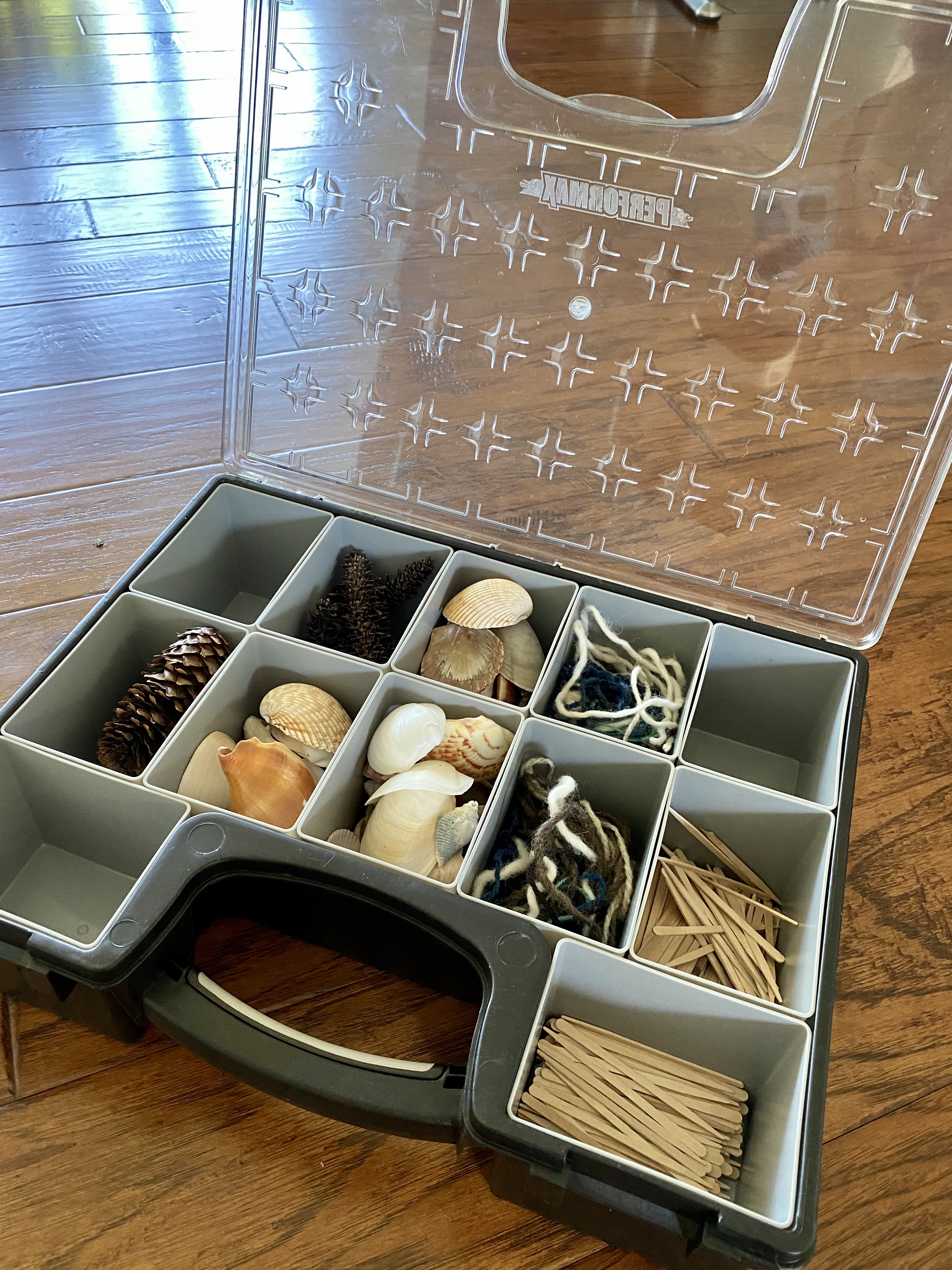
I had a million ideas right away and needed a way to ground them so I started by focusing on ideas for what to put in them and also building the kits to give me a more tangible sense of what it would look like. I hate so much that educators are almost always forced to purchase things out of their own pocket, so I spent school budget money to purchase the toolboxes. I bought two different kinds, five altogether, so that I can share them between tables – I typically teach 28 students at a time, so I wanted to make sure that I had enough kits to share materials between 10 different groups if need be. I also needed the kits to not take up too much space in our classroom, be easy to store and move, as well as have different size compartments. The first kind I bought was this one and the second kind was this one.
All the boxes are removable in both kits so we can spread them out on the different tables as needed.
Once I had the boxes, then I got more serious with my materials. I had a few guidelines I wanted to follow:
Natural materials whenever possible
Different sizes of things to use
Material that doesn’t necessarily look like “one” thing in order for them to be used for many things
Low cost and easy to replace
Then I wrote a list, there are so many lists floating on the internet but I posted mine to Instagram and got even more ideas as well as a huge “Duh!” moment. Notice on my original list, I have nuts on it. That is not going to work at all for some of my students due to their allergies. After a helpful educator made me see the light, I updated my original list.
I knew that if I felt like spending a ton of money, I easily could just order all of these things but I don’t want to. So, instead I turned to my local Buy Nothing Facebook group and asked if anyone had any materials they could donate. So what you are looking at in the kits above, almost everything is donated from kind strangers or friends who happened to have materials lying around. Amazing!
So right now in the kits I have:
Seashells, all sorts, all sizes.
Pine cones – I need to gather more.
Small popsicle sticks – they are pointy and I don’t know if I love that.
Wine corks that do not have wine labels on them.
Small cork buttons.
Wood buttons – I bought a giant bag off the internet.
Wool yarn in different colors – I have cut lengths of string in a variety of lengths.
White rocks.
Feathers – I think I may add more of these.
Glass beads.
Slices of wood.
I also purchased felt mats in green, gray, and brown for the kids to use as a background. They can use more than one if we have enough left over, again I went with natural tones as a way to center us in nature even if the story takes place in a different setting.
Things I would still like to add:
Beach pebbles for more color
More cork
Cinnamon sticks
Acorns
Large popsicle sticks
Ideas for use
So while the kits themselves are a lovely work in progress and bring me happiness right now as I plan, what matters more than the stuff in them is making space for them to be used with our students. So as I planned for the first two weeks of instruction (I do this in order to be able to walk away for a while, not because I want to work all summer), I planned with the kits in mind.
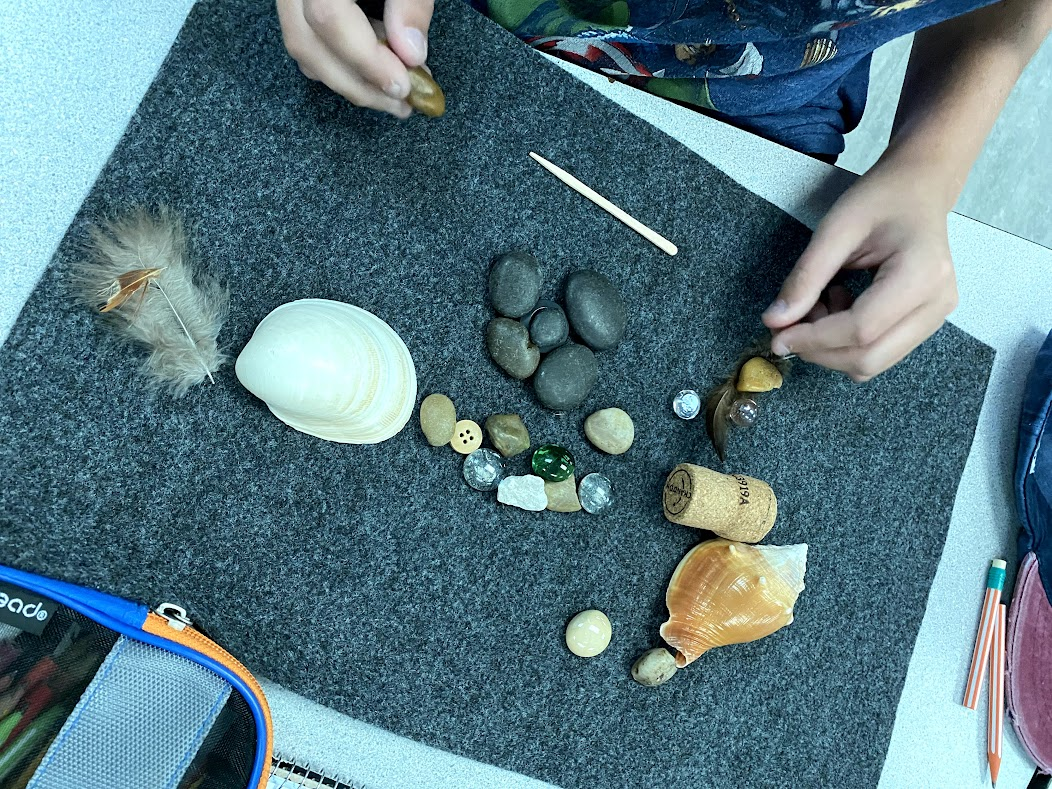
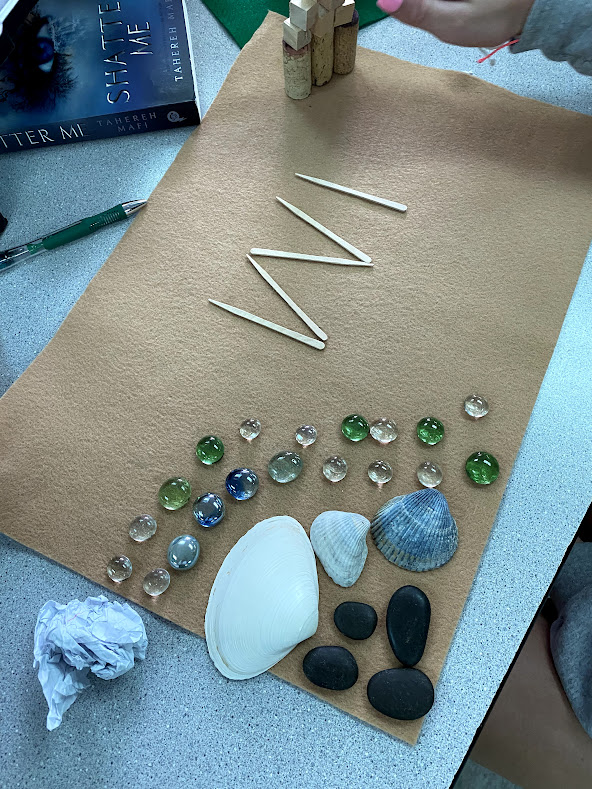
My two-week plan can be viewed here, but please know that it is so much a work in progress, that some of the ideas in it are my own, and others are based on the incredible work others have kindly shared, and that I have given credit to those whose work I am borrowing from or copying. Please feel free to also borrow or use my ideas, just give credit. The kits will be utilized, hopefully, on the third day of school in an activity where students continue to think of the stories they carry and start to build scenes from their own lives that they then, in turn, share with their peers at their tables. After their initial appearance, they will continue to be integrated into our work as we start our first longer writing exploration; personal narrative. Students can use events from their own lives or springboard events from their own lives into a fictional story.
I also want us to think of how the kits may help us work within the emotions we have tied up with our writing, how we can use them to go deeper into story and how stories can weave us together even when we don’t see eye to eye. I am hoping that as we explore our own identities and how that makes us view and react to others, these tangible items will ground us and make us feel safer within our burgeoning community. I am hoping that having these tactile explorations will bring more playfulness into our classroom, as well as more joy. We will also create expectations of how to use the kits with each other. My main focus for that is to be respectful of the material and of what is shared within their stories, but I will ask the students to also think of how to use the materials, how to clean up in order to preserve the kits, and how to work together. It really all ties into the community work we do throughout the year.
My own children helped me eagerly build the kits and have since then also used them. It has been amazing to see them build scenes, stories, and whole worlds using just these materials and then walking me through their stories that they now see so clearly. Even my son who has repeatedly that he hates writing has been using the kits and telling me his stories. I hope I will see the same willingness to try in my 7th graders.
Update
I rolled these kits out with students a few times and the results were mixed. Some LOVED them and jumped right in building scenes, drafting stories, and using them to get their imagination flowing. Others not so much, they played with the materials after a while and built embankments and such (yes, even in 7th grade). But you know what, that actually makes sense to me; some kids will love storytelling this way, others will not. Much like we explore different ways to draft, this then became another choice for it.
And for some kids they allowed a freedom they hadn’t felt in a while as they sat in front of screens, so as I think of rolling them out next year; they will be a choice, not a force as so many other things are in our classroom. Not meant to be yet another way to force kids into a specific mold of what a writer is, but instead offering them ways to discover how they write best. How they would like to play with words and story. I will also dive a little further into how we care for the materials, most were kind to the things, a few had to be reminded. That all comes down to the make up of our classes and the energy the students bring into our space.
Ideas for use
A few ways you can use kits like these:
Draft your story, scene, or storyline
Poetry creation
Introduce yourself
Partner story creating
Summarizing a read-aloud, article, or other media
Create scenes to then act out
One child creates a scene, the other writes the story without knowing what is but just based off of the components shown
Even with mixed success, they are still exciting to me. They offer us more hands-on opportunities, more ways to use oral storytelling before jumping into typing or handwriting, and also offer us a way to create build community; stories bind us together and trusting each other with our stories is powerful.
One of my most successful ways in establishing trust and urgency with my 7th grade students and their reading choices is through our one-one-one conferring time. This established time happens during our independent reading time, every day for 20 minutes we start class with this self-selected reading time where every child is invited to fall into the pages of a book. It is the cornerstone of much of our continued work together and allows me a peek into who how they see themselves as readers, as well as the work they want to undertake.
Every conference is five to seven or less minutes after the initial one, that means that I usually can meet with three students every day. With class sizes ranging between 25 and 29 kids, this gives me a chance to meet with every student once every three to four weeks depending on what else I might need to help with during their independent reading time. When I taught 45 minute classes, it took longer as we only had 10 minutes of self-selected reading to start the class with.
I always take notes while I meet with them, it is to help me remember what we discussed, help me support their pathway and also keep track of who I am meeting with, I usually meet with them alphabetically because every child deserves a reading conversation and they can always see what I write down. I don’t want any child to wonder what notes I am taking and worry about that for some reason.
The conferring note-taking sheet I use changes as I think about its use further every year, so if you like this current version make sure you make a copy of it because inevitably it will change.
The whole sheet
The top portion of the sheet is dedicated to when we meet for the very first time, while my students fill in an initial reading survey which offers me a glimpse into their thoughts of who they are as readers, it is really not until I sit down with them and get to know them that we start the work. After all a survey is just an invitation but a conversation is where we can start to explore their identity if they feel comfortable to do so.
The top portion
The different components mean…
Confer by me or them – where would they like to have these conversations? I want to respect their boundaries and make them feel as comfortable as I can as we work to establish trust.
Book reading and rank – What’s the title of their current book and how would they rank the current book they are reading on a scale form 1 to 10.
Goal – What is the initial goal they have set for themselves as readers in the 7th grade reading challenge?
Why – Why have they set this goal, this is an important conversation to have because many of my students set a goal to just make the teacher happy, not a goal that they actually care about.
Last Year – What did their reading lives look like the previous year?
Progress – By the time we meet they have been working on their goal for a few days, how has it been going?
Hard about reading – what do they find difficult about reading?
The subsequent sections are shorter, I take fewer notes in order to be able to meet with students more frequently. Of course, if a child needs more time then we take it.
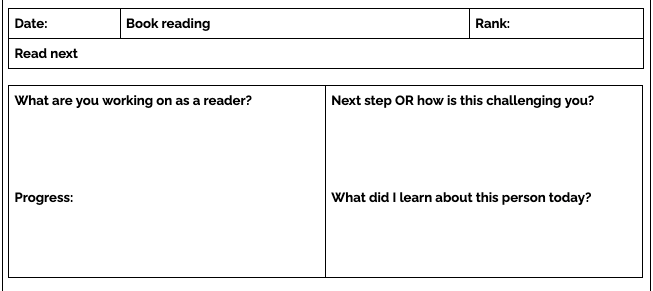
Subsequent sections
Some of the components remain the same, but the new ones are…
Read next – Do they have ideas of what to read next? I so often find that the vulnerable readers I teach have few ideas for what to read next and then spend an extraordinary amount of time trying to find a new read, this question will allow me a peek into their process and help them start book shopping before they finish or abandon their current book.
What are you working on as a reader – what is the goal they have been working on?
Progress – How has it been going?
Next step OR how is this challenging you – What are next steps they can take, what are next steps I can help them with and/or how does their current reading goal challenge them?
What did I learn about this person today? It is vital to me that I leave with a deeper understanding of who they are as a person and not just about reading, this question reminds me of that.
While this conferring sheet is only a small sliver of the work that happens all year as they explore and develop their reading identity further, it serves as a conversational touchpoint that reminds us of the goals we have, the work we need to do, and who we are as human beings in our classroom. While some kids are eager to share their journey as readers, others are much more hesitant or fully unwilling and I respect that as well. After all, they don’t know me yet so they have no reason to trust me. We then take the time needed to develop our relationship and continually invite them into this conversation. It takes patience and dedication but every child is worth it.
A few years ago I traveled to do a day of learning with passionate educators in Maple Ridge/Pitt Meadows in British Columbia. After flight cancellations and changes in airports, Denise Upton, one of the district’s helping teachers, graciously agreed to pick me up and take care of me during the stay. While together, she told me excitedly about Story Workshop, oral storytelling grounded within playful literacy, that they were doing with children as part of their literacy approach. She shared all of the work that they did with students in order to give them natural materials to manipulate and create stories with before they ever sat down to write. She spoke of Indigenous oral storytelling traditions and how they were working on bringing the rich traditions of the peoples’ whose land their school buildings sat on and whose tribal members were within their school population back into the classrooms as a way to honor, teach, and preserve a broader envisioning of writing I was inspired and intrigued. Particularly, after she told me how they were using these material kits with their upper grade levels as well and that the response they had was incredibly positive. After a whirlwind visit, the idea sat in the back of my mind for a while, hoping to someday become something I wanted to do with my own 7th graders.
Well, after a year of teaching unlike any other, after too much screen and not enough togetherness. After once again teaching kids who repeatedly told me how much they hated writing, how writing was so hard, whose sentences were forced across the pages, I decided that some day was now. With a commitment to reconsider every unit and every idea we build our classroom learning on, taking our writing in a much more tactile and playful direction was exactly what I need right now to get excited about next school year. Hopefully, my incoming students will think so as well.
So with a loose idea of what it was Denise had shared with me, the seeds started to grow; what if I build some oral storytelling kits for kids to use in partnerships, trios, or by themselves before we begin to write? What if I collect natural materials for them to manipulate and play with as they share stories from their own lives and also from their imaginations? Surely someone had done this before?
The answer is yes, many have! None of my ideas shared here are really original but I got so many questions on social media when I shared the kits I was building that I figured a blog post would be nice. If you are learning about Indigenous storytelling, there are so many wonderful resources shared, such as this one. If you google “Loose Parts”, you can see a lot of information. If you follow the work of Angela Stockman, she has been sharing so many ideas for years and is truly inspirational. If you are trained within Montessori, you know this work. If you know Reggio Emilia principles, then you know these ideas. If you have worked with younger grades, you probably do this already. There are so many resources out there, so dig in and learn.
My purpose for these kits are to get kids talking more before they write out stories, whether they be stories from their own lives or stories they invent. I want them to build scenes or entire stories together or individually depending on the exploration we are doing. I want them to play with their imagination and ot be forced into written production as quickly as we have done in the past, I want them to build community through story, I want them use their hands more. I want English to have more joy and I want it to authentically fit into the identity-centered work we already do in our literacy explorations.
Building the Kits
I had a million ideas right away and needed a way to ground them so I started by focusing on ideas for what to put in them and also building the kits to give me a more tangible sense of what it would look like. I hate so much that educators are almost always forced to purchase things out of their own pocket, so I spent school budget money to purchase the toolboxes. I bought two different kinds, five altogether, so that I can share them between tables – I typically teach 28 students at a time, so I wanted to make sure that I had enough kits to share materials between 10 different groups if need be. I also needed the kits to not take up too much space in our classroom, be easy to store and move, as well as have different size compartments. The first kind I bought was this one and the second kind was this one.
All the boxes are removable in both kits so we can spread them out on the different tables as needed.
Once I had the boxes, then I got more serious with my materials. I had a few guidelines I wanted to follow:
Natural materials whenever possible
Different sizes of things to use
Material that doesn’t necessarily look like “one” thing in order for them to be used for many things
Low cost and easy to replace
Then I wrote a list, there are so many lists floating on the internet but I posted mine to Instagram and got even more ideas as well as a huge “Duh!” moment. Notice on my original list, I have nuts on it. That is not going to work at all for some of my students due to their allergies. After a helpful educator made me see the light, I updated my original list.
I knew that if I felt like spending a ton of money, I easily could just order all of these things but I don’t want to. So, instead I turned to my local Buy Nothing Facebook group and asked if anyone had any materials they could donate. So what you are looking at in the kits above, almost everything is donated from kind strangers or friends who happened to have materials lying around. Amazing!
So right now in the kits I have:
Seashells, all sorts, all sizes.
Pine cones – I need to gather more.
Small popsicle sticks – they are pointy and I don’t know if I love that.
Wine corks that do not have wine labels on them.
Small cork buttons.
Wood buttons – I bought a giant bag off the internet.
Wool yarn in different colors – I have cut lengths of string in a variety of lengths.
White rocks.
Feathers – I think I may add more of these.
I also purchased felt mats in green, gray, and brown for the kids to use as a background. They can use more than one if we have enough left over, again I went with natural tones as a way to center us in nature even if the story takes place in a different setting.
Things I would still like to add:
Glass beads of some sort
Beach pebbles for more color
More cork
Cinnamon sticks
Wood slices
Acorns
Large popsicle sticks
Ideas for use
So while the kits themsleves are a lovely work in progress and bring me happiness right now as I plan, what matters more than the stuff in them is making space for them to be used with our students. So as I planned for the first two weeks of instruction (I do this in order to be able to walk away for awhile, not because I want to work all summer), I planned with the kits in mind.
My two week plan can be viewed here, but please know that it is so much a work in progress, that some of the ideas in it are my own and others are based off of the incredible work others have kindly shared, and that I have given credit to those whose work I am borrowing from or copying. Please feel free to also borrow or use my ideas, just give credit. The kits will be utilized, hopefully, on the third day of school in an activity where students continue to think of the stories they carry and start to build scenes from their own lives that they then, in turn, share with their peers at their tables. After their initial appearance, they will continue to be integrated into our work as we start our first longer writing exploration; personal narrative. Students can use events from their own lives or springboard events from their own lives into a fictional story.
I also want us to think of how the kits may help us work within the emotions we have tied up with our writing, how we can use them to go deeper into story and how stories can weave us together even when we don’t see eye to eye. I am hoping that as we explore our own identities and how that makes us view and react to others, these tangible items will ground us and make us feel safer within our burgeoning community. I am hoping that having these tactile explorations will bring more playfulness into our classroom, as well as more joy. We will also create expectations of how to use the kits with each other. My main focus for that is to be respectful of the material and of what is shared within their stories, but I will ask the students to also think of how to use the materials, how to clean up in order to preserve the kits, and how to work together. It really all ties into the community work we do throughout the year.
My own children helped me eagerly build the kits and have since then also used them. It has been amazing to see them build scenes, stories, and whole worlds using just these materials and then walking me through their stories that they now see so clearly. Even my son who has repeatedly that he hates writing has been using the kits and telling me his stories. I hope I will see the same willingness to try in my 7th graders.
So there you have, my entry in oral storytelling kits. I will share more ideas as I use them with students, but for now, the kits are being built, the ideas are coming together, and the work is just beginning. Have you used kits like this before? Do you have any ideas or questions? I would love to hear your thoughts.