being a teacher, being me

Someone’s Beginning

http---www.pixteller.com-pdata-t-l-258325.jpg

You wouldn’t know by looking at me that my body is broken.  That for years we tried to have a child, only to fail.  That it was not until the doctors intervened that my body finally worked for a little bit, enough to have Theadora.  Enough to give us the biggest gift one can get. We thought I was fixed, but I wasn’t.  We lost one in between Theadora and the twins; a dream disappeared followed by so many unanswerable questions.  For years we hoped, and for every pregnancy I had, sadness, fear, and the unknown seemed to come along.

You wouldn’t know that my youngest daughter, Augustine, really should not be alive.  That her conception should not have been possible.  That my body did everything it could to get rid of her.  That she was born almost 10 weeks early, 2 years ago today.  That she was born so fast that the nurse caught her and rushed her away from us.  You wouldn’t know that for 6 weeks our breaths were held as she fought to grow in the NICU.  That the beeps and the alarms followed us home and I would wake in the middle of the night, wondering if she was breathing.  That when we left the NICU with her, she weighed 5 pounds and I thought the doctors had made a mistake; surely something this fragile could not be ok.

But she is.  She is strong.  She is bright.  She is stubborn.  She is ok.

When she goes to school, no one will know how fragile her beginning was.  When she goes to learn, no one will know that we were told that she may have learning disabilities because my body forced her into this world too early.  Nobody will know how many brain scans she had to have to make sure that there had been no damage.

Every child that comes to us has a beginning.  A story we do not know.  A story that may still shape them to this day.  A story that is hidden and yet still plays a part in their life.

Don’t forget the story.  You never know how much someone’s beginning plays a part in their now.  We do not just teach children for one year, but we teach them for all of their years.  Even the years, we did not know them.

Happy birthday, Augustine.  May you continue to astonish us with your strength, your spirit.  May you continue to be perfectly average, because we never wanted anything more.

img_3003_23423916221_o.jpg


If you are looking for a great book club to join to re-energize you in January, consider the Passionate Learners book club on Facebook.  We kick off January 10th.  

being a teacher

There/Their/They’re – A Small Trick

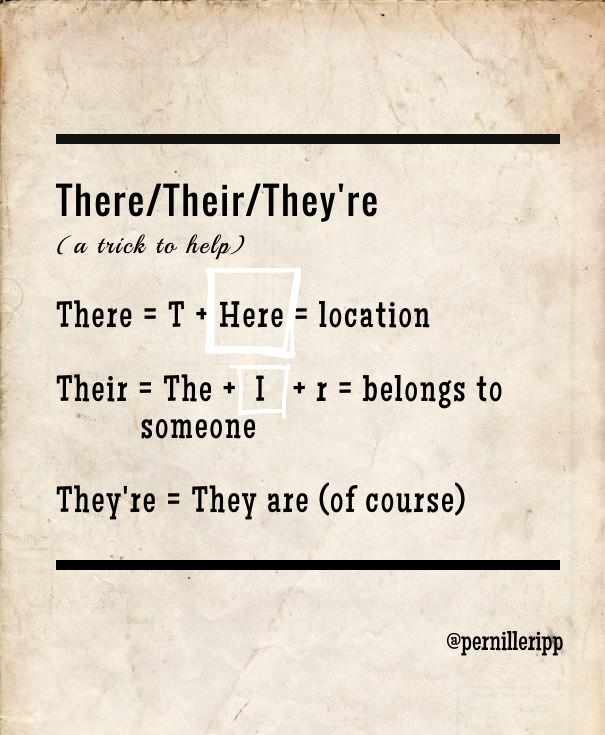
I have been conferencing one-on-one exclusively with my students for the past 2 weeks and one of the things I come across again and again is their inability to distinguish between there/their/they’re; a problem I know many educators run into.  Today, a student and I realized this simple trick,  the other students loved it, so I thought I would share it.

http---www.pixteller.com-pdata-t-l-258053.jpg

If you are looking for a great book club to join to re-energize you in January, consider the Passionate Learners book club on Facebook.  We kick off January 10th.  
aha moment, being a teacher, being me, Literacy, questions, Reading, student choice

The Questions to Ask When The Kids Aren’t Reading

http---www.pixteller.com-pdata-t-l-256147 (1).jpg

I met my first book abandoner my very first year of teaching.  Yet, he was not your average run of the mill book abandoner.  No, he was the “look you straight in the eye and ask you what you are going to do about it” kind of abandoner.  So I did what I knew best; forced him to read the book and not allow him to abandon it.  And he did what he knew best; fake read for a good amount of time, skimmed a few pages, and failed the book report as well as the presentation.  Repeat with every book.  I don’t think he ever read anything beside Diary of A Wimpy Kid that year, and that was even under the radar.

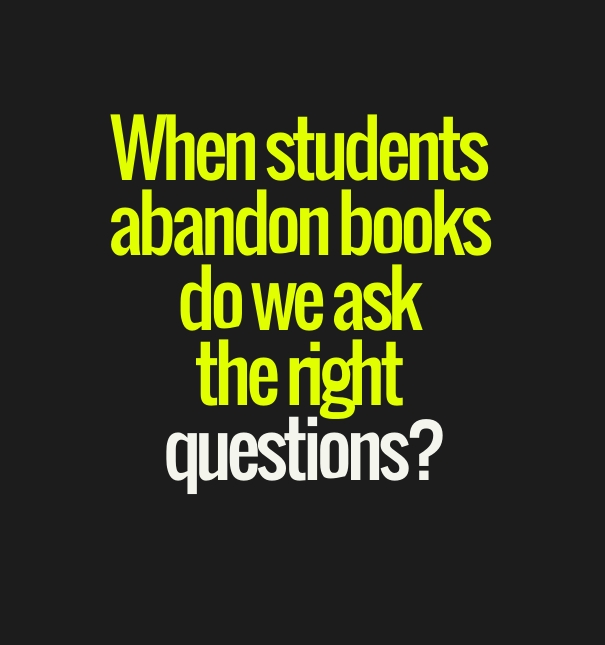
Everyone has these types of readers.  The ones that abandon because they hate to read.  The ones that abandon because they cannot find a great book.  The ones that abandon because they get bored.  Some years we have a lot, others not so many.  So how can we heal break the abandonment cycle?  How can we help these kids help themselves?  Well, there are a few questions we can ask.

Do they have choice?  Because if they don’t, then that is the very first place we start.  And not limited choice based on levels or lexiles, but real honest-to-goodness choice where they get to pick their reading materials.

Do they have time?  If little time is given to reading then we are expecting them to do something they may not like outside of school.  The chances of that happening are pretty slim.

Do they have access?  We know that students need great books in their hands.  We know students need great libraries, but they also need books in our classrooms.  And not old, worn out books, but new, enticing, high-interest books that they can check out easily.

Do they have people?  Is it cool to not be a reader in their friend group?  Who do they have to talk books to?  Do they have reading role models that extend beyond the teacher?  Get them connected in a meaningful way with others that read.

Do they have reason to read?  And by that, I don’t mean because of a prize or a reward.  Do they see any kind of gain from reading?  Is anything positive connected to the art of reading?  Will it actually make their lives better or is it just one more thing to do?

Do they have different ways to read?  Reading is not just done with our eyes but also with our ears, so if a child is constantly abandoning books get them hooked on an incredible audio book.  This has changed the reading path of several of my students in a profound way.

Are they hiding their true ability?  I have taught several students that could ace their reading assessment, mostly because it had been given to them so many times, and yet had a large gap in their skills.  So is their book abandonment masking a larger problem such as not actually understanding what they are reading or not having the stamina to stay with the story?

Are we making them do things that kill their love of reading?  When students abandon books a lot, it is a sure sign that we need to reflect on our own practices.  And not just skim over that reflection and pretend that everything must be ok.  Are reading logs killing their love of reading?  Are programs liked Accelerated Reader or LLI?  Are we constantly asking them to do things with their reading?

Have we asked them?  This is the biggest because too often we try to figure out why a child is abandoning books and we never ask them why.  Not beyond the “What didn’t you like about it?”  So instead we must give the students a chance to discuss or reflect and really start to study their own habits.  What patterns do they see?  What types of books might they like to read?  What can they do to change their habits?  Students need to feel empowered in their self-reflection because otherwise, their pattern won’t change.  They also need to set goals and then be able to honestly assess their own progress.

Do they see themselves in the books?  Such an important question asked by Dr. Jenn Davis Bowman.  Because we need diverse books for all of our kids and if students cannot connect with what we have in our library then they will not read.

If you like what you read here, consider reading my newest book, Passionate Readers – The Art of Reaching and Engaging Every Child, out August 2017.  This book focuses on the five keys we can implement into any reading community to strengthen student reading experiences, even within the 45 minute English block.  If you are looking for solutions and ideas for how to re-engage all of your students consider reading my very first book  Passionate Learners – How to Engage and Empower Your Students.      Also, if you are wondering where I will be in the coming year or would like to have me speak, please see this page.


being a teacher, books, Literacy, Reading

The Books I Am Giving As Gifts

While I made several book gift lists this year, I thought I would share the books that I am giving personally to my family.  the books that took my breath away, the books that I know will make a difference to them and provide them with an incredible reading opportunity.

Laura Amy Schlitz’s The Hired Girl will be handed to the woman who loves historical accounts and likes to learn more about the past.

For the brother-in-law that loves to think deeply about the world, Neal Shusterman’s incredible Challenger Deep will hit all of the right notes.  Bonus is that he saw me reading it and asked a lot of questions.

For the mother that taught me to stand up for all that I believe in and not to give up even when the world seems against you, another Neal Shusterman book; Unwind, the incredible first book of his series.

For the brother that loves a great page turner, especially one that involves the covering up of warfare, crazy diseases and just got engaged so a little bit of love is ok, Illuminae was an easy choice.

For the brother who introduced me to the wonders of Neil Gaiman and loves his comic book art as much as I do, Holly Black’s dark and amazing Coldest Girl in Coldtown made all the sense in the world.

For the brother that told me to read Harry Potter when he was only 8, I know get to tell him to read Six of Crows by Leigh Bardugo knowing that he will fall into the fantasy world as much as I did.  And then he can wait on the sequel along with me).

For the sister-in-law studying human psychology as she prepares to be a hospice nurse, Joelle Charbonneau’s masterful page turner Need was an easy decision.

I could have given All American Boys by Brendan Kiely and Jason Reynolds to every single person on my list but thought I would diversify.  Instead my brother’s girlfriend will be the lucky receipient of the must read book of the year.

To my future sister-in-law who has brought nothing but love to our family, I wanted to give her a great book that would leave her guessing until the shocking conclusion.  E. Lockhart’s We Were Liars was the perfect fit.

To the brother of my brother-in-law who loves a great mystery and also happens to be British, Jackaby by William Ritter is the perfect choice.  This book happens to be great for any Sherlock Holmes or Dr. who fans out there, no matter their age.

To my sister who works as a domestic abuse advocate, the heart-wrenching story of Joseph in Gary D. Schmidt’s Orbiting Jupiter is sure to make her read all night.  This is another book I could give to everyone on my list.

To my dad, who is still an old hippie at heart, who lived through the Vietnam Era, Steve Sheinkin’s latest page-turner Most Dangerous is a guaranteed fit.

To my other future sister-in-law whose degree is in social work, who cares so much about others, All the Bright Places by Jennifer Niven will probably make her cry but then make her think.

And finally to my step-brother who served 2 tours, who does not mind escaping into a great book as he finishes his nursing degree, the incredible Every Day by David Levithan.

All of these books are books I have loved and I hope my family feels that.  I hope they know that selecting just the right book is not a chore, but instead a privilege.  Which books will you be giving as gifts?

PS:  Here are my lists of books as gifts

Some Picture Books to Give As Gifts

Some Great Middle Grade Books to Give As Gifts

Some Great YA Books to Give As Gifts

If you are looking for a great book club to join to re-energize you in January, consider the Passionate Learners book club on Facebook.  We kick off January 10th.  
aha moment, Be the change, being a teacher, connect, Student, Student dreams

How Do We Know Who We Don’t Even Know?

http---www.pixteller.com-pdata-t-l-255045.jpg

I think I teach 128 students this year but I haven’t done the math.  There is a lot of them.  I know all of their names, have since the first week.  I know their writing styles, their book preferences, I know who will avoid me and who will seek me out.  I teach 128 students but  am not connected to 128 students.  I have those that I am closer to.  That I joke around with, that come to me asking for help, that leave me notes, that I have nicknames for.  I have the ones I truly consider my kids, the ones I consider mine.

Call it the curse of teaching a lot of students, but no matter how much you try, not every kid will become connected to you.  That is why I am thankful for my incredible team; I know how much they care about the kids we teach, I know they have “their” kids too that they feel close to.

And yet, in all of those connections, we know that there are kids that do not “belong” to anyone.  That do not have a special relationship with a teacher.  And by now those kids that we haven’t quite built a relationship with are starting to fall through the cracks.

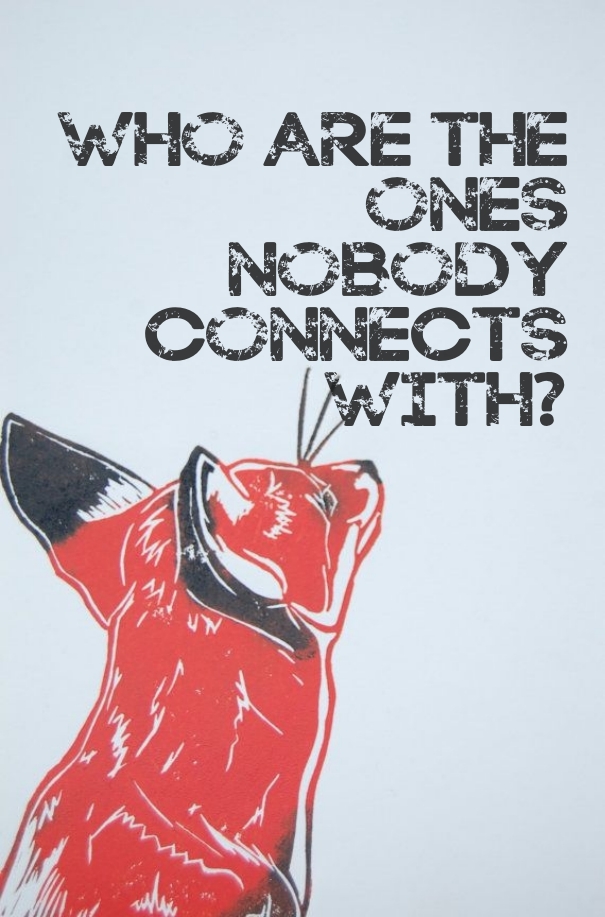
So what do we do?  How do we know who we don’t even know?  How do we as a team, whether school-wide, grade-level or in some other configuration figure out who those kids are that nobody is seemingly connecting with?  Well, there is a simple way to find out, and no, I did not come up with this idea but wanted to pass it on.

Put all of their names on a big piece of paper and hand every teacher a marker.  Put a dot next to those kids who you feel you have a closer relationship to.  Then stand back and look.  Who has no dots?  Who has just one?  Discuss those kids.  Pay special attention, make a list, and the next time you teach them, ask a question not related to school.  Not related to the work.  Not related to what you share already.  Do it the next day, and the next day.  Pick a few kids at a time if there are too many.  Invest your time, and not in a forced way, but in a human way.  don’t force a relationship, but dedicate time to giving one a chance.

As my brilliant colleague, Reidun Bures (follow her at @ReidunLee) pointed out today, “We don’t see our own patterns of who we speak to.  We get comfortable and then wonder why some kids don’t respond to us as well.”  And she is right; we all try to connect with all of our kids and don’t see the ones we haven’t quite connected with.  Not seeking them out becomes a part of our pattern.  But it doesn’t have to be that way.  All kids should have at least one teacher that has their back, one teacher to fall back on.  And the first step is to grab a marker and make a dot.  And then do something with the result.

If you are looking for a great book club to join to re-energize you in January, consider the Passionate Learners book club on Facebook.  We kick off January 10th.  
 

aha moment, being a teacher, being me, books, Literacy, Reading

On Reading Logs

http---www.pixteller.com-pdata-t-l-252897.jpg

I write this post not to shun, not to rage, and not to put down. I write this post not to say what is right or wrong, but instead to add a little tiny piece to the ongoing discussion of where reading logs may or may not fit into our classrooms.  Of the damage and the usefulness of reading logs.  This is not a post with absolutes, or at least, I don’t think it will be.  Instead, it is a post meant for discussion.

I have written before on my complicated relationship with reading logs; from being a teacher who demanded all students fill them out, to a teacher who threw them out, to a teacher who was asked to use them as part of their teaching, to a teacher whose students asked them to stop, to a parent who has signed them.  I have written about what to do instead of a reading log.  But I have never written about how to use them better.  Because I don’t like reading logs, there I said it, but at the same time, there are so many teachers that do, great teachers that care about children’s love of reading, and there are even teachers that have to use them.  And I don’t feel that shaming others will further the conversations.

My biggest issue with reading logs comes from the inherent lack of trust that they communicate; we do not trust you to read every night, we do not trust you to read long enough, we do not trust you to grow as a reader, so fill out this paper instead.  And while I could write a whole post on that, I think Jessica Lifshitz did a much better job on it than I ever will.

And yet, I also see the value in getting a window into the reading lives of a student.  I see the value of having students understand their own reading habits so they can figure out how to grow.  To mine their own data so to speak in order for them to discover new patterns and new goals.  So what can we do, if we have to use reading logs (or we want to) to make them better for students?

Ask the students.  Ask the students their feelings on reading logs and consider their feedback carefully.  If most of your students think this tool will help them become stronger readers then work one out with them.  For those that are opposed to them, figure something else out.  If we truly want students to fully embrace the opportunities that we say can be found within a reading log then we need to make sure they have buy in as well.  Create reading logs that are meaningful to the students, which means that they will probably look different from year to year, based on the students we teach.

Ask the parents.  I will flat out tell you that I will sign whatever I have to from school.  I will not count the minutes, I hate writing down titles because we read a lot, and I do not see much value in her logging her reading every night.  If you want proof, ask me in an email or in conversations, but do not make me sign a piece of paper.  If some parents like reading logs then by all means work out a system with them, but exempt the other parents since more than likely they will probably not be invested anyway.

Differentiate.  For the kids that do want a reading log, find out what it is they would like to gain from it.  I have a few students that love coming in every Monday and writing down the titles of the books they read or abandoned over the weekend (that is all they keep track of plus a rating).  For those kids their record keeping is a way for them to remember what they have read and whether they liked it or not.  They do not keep track of minutes or anything like that, we discuss that in our written reading reflections that we do once in a while or face to face.  So find out what it is that the students like about logging their reading, if it is the reward that is attached to it then that should be a huge warning sign.

Keep it in class.  When I had to do a reading log in my former district, we kept it in class.  Students were asked to write down title and for how long they were focused on the book right after independent reading.  That way, organization and parent follow up were removed from the equation and all kids (and me) were following the district expectation.

Stop rewarding.  If reading logs really are meant as a way to investigate ones’ own reading habits then stop tying in rewards with them.  The reward is in the reading, not the ticket, not the pizza, not the trinket.  Ever.

Make it an experiment.  If you like using reading log to find out student habits, then do it as a 2 week experiment with all students.  Have them for 2 weeks keep track of when, where, what, and how much they read and then have daily or weekly conversations and reflections on what they discover.  Set tangible goals from that.  Do it periodically throughout the year if you really want this to be seen as a learning opportunity, that way students can see a value in tracking their reading life this way.  If you have them do it all year, most students lose interest and will not see it as an opportunity to grow but just as one more thing to do.

Leave time for reflection.  Rather than log, we reflect.  My students set monthly reading goals and then at the end of the month they reflect on how they did.  The students and I will meet and discuss formally and informally and this is what I use for my vantage point into their reading life.  I ask them to tell me what they are working on and they do.

Don’t forget the purpose of reading logs.  If the purpose is to help students grow as readers then make sure that the very act of filling out a reading log, with or without parent signature, is not damaging that purpose.  It is often when we set up more processes for students in order to help them read better that we lose them as readers.  When kids spend more time doing things attached to reading, rather than the act of reading we have a problem.


In the end, in our pursuit to establish classrooms filled with passionate readers, we must make sure that the things we do, even little parts of our day like reading logs, do not do more harm than good.  That we fit our processes around our students, rather than the other way around.  That we continue to debate, question, and consider as we decide what to invest our time in.  And that we always, and I mean always, ask the students what they think.  Even the little ones, they have a voice that matters too.

For all my ramblings on reading logs, here is where to start.

If you are looking for a great book club to join to re-energize you in January, consider the Passionate Learners book club on Facebook.  We kick off January 10th.